




Love Tester Summary
Get From the Official Digital Markets
All trademarks belong to their
respective owners.
Love Tester feels like one of those tiny casual apps that does not pretend to be scientific, serious, or emotionally deep, and that is exactly why it can be oddly entertaining. I do not open it expecting a real answer about romance, compatibility, or the future of a relationship. I open it for the silly suspense of typing two names, pressing a button, and waiting for the app to deliver a dramatic percentage as if it has secretly understood the chemistry of two people in three seconds.
What makes Love Tester work is its simplicity. There is no complicated tutorial, no heavy storyline, and no demanding gameplay system. The entire experience is built around curiosity, comedy, and playful guessing. I can test my name with a crush, a celebrity, a friend, a fictional character, or a completely ridiculous combination just to see what result appears. It is not about truth. It is about the tiny moment of amusement before the number appears on screen.
A Bright, Simple Interface Made for Instant Reactions
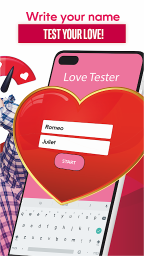
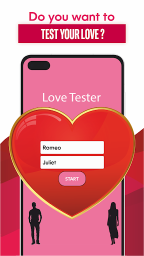
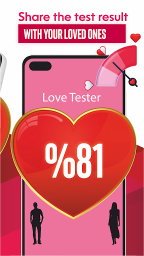
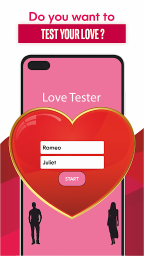
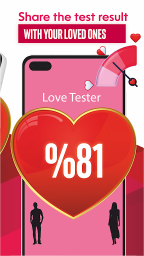
The visual style of Love Tester is usually direct and playful. It often uses hearts, pink or red tones, soft gradients, cute icons, and simple input boxes. The design tells me immediately what kind of experience I am entering. This is not a serious relationship tool. It is a light entertainment app built around romance-themed visuals and quick results.
I like when the interface stays clean. A Love Tester app works best when I can enter names quickly and get a result without navigating through unnecessary menus. The charm comes from speed. Type, tap, react, repeat. If the app adds too many extra screens, ads, or confusing buttons, the joke loses momentum.
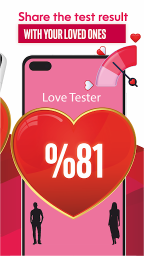
The best versions of this concept understand that presentation matters. A small animation, a pulsing heart, a suspenseful loading bar, or a funny message can make the result feel more exciting. The actual calculation may be meaningless, but the reveal can still be fun if the app creates a playful mood around it.
The Main Characters Are the Names I Type
Love Tester does not have traditional characters. The main characters are the names I put into it. That is part of the appeal because the app becomes personal immediately. The moment I type two names, even as a joke, the result feels connected to real people, imaginary pairings, or private curiosity.
I enjoy how flexible that makes the experience. I can use it seriously for two seconds, then immediately use it for comedy. One moment I test two people I actually know. The next moment I test myself with a movie character, a snack, a pet name, or a completely impossible pairing. The app gives the same dramatic treatment to all of them, which makes it funnier.
This name-based structure also makes Love Tester easy to share with friends. It is the kind of app that works better when someone else is watching. The result becomes a conversation starter, a teasing moment, or a quick group laugh. Alone, it is a tiny novelty. With friends, it becomes a social toy.
The Gameplay Is Barely Gameplay, But That Is the Point
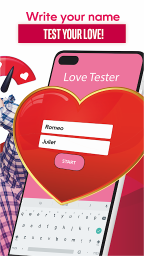
Love Tester is not built around challenge. There are no levels to master, no strategy to develop, and no real skill curve. The interaction is extremely simple: enter names, start the test, read the result. In most games, that would feel too thin. Here, the minimal design is the entire concept.
I think this works because the app is more like a digital fortune cookie than a game in the traditional sense. The entertainment comes from anticipation and interpretation. If the score is high, it becomes funny or exciting. If the score is low, it becomes a reason to laugh, complain, retest, or blame the app for being dramatic.
The weakness is obvious: the novelty can fade quickly. After several tests, I start to understand the rhythm. Unless the app adds varied messages, modes, animations, or playful extras, the experience may feel repetitive. Love Tester is best enjoyed in short bursts, not as something I expect to play for an hour.
The Fun Comes From Pretending the Result Matters
The most entertaining part of Love Tester is the fake seriousness. I know the percentage is not a real measurement of affection or compatibility, but the app frames the result like it means something. That playful contradiction is the whole joke. I am not fooled, but I still react.
I like when the app includes short result messages along with the percentage. A simple number is fine, but a little phrase can add personality. A high score might feel sweet, a medium score might feel teasing, and a low score might become funnier if the message is dramatic. The writing does not need to be deep; it just needs to match the light mood.
This pretend importance is why Love Tester works so well with crushes, friend groups, and fictional pairings. It gives people an excuse to talk about romance without making the conversation too serious. The app becomes a harmless stage for curiosity, jokes, and tiny emotional reactions.
Best as a Party Trick or Quick Social Game
Love Tester is strongest when used socially. If I am sitting with friends, it can quickly become a mini-game. Everyone suggests names, laughs at the results, argues with the score, and tries another combination. The app does not need deep mechanics because the people around it create the entertainment.
I can imagine it working especially well for younger audiences, sleepovers, casual hangouts, school breaks, or light social media content. It has that simple “try this and react” format that fits quick sharing. The result can become a screenshot, a joke, or a playful message.
When used alone, it is still amusing, but the experience is much shorter. I might test a few names, smile at a surprising result, then close it. That is not necessarily a flaw. Some apps are meant to be tiny moments of entertainment rather than long sessions.
Romance Theme Without Real Relationship Advice
One important thing I appreciate is when Love Tester stays clearly playful. It should never present itself as real emotional guidance. A name-based result cannot tell me whether two people are compatible, whether a relationship is healthy, or whether someone truly likes someone else. The app is entertainment, not advice.
That boundary matters because the romance theme can feel personal. A fun score is harmless when everyone understands the joke. It becomes less useful if someone treats it as proof of anything meaningful. I enjoy Love Tester most when it keeps the tone light and avoids pretending to know more than it does.
In that sense, the best way to use the app is with humor. It can be cute, silly, and playful, but it should not replace real communication. A conversation with a real person will always matter more than a random percentage wrapped in heart graphics.
Extra Modes Can Make the Concept More Interesting
Some versions of Love Tester add extra features, and those can help extend the fun. Different test types, zodiac-style prompts, friendship checks, daily love quotes, compatibility messages, or playful mini-results can make the app feel less repetitive. The core idea remains simple, but variety gives me more reasons to keep tapping.
I like when extra modes stay easy to understand. A Love Tester app should not become overloaded with complicated systems. Its charm comes from being fast and funny. Extra features work best when they add flavor without slowing the main action.
Customization can also help. Choosing themes, saving favorite results, sharing cards, or generating funny messages can make the app more social. Since the result itself is not serious, the surrounding presentation becomes very important. The more shareable and playful the output feels, the better the app works.
Ads and Repetition Can Hurt the Experience
The biggest problem with many simple novelty apps is interruption. If ads appear too often or block the result too aggressively, the fun disappears quickly. Love Tester depends on momentum, and nothing weakens that momentum like waiting through a long interruption after every test.
Repetition is the other obvious issue. The basic idea is funny, but it is limited. If the app gives the same style of result every time, the excitement fades. A strong Love Tester needs enough variation in messages, animations, and small surprises to keep the experience from feeling mechanical.
I do not expect a Love Tester app to be deep, but I do expect it to respect the quick-play format. The best version is smooth, fast, cute, and not too pushy. The weakest version feels like a thin joke stretched around too many ads or repeated screens.
Why Love Tester Still Has Casual Appeal
Love Tester continues to be appealing because it is built around a universal curiosity. People like testing names, imagining pairings, and reacting to romantic possibilities, even when they know the result is nonsense. The app turns that curiosity into a tiny game.
I also think the nostalgia factor helps. Many people have seen some version of a love calculator online, on old websites, in mobile apps, or as a playground-style joke. Love Tester feels like a digital version of passing a note or asking a silly question with a serious face.
Its appeal is not depth. Its appeal is instant emotional comedy. For a few seconds, a random number feels like a dramatic revelation. Then I laugh, try another name, and let the app be exactly what it is: a cute, unserious compatibility toy.