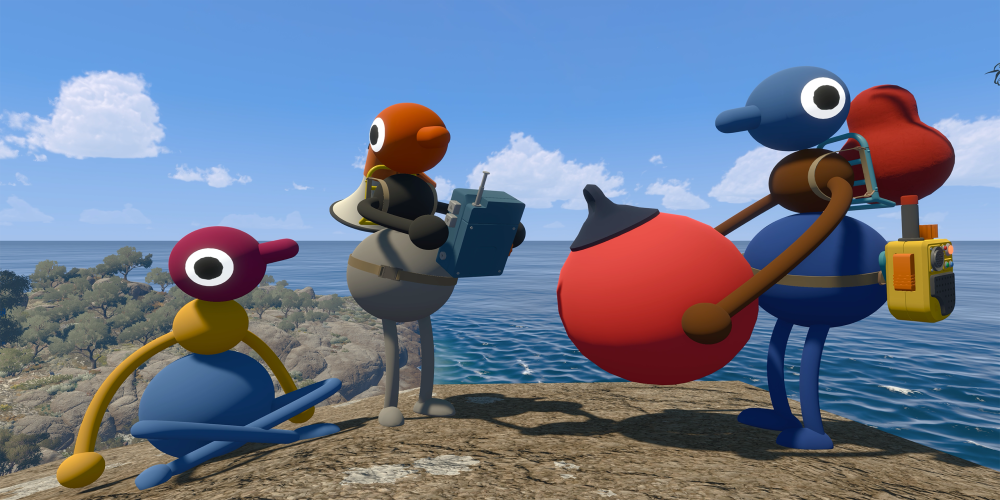
Big Walk gives players an unusual amount of freedom. There are few traditional objectives, no constant quest markers, and very little pressure to follow one correct route through the island. Much of the experience comes from wandering with friends, discovering strange locations, solving cooperative puzzles, and occasionally realizing that nobody remembers where the group left an important item.
That open design is part of the game’s appeal, but it can also create confusion. Some systems are explained only briefly, while others become clear only after players have already spent a considerable amount of time exploring.
The following Big Walk tips are designed to make the opening hours smoother without revealing the game’s most important surprises. They cover tower progression, equipment storage, session persistence, long-distance communication, transportation, puzzle-solving habits, and completion requirements.
1. Focus on One Tower Before Moving to Another
Big Walk begins with a tutorial area that introduces the basic structure of exploration and cooperative problem-solving. Players complete four early puzzles, shape a key, and use it to lower the footbridge wrapped around the mountain.
Once the bridge becomes available, most of the island opens up. The group can head in almost any direction, which makes it tempting to visit every visible landmark and begin several objectives at once.
A more efficient approach is to select one colored mountaintop tower and concentrate on completing it before moving to another. The island contains red, blue, green, and yellow towers, each connected to a major progression reward.
Every tower includes a console that must be filled with enough puzzle-related objects. These unusual items may receive different names depending on the group, but their function is consistent: collect them by solving activities and use them to advance the selected tower.
Why Completing One Tower at a Time Helps
- The group maintains a clear shared objective;
- Collected puzzle items are used more efficiently;
- Players spend less time crossing the island without a plan;
- Tower rewards become available earlier;
- New abilities or tools can simplify later exploration;
There is nothing wrong with investigating another region when something looks interesting. However, repeatedly switching between towers can delay the rewards that make the rest of the game easier.
2. Start With the Red Tower
The towers can be completed in any order, but the game places the group relatively close to the red tower after the opening section. This positioning works as a gentle suggestion rather than a strict requirement.
Following that suggestion is worthwhile. The reward connected to the red tower is particularly useful during later exploration and can reduce some of the difficulties that appear while travelling around the island.
Other towers also provide important benefits, but the red tower offers the strongest early advantage for a new group. Beginning there creates a smoother progression path without removing the freedom to explore.
How to Approach the Red Tower
- Complete the tutorial and lower the footbridge;
- Travel toward the red mountaintop tower;
- Search the surrounding region for puzzles;
- Collect five of the required puzzle objects;
- Place them in the tower console;
- Claim the major reward before choosing the next tower;
The exact reward is best discovered naturally. Knowing that the red tower is worth prioritizing is enough to avoid wandering for several hours before unlocking one of the game’s most useful advantages.
3. Search Blue Buildings for Backpacks and Belts
While exploring, players will encounter distinctive blue structures positioned around the island. These buildings contain some of the most practical equipment in Big Walk.
Inside each structure, the group can find either a backpack or a belt. Each of these items provides one additional storage position.
A player can normally carry objects in both hands. Equipping a backpack and belt increases the total carrying capacity to three items when the stored equipment is counted alongside the object held directly.
Why Additional Storage Matters
Many puzzles require objects to be transported between locations. Without extra storage, players may need to leave useful tools behind or make repeated journeys.
Backpack and belt slots are also more secure than ordinary hand-held items. Objects stored in them do not fall away when a player drops from a great height.
This makes them particularly useful for valuable tools such as flashlights, communication equipment, or puzzle items that would be inconvenient to retrieve again.
Equipment Requires Cooperation
Big Walk is heavily designed around group interaction, and equipment management reflects that philosophy. Players cannot freely equip, remove, or manage every backpack and belt item alone.
A friend must help with certain equipment actions. Make sure the group understands who is carrying what before separating or beginning a difficult route.
It is also wise to distribute useful items across several players. Keeping every important tool on one person creates problems when that player becomes separated from the group.
4. Hold Important Items Before Ending a Session
Big Walk includes a persistence system that can be easy to overlook. At the beginning of each session, the group appears in the gym area, where a Lost and Found table stores certain items from the previous session.
Objects held by players when the host ends the session will appear on this table the next time the group plays. This provides a convenient way to preserve useful equipment between sessions.
For example, a group that wants immediate access to a flashlight during the next session should make sure someone is holding it before the host closes the game.
What Counts as a Held Item?
- Objects carried directly in a player’s hands;
- Equipped backpacks;
- Equipped belts;
- Items stored inside those equipment slots;
Before ending a session, gather the group and decide which tools should be available immediately next time. Assign those objects to players and confirm that nothing important has been left on the ground.
What Happens to Forgotten Items?
Forgetting to hold an item does not permanently remove it. Objects that are not preserved through the Lost and Found system return to their original spawn locations.
This means the group can retrieve them again, although doing so may require travelling across the island. Remembering the persistence rule saves time and prevents unnecessary return trips.
5. Use More Than Walkie-Talkies to Communicate
Big Walk encourages groups to separate, explore different routes, and communicate across distance. Walkie-talkies are an obvious solution, but they are not the only communication system available.
The island contains several tools that can be used for messages, signals, and location sharing. Creative groups can develop their own communication rules rather than depending entirely on voice range.
Write Messages on Signs
The gym contains signs on which players can write messages. These signs can be positioned where distant players may see them through spyglasses or binoculars.
A sign can communicate a destination, warning, plan, or meeting point. Keep messages short enough to be read from far away.
Use Tower Radio Stations
Each tower contains a radio station that can communicate with players carrying walkie-talkies. A person at the tower can therefore contact distant group members even when ordinary voice communication is unavailable.
This is useful when one player remains at a tower while the rest search for puzzle objects elsewhere.
Fire Flares From Towers
Towers also provide flares that can reveal a player’s location. A visible flare can function as a meeting signal, emergency request, or confirmation that someone has reached the tower.
Before splitting up, agree on what a flare means. Without a shared rule, half the group may interpret it as an emergency while the other half treats it as a celebration.
Create Flashlight Signals
Flashlights and the large glowing bulbs found around the island can be used for simple visual communication. The group does not need to learn a formal signaling system.
Establish a few basic meanings:
- One short flash for confirmation;
- Two flashes for a request to regroup;
- A continuous light for a visible meeting point;
- Repeated rapid flashes for assistance;
A small shared system can remain useful when players are separated by distance, terrain, or communication limitations.
6. Learn How the Train Moves Around the Island
At a later point, players can activate the island’s train. The method should be discovered through normal exploration, but understanding how the train behaves can prevent unnecessary waiting.
Once active, the train continues moving around its route. It does not normally stop unless someone is aboard and actively holding the brake.
This means players should not wait at a station without checking where the train currently is. Every station includes a real-time display showing its position on the island.
How to Use Train Stations Efficiently
- Check the route display before waiting;
- Estimate whether the train is approaching or moving away;
- Continue on foot when the wait would be longer than the journey;
- Use the train when travelling with several items or group members;
- Watch the landscape for unexplored landmarks during the ride;
The train is not necessarily the fastest way to travel. The same is true of the ski lift that can also become available.
These systems are valuable because they provide a different perspective on the island. A train journey may reveal paths, structures, and puzzle locations that are difficult to notice from ground level.
7. Approach Puzzles From Every Possible Angle
Big Walk contains dozens of cooperative puzzles with very different structures. Some resemble recognizable activities, while others rely on observation, communication, object placement, timing, or unusual interpretations of the environment.
A puzzle may appear complicated because the group is assuming that it follows rules the game never established. When progress stops, question the assumptions surrounding the problem.
Questions to Ask When the Group Is Stuck
- Can the puzzle be viewed from another position?;
- Does one player need to observe while others act?;
- Can nearby objects be moved or carried?;
- Is the answer visible somewhere in the environment?;
- Does the puzzle require synchronized actions?;
- Is the group interpreting a symbol or instruction too literally?;
- Could a tower reward or tool make the solution easier?;
Some solutions are intentionally simple. Players may spend too much time inventing a complicated sequence while the necessary clue remains directly in front of them.
Study everything in and around the puzzle area. Decorative objects, viewing angles, colors, shapes, sounds, and nearby structures may all provide information.
Communicate Clearly
Cooperative puzzles become much harder when several players speak at once or use vague instructions. Assign one person to describe what they see while another performs the action.
Use specific language. Instead of saying “move that thing over there,” identify the object, direction, and distance. Clear communication saves more time than frantic experimentation.
8. You Do Not Need Every Puzzle to Reach the Ending
Big Walk contains more puzzles than the minimum required for reaching the main ending. Players must complete most of the important progression content, but they do not need to solve absolutely everything before seeing the credits.
This is helpful when one puzzle has delayed the group for too long. Instead of allowing a single activity to stop all progress, mark the area mentally and explore elsewhere.
Another puzzle may provide a useful object, teach a related mechanic, or simply give the group a better idea after a break.
Why Continue After the Main Ending?
Players who enjoy the island may still have good reasons to return and complete the remaining puzzles. Additional discoveries and completion-related rewards provide motivation beyond the credits.
The best approach is to avoid turning the first playthrough into a strict completion checklist. Follow the main tower progression, solve the puzzles that attract the group, and return to unfinished challenges later.
Big Walk is at its strongest when curiosity leads the journey. Attempting to complete every activity immediately can make the island feel smaller and more mechanical than intended.
Additional Inventory Tips
Inventory management becomes increasingly important as the group discovers more tools. Decide which items support the current objective before leaving the gym or another central location.
A flashlight may be useful for dark areas, while binoculars support long-distance observation and signs provide remote messages. Carrying several tools without a plan may leave no space for puzzle objects.
Divide Equipment Roles
- Assign one player to carry communication equipment;
- Give another player observation tools;
- Keep one inventory slot available for puzzle objects;
- Distribute essential tools so one fall does not interrupt the entire group;
- Confirm who holds preserved items before ending the session;
Roles do not need to remain permanent. Change them according to the region and puzzle type.
How to Avoid Losing the Group
Getting separated is part of Big Walk, but the group should establish a recovery plan before travelling in different directions.
Select a visible landmark as a meeting point. Towers are useful because their colors can be identified from many parts of the island.
Agree on a maximum exploration period before checking in. Players can use walkie-talkies, radio stations, signs, flares, or lights to confirm their locations.
When several communication tools are unavailable, move toward high ground. A better view may reveal other players, landmarks, or the route back to the gym.
Why You Should Keep Looking Around During Transport
Train and ski-lift journeys are not merely pauses between destinations. They provide elevated or unusual viewing angles that can reveal activities hidden by terrain.
Use binoculars during transport when possible. Look for colored towers, blue equipment structures, puzzle areas, footpaths, lights, and unusual environmental formations.
Call out discoveries so another player can place them in the group’s shared mental map. Even when the transport route is slow, the information gained can make later travel more efficient.
How to Organize a Productive Session
Because Big Walk provides so much freedom, a group can spend an entire session wandering without completing a clear objective. That may still be entertaining, but a small amount of planning helps when players want to progress.
A Simple Session Plan
- Check the Lost and Found table;
- Equip backpacks, belts, and necessary tools;
- Select one tower or region;
- Agree on communication signals;
- Travel toward the selected objective;
- Solve nearby puzzles and collect the required objects;
- Return important equipment to designated players before closing;
This structure leaves plenty of room for spontaneous exploration while preventing useful items and objectives from being forgotten.
Common Big Walk Beginner Mistakes
- Trying to complete several towers simultaneously;
- Ignoring the nearby red tower during the opening hours;
- Walking past blue structures without checking inside;
- Ending the session while important equipment remains on the ground;
- Assuming walkie-talkies are the only long-distance communication method;
- Waiting for the train without checking its real-time position;
- Approaching every puzzle from only one viewpoint;
- Believing every puzzle must be completed before the ending;
- Allowing one difficult activity to stop the entire session;
- Failing to agree on communication signals before splitting up;
Most of these mistakes do not permanently damage progress. They simply create additional travel and confusion, which can be avoided once the group understands the game’s unusual systems.
Best Tower Order for New Players
The complete tower order remains flexible. Starting with red is the most practical recommendation because of the early location and useful reward.
After red, choose the next tower according to where the group has already discovered puzzles and which regions remain interesting. There is no need to follow a strict optimized route.
Completing one tower fully before changing focus remains more important than the exact order of the final three.
What to Do When a Puzzle Feels Impossible
Begin by stopping all actions and observing the area. Repeatedly attempting the same method can make obvious clues harder to notice.
Assign different roles. One player should remain at a distance and describe what changes while others interact with objects.
Search the surrounding environment rather than only the central puzzle. Instructions or patterns may be located above, behind, or outside the immediate area.
When no progress is made, leave and return later. Big Walk rarely requires the group to solve one specific optional puzzle before doing anything else.
Should You Explore Alone or Stay Together?
Staying together makes cooperative puzzles easier and reduces the chance of losing useful items. Separating allows the group to locate landmarks and puzzle areas more quickly.
A balanced approach works best. Travel together toward the main objective, then divide temporarily when searching a limited region.
Maintain communication and agree on a meeting point before separating. Players carrying essential tools should remain reachable rather than disappearing toward opposite ends of the island.
Final Big Walk Checklist
- Complete the opening tutorial and lower the footbridge;
- Focus on one colored tower at a time;
- Prioritize the red tower first;
- Search blue structures for backpacks and belts;
- Store valuable items in equipment slots when possible;
- Hold important gear before the host closes the session;
- Use signs, radios, flares, and lights for communication;
- Check train displays before waiting at a station;
- Study puzzles from several physical and conceptual angles;
- Leave difficult optional puzzles and return later;
- Continue exploring after the credits when more content remains;
Getting the Most From Big Walk
Big Walk is not designed around constant instructions. Its world becomes enjoyable when players experiment, communicate, become temporarily lost, and create their own methods for navigating the island.
Beginning with the red tower provides a strong early direction, while backpacks and belts make important equipment easier to manage. The Lost and Found system helps preserve tools between sessions, but only when the group remembers what everyone is carrying before the host closes the game.
Communication should extend beyond ordinary conversation. Radios, walkie-talkies, signs, binoculars, flares, flashlights, and environmental objects can all help a separated group remain connected.
Most importantly, do not allow one confusing puzzle to define the entire session. Change perspective, discuss the environment, try a simpler interpretation, or leave and return later. Big Walk rewards curiosity more than perfect efficiency, and some of its most memorable moments begin when the group confidently heads in the wrong direction together.