Geometry Dash Summary
Get From the Official Digital Markets
All trademarks belong to their
respective owners.
Geometry Dash feels like a game that turns rhythm, frustration, precision, and stubborn optimism into one sharp little package. I started it expecting a simple arcade platformer with music, but it quickly became clear that the game is more like a reflex test wearing neon colors. Every jump matters, every obstacle has a rhythm, and every mistake sends me right back to the beginning with the quiet challenge of trying again.
What keeps Geometry Dash interesting for me is how honest it feels. The game does not hide behind complicated systems or long tutorials. I control a small geometric icon, move forward automatically, and tap at the right time to survive patterns built around spikes, platforms, portals, gravity shifts, and music cues. It sounds simple, but the actual experience can become intense very quickly. When I finally clear a difficult section after dozens of attempts, the satisfaction is immediate and surprisingly strong.
A Neon World Built From Shapes and Timing
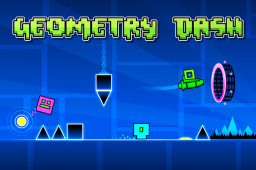
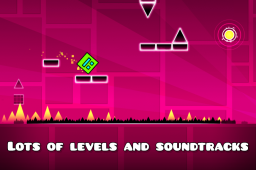
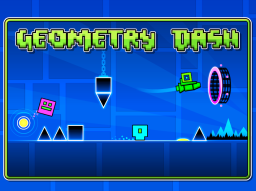
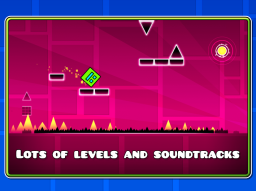
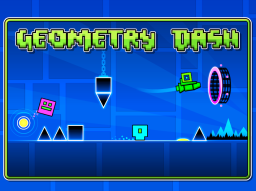
The visual style of Geometry Dash is instantly recognizable. It uses sharp shapes, glowing colors, bold outlines, and rhythmic movement to create levels that feel both simple and hypnotic. Nothing about the world tries to look realistic, and that is a major strength. The game looks like a digital obstacle course made from triangles, squares, lights, and sound waves.
I like how clean the design is. Obstacles are usually easy to recognize, even when the level becomes fast and crowded. Spikes look dangerous, platforms look solid, and portals clearly signal that something about movement is going to change. The game’s aesthetic is not just decoration. It helps me read the level at high speed.
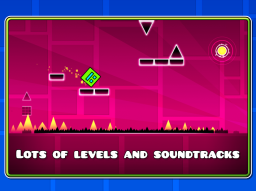
The bright colors also give each stage its own mood. Some levels feel playful and energetic, while others feel darker, sharper, or more intense. Background pulses, moving objects, and color changes make the screen feel alive. At its best, Geometry Dash looks like the music has turned into architecture.
The Main Character Is a Tiny Icon With Big Personality
Geometry Dash does not have a traditional hero with dialogue or a deep backstory. The main character is the icon I control, and its personality comes from movement, customization, and the constant struggle to reach the end of a level. It may only be a cube, ship, ball, wave, robot, spider, or another form, but it starts to feel strangely personal after enough failed attempts.
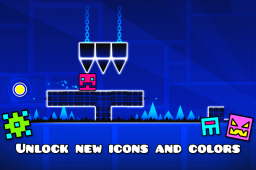
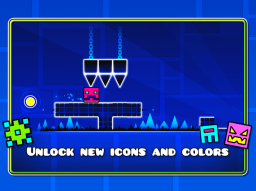
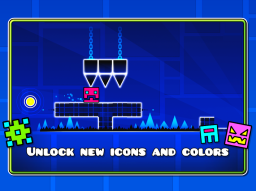
I enjoy how the game lets me customize icons, colors, trails, and effects. These changes do not rewrite the gameplay, but they make my progress feel more personal. Choosing a new icon after completing a challenge gives me a small sense of identity inside a game that is otherwise built around pure timing.
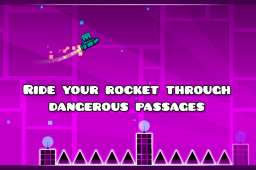
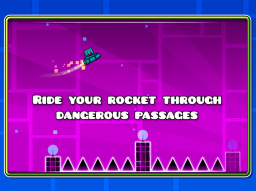
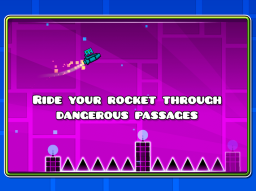
The different forms also keep the character from feeling static. The cube jumps, the ship flies, the ball flips gravity, the wave moves in sharp diagonal lines, and other forms change the rhythm completely. Each mode feels like a new version of the same character, forcing me to adjust without leaving the core identity of the game.
Rhythm Is the Secret Engine of the Gameplay
Geometry Dash works because it connects movement to music so tightly. I do not only watch the obstacles; I listen to the level. The soundtrack often hints at when to jump, hold, release, or prepare for a sudden shift. After enough attempts, the level becomes almost memorized as a musical pattern.
This rhythm-based design makes the game feel different from ordinary platformers. In many games, I react to what I see. In Geometry Dash, I react to what I have learned, what I hear, and what I expect to happen next. The best runs feel less like random survival and more like performing a small piece of choreography.
The music also softens the repetition. Since I restart often, a weak soundtrack would make the game tiring much faster. Instead, the energetic tracks help each attempt feel like another chance to sync with the level. When the beat, visuals, and movement line up perfectly, Geometry Dash becomes genuinely thrilling.
Difficulty That Tests Patience More Than Anything Else
Geometry Dash can be difficult in a very direct way. It gives me a challenge, lets me fail quickly, and asks whether I want to try again. There are no complicated excuses. If I mistime a jump or panic during a portal section, the run ends. That can be frustrating, but it also makes improvement easy to understand.
I appreciate how the game teaches through repetition. Each attempt reveals a little more about the level. I learn where to jump early, where to wait, where to hold longer, and where a visual trick might catch me off guard. Progress often comes in small pieces, but those pieces eventually connect into a full successful run.
The difficulty is not always gentle. Some sections require intense memorization, and certain user-made levels can be overwhelming. Still, the challenge feels central to the game’s identity. Geometry Dash is not trying to be relaxing in the traditional sense. It is trying to create that focused state where every attempt brings me slightly closer to mastery.
Level Design Feels Like Puzzle Solving at High Speed
The best levels in Geometry Dash are not only hard. They are carefully arranged. A good level teaches me its rhythm, builds tension, introduces new patterns, and then tests whether I have truly learned them. I like when a section feels impossible at first, then slowly becomes readable after repeated attempts.
Portals are one of the most important design tools. They change gravity, speed, size, or movement type, and they force me to adjust instantly. A level can move from cube jumping to ship flying, then into ball movement, then into wave control, all within a short span. These transitions keep the gameplay from becoming repetitive.
There is also a strong memory element. I often need to know what is coming before it appears. That gives the game a puzzle-like quality. I am not solving with words or numbers, but with timing, pattern recognition, and muscle memory. Each level becomes a route that I slowly decode through practice.
The Level Editor Gives the Game a Huge Creative Life
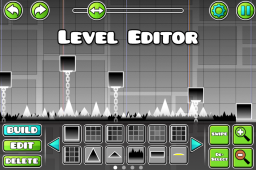
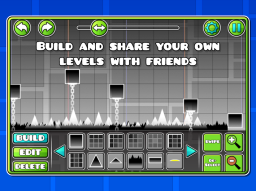
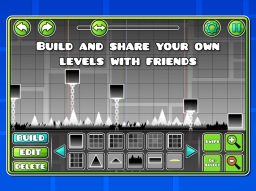
The level editor is one of the main reasons Geometry Dash has stayed relevant for so long. It turns the game from a set of official stages into a creative platform where players can build their own challenges, visual experiments, and rhythm-based obstacle courses. This gives the community enormous influence over the game’s identity.
I find user-made levels fascinating because they show how flexible the basic mechanics are. Some creators focus on clean timing and fair progression. Others build visually complex stages with cinematic effects, custom decorations, and dramatic transitions. The range is much larger than I expected from a game about a jumping geometric icon.
The editor also creates an endless skill ladder. There are easy levels for casual play, stylish levels for visual enjoyment, and extremely demanding levels for players who want a serious test. This community-driven variety gives Geometry Dash far more replay value than it would have with only the official content.
Sound Design Makes Every Attempt Feel Alive
Sound is essential in Geometry Dash. The music is not just background decoration. It guides movement, supports memorization, and gives levels emotional momentum. A good track can make even repeated attempts feel energetic rather than dull.
I also like the crisp feedback from jumps, portals, pads, and transitions. The game communicates changes clearly, which matters because everything happens quickly. When I pass through a portal or launch from a jump pad, the sound and visual response help me understand the new rhythm immediately.
The combination of sound and motion is what gives Geometry Dash its addictive quality. A failed attempt does not feel like a long setback. It feels like missing a note in a song and wanting to start again until the sequence finally plays correctly.
Why It Works So Well in Short Sessions
Geometry Dash is excellent for short play sessions because attempts are quick. I can open the game, practice one section, make a few runs, and feel some progress even if I do not complete a level. That makes it easy to play in small bursts.
At the same time, the game can easily pull me into longer sessions. One more attempt becomes ten more attempts, especially when I reach a new percentage record. The progress bar is a clever motivator because it shows exactly how close I am to finishing. Even a tiny improvement feels meaningful.
This structure keeps the game tense without requiring a long commitment. A full level may take only a short time to complete successfully, but reaching that successful run can become a personal mission. Geometry Dash turns seconds of gameplay into minutes or hours of practice.