Little Nightmares Summary
Get From the Official Digital Markets
All trademarks belong to their
respective owners.
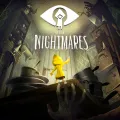
Little Nightmares feels like a childhood fear that learned how to walk on thin legs through a damp hallway. I went into it expecting a short horror-platformer with a memorable art style, but what stayed with me was the atmosphere: the heavy silence, the strange scale of every room, the feeling that I was tiny, hungry, exposed, and surrounded by a world that had no interest in explaining itself kindly. It is not loud horror. It is the kind of horror that waits in the corner of the screen and lets me notice it a second too late.
What makes Little Nightmares so effective is how it uses vulnerability. I do not feel like a hero arriving to defeat evil. I feel like a small child trying to survive inside a grotesque machine of appetite, control, and neglect. The game rarely tells me exactly what everything means, but it constantly gives me images that feel symbolic: oversized furniture, distorted adults, cages, kitchens, meat hooks, long tables, locked doors, and shadows that seem to swallow the edges of the world.
The Maw Feels Like a Living Trap
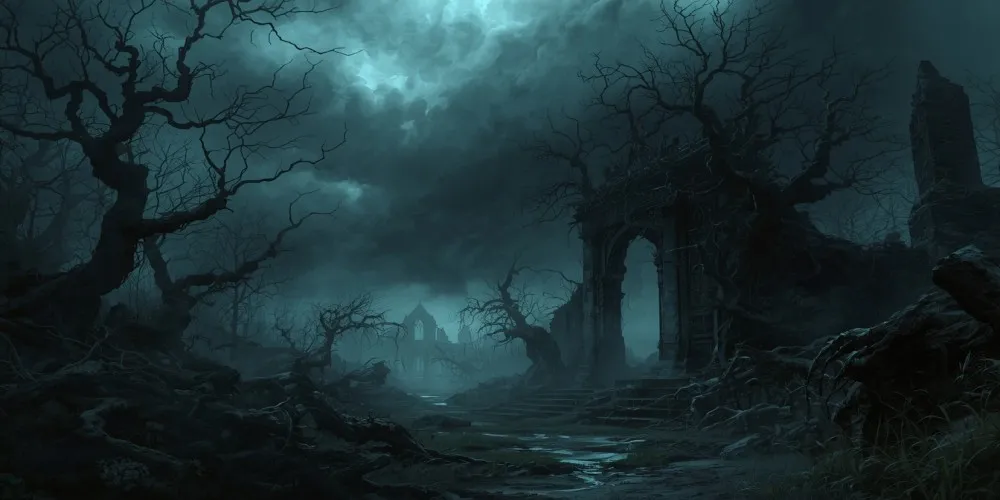
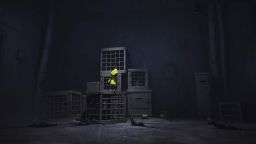
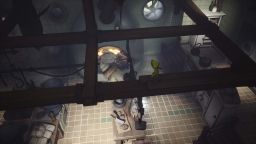
The setting is one of the strongest parts of Little Nightmares. The Maw is not just a location; it feels like a monstrous structure with its own routines, hunger, and secrets. Every area seems built for someone much larger than Six, which makes ordinary objects feel intimidating. A table becomes a landscape. A door handle becomes a challenge. A shelf becomes a climb. A kitchen becomes a place of panic.
I like how the game makes scale frightening. The world is not scary only because there are enemies. It is scary because everything tells me I do not belong there. The floors creak, pipes groan, lights flicker, and rooms stretch upward with a sense of impossible weight. Even when nothing is chasing me, I feel watched by the environment itself.
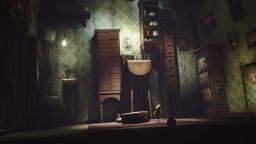
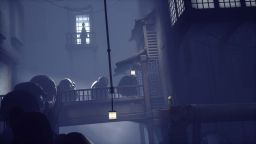
The Maw also has a grim industrial beauty. Its metal corridors, wooden rooms, hanging cages, oily kitchens, and dim sleeping quarters create a place that feels old, used, and cruel. It has the logic of a nightmare: not random, exactly, but distorted in a way that makes emotional sense before it makes literal sense.
Six Is Small, Silent, and Strangely Compelling
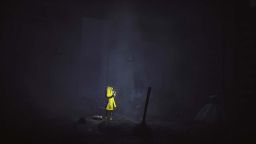
Six is the main character, and her design is brilliant because it is so simple. A tiny figure in a yellow raincoat stands out immediately against the dark, dirty world around her. That raincoat does a lot of visual work. It makes her readable, fragile, and iconic without giving her a single spoken line.
I found Six compelling because the game lets her remain mysterious. She is not explained through long dialogue, diary entries, or constant inner monologue. I learn about her through movement, hunger, fear, and action. She climbs, hides, runs, pulls objects, lights matches, and keeps moving forward because stopping does not feel like an option.
Her silence makes the world feel even colder. No one comforts her. No one explains the rules. No one tells her she is brave. That absence gives Little Nightmares much of its emotional force. Six is not presented as a traditional hero; she is a small survivor inside a place that turns survival into something morally uncomfortable.
The Visual Style Is Cute Until It Becomes Horrible
Little Nightmares has one of my favorite kinds of horror aesthetics: it begins with something almost storybook-like, then twists it into discomfort. The character proportions are exaggerated, the spaces are theatrical, and the lighting often looks carefully staged. Yet the details are grimy, fleshy, damp, and wrong.
I like how the game uses contrast. Six looks tiny and almost doll-like, while the adults around her are grotesque, stretched, swollen, masked, or distorted. This creates a constant feeling that childhood has been trapped inside an adult world made monstrous. The result is unsettling without needing constant shocks.
The color palette is also carefully controlled. The darkness is not flat black; it has browns, greens, yellows, sickly light, and deep shadow. The yellow raincoat becomes a small flame inside the gloom. It gives me something to hold onto visually, which makes the surrounding world feel even more oppressive.
Enemies Feel Like Fears Given Human Shape
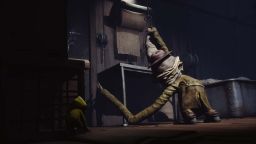
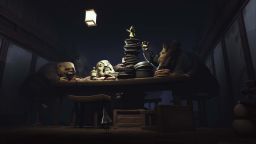
The enemies in Little Nightmares are unforgettable because they do not feel like ordinary monsters. They feel like distorted authority figures, each connected to a different kind of childhood fear. The Janitor, with his long arms and blind searching, makes hiding feel unbearable. The Twin Chefs turn the kitchen into a disgusting performance of labor and appetite. The Guests are perhaps the most disturbing because their hunger feels endless and empty.
I appreciate how each enemy changes the rhythm of the game. The Janitor creates slow tension and listening-based dread. The Chefs bring frantic pursuit and grotesque comedy. The Guests create a wave of panic because their bodies and desire seem impossible to satisfy. Each chapter has its own nightmare logic.
The game rarely overexplains these figures, and that restraint helps. I do not need a detailed biography for every creature. Their designs tell me enough. Their bodies, movements, and environments suggest what they represent, while the lack of certainty keeps them unsettling.
Stealth Feels Fragile and Physical
The gameplay is built around stealth, platforming, light puzzles, and escape sequences. I enjoyed how vulnerable it made me feel. Six cannot overpower the world. She has to hide under tables, slip through gaps, climb shelves, drag objects, and time her movements carefully.
Stealth in Little Nightmares works best when I feel the enemy nearby but not fully visible. A sound, a shadow, or a sudden movement can create immediate tension. Because Six is so small, even crossing a room can feel dangerous. The game makes me think about space differently, constantly searching for cover, routes, and objects I can use.
The controls can sometimes feel slightly heavy, especially during precise jumps or rushed chase moments. That can be frustrating, but it also contributes to the physical vulnerability of Six. She does not move like a superhero. She moves like a small child pulling herself through a hostile world.
Puzzles Are Simple, But the Atmosphere Makes Them Matter
The puzzles in Little Nightmares are usually not extremely complex. I pull levers, move boxes, climb furniture, use keys, distract enemies, or figure out how to cross a dangerous room. On paper, many of these tasks are straightforward. In practice, they become tense because of the atmosphere surrounding them.
I like that the game does not interrupt itself with overly technical puzzle systems. It keeps the focus on mood and survival. A puzzle is rarely just a puzzle; it is a way to move through a frightening space. The question is not only “How do I solve this?” but also “Can I do it before something notices me?”
This design keeps the pacing smooth. The game moves from exploration to puzzle-solving to hiding to chase sequences without feeling too mechanical. The simplicity helps maintain the dreamlike rhythm. I am not solving abstract logic problems; I am navigating a nightmare with whatever small tools the environment offers.
Sound Design Does More Than the Script Ever Could
Little Nightmares uses sound beautifully. There is very little dialogue, so the audio carries much of the storytelling. Creaking wood, distant metal, wet footsteps, heavy breathing, distorted murmurs, kitchen noises, and sudden chase music all shape the experience. The world sounds alive in the worst possible way.
I especially like how silence is used. Quiet moments do not feel peaceful; they feel tense. When I hear only Six’s footsteps or the faint hum of a room, I start expecting something to move. The absence of sound becomes a threat because the game has taught me that danger often appears from stillness.
The enemy sounds are also memorable. The Janitor’s movements, the Chefs’ ugly activity, and the Guests’ awful hunger all make their areas feel distinct. The sound design gives each threat a presence before it fully appears, which makes the horror feel more psychological than purely visual.
The Story Works Because It Refuses Easy Answers
Little Nightmares tells its story through images, movement, and implication. It does not stop to explain the Maw, Six’s past, the meaning of every creature, or the full structure of this world. I liked that because the game feels stronger as a nightmare than it would as a fully explained myth.
The lack of clarity invites interpretation. I found myself thinking about hunger, childhood, exploitation, fear, consumption, and the way powerful figures feed on the small and powerless. The game does not need to state these themes directly. It builds them into the spaces I move through.
That ambiguity may frustrate players who want complete answers. I understand that. But for me, the mystery is part of the attraction. Little Nightmares feels like remembering a bad dream in fragments. The pieces are vivid, disturbing, and emotionally connected, even when the full logic remains hidden.
Short Length Helps the Game Stay Sharp
Little Nightmares is not a huge game, and I think that works in its favor. It does not stretch its ideas too thin. The experience is compact, focused, and carefully paced. Each chapter introduces a new kind of fear, then moves on before the atmosphere becomes routine.
I appreciate games that know when to stop adding more. Little Nightmares feels like a dark fable rather than an endless horror campaign. Its short length makes the images more concentrated. I remember the long arms, the kitchen, the dining room, the hunger, and the yellow raincoat because the game gives those moments enough space without burying them under too much filler.
The replay value comes less from mechanical variety and more from atmosphere, interpretation, and small details I may have missed the first time. It is the kind of game I return to not because I need a different ending every time, but because I want to walk through that nightmare again and notice what still unsettles me.