

















Hello Neighbor Summary
Get From the Official Digital Markets
All trademarks belong to their
respective owners.
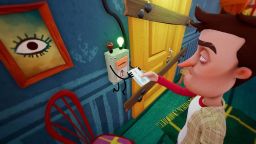
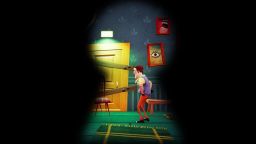
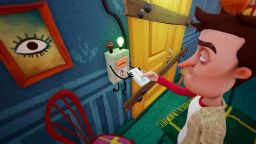
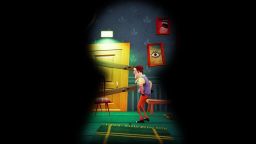
Hello Neighbor feels like a strange suburban nightmare disguised as a colorful stealth puzzle game. I went into it expecting a simple game about sneaking into a neighbor’s house, but the experience turned out to be more unusual than that. It has the look of a cartoon thriller, the structure of an escape room, and the mood of a childhood rumor that somehow became real. The house is not just a building. It feels like a puzzle box with locked doors, hidden switches, secret routes, and one very suspicious man trying to keep me out.
What makes Hello Neighbor interesting to me is its mix of curiosity and discomfort. The game constantly tempts me forward with one question: what is he hiding? That question gives even simple actions a nervous edge. Opening a window, moving a box, checking a hallway, or climbing onto a roof can feel exciting because I know the neighbor may appear at any moment. The game works best when I am experimenting, failing, learning the house, and slowly turning fear into strategy.
A Cartoon Suburb With Something Wrong Under the Paint
The visual style is one of the first things I noticed. Hello Neighbor does not look realistic, and that choice gives it a strong identity. The houses are stretched, the colors are bold, the rooms feel exaggerated, and the whole suburb has a slightly unreal quality. It looks friendly at first glance, but the more I explore, the more unsettling it becomes.
I like that contrast. The bright lawns, simple streets, and playful shapes create a false sense of safety. Then the neighbor’s house interrupts that comfort with locked rooms, strange architecture, hidden spaces, and objects placed like clues. The world feels as if a children’s cartoon has been quietly invaded by paranoia.
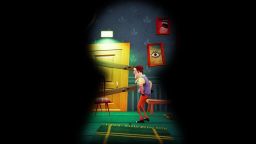
The house itself is the main visual attraction. It grows stranger as the game progresses, becoming taller, more complicated, and more irrational. Stairs lead to odd places. Rooms connect in unexpected ways. Rooftops, platforms, pipes, ladders, and hidden passages make the building feel alive. It is not a normal home. It is a character made of doors, traps, and secrets.
The Neighbor Is More Than a Simple Obstacle
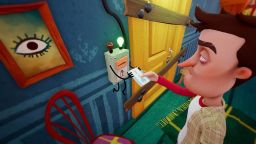
The neighbor is the face of the game, and he gives the whole experience its tension. He is not frightening because he looks realistic. He is frightening because he is unpredictable, theatrical, and always connected to the mystery. His mustache, gloves, sweater, and exaggerated movements make him instantly recognizable. He looks almost funny until he suddenly appears behind me.
I found him most effective when I treated him less like a monster and more like an active homeowner defending a secret. He listens, searches, reacts, and changes his behavior based on what I do. If I use the same route too often, he may start preparing for it. That idea gives the game a clever twist: the house is not static, and the opponent is not simply waiting in one place.
The artificial intelligence can be impressive, but it can also feel uneven. Sometimes the neighbor’s behavior creates brilliant tension, especially when he blocks a familiar path or surprises me after I make noise. Other times, he behaves strangely or gets caught in awkward patterns. Even then, his presence remains important because he keeps every attempt from feeling completely safe.
Stealth Built Around Experimentation
Hello Neighbor is not a traditional stealth game where I simply crouch in shadows and memorize patrol routes. It is more experimental. I throw objects, break windows, stack boxes, distract the neighbor, unlock doors, move furniture, and search for unusual ways into the house. The game wants me to test ideas, even ridiculous ones.
I enjoy that playful approach because it makes progress feel personal. When I find a new entrance or solve a route problem, it feels like I discovered it through curiosity rather than being handed an obvious answer. The game rewards players who poke at the environment and ask what might be possible.
At the same time, this design can become confusing. Because the game gives limited explanation, I sometimes felt unsure whether I was missing a clue, using the wrong item, or fighting against awkward physics. That uncertainty is part of the identity, but it can also slow the rhythm. Hello Neighbor is most enjoyable when experimentation feels clever, not when it feels like guessing in a messy room.
The House Works Like a Giant Puzzle Box
The neighbor’s house is the real center of the game. Every locked door, hidden key, strange switch, and blocked path turns the building into a layered puzzle. I do not simply move through it. I study it. I look for routes, test objects, remember shortcuts, and slowly understand how one area connects to another.
I liked how the house changes across acts. It starts with a more grounded layout, then becomes increasingly bizarre and vertical. This gives the game a sense of escalation. The deeper I go, the less the building feels like ordinary suburbia and the more it feels like a physical version of someone’s secrets.
The best puzzle moments come when a solution makes me feel smart. Finding a key after following visual clues, using an object in an unexpected way, or reaching a high area through improvised movement can be very satisfying. The weaker moments happen when puzzles become too unclear, making progress depend more on trial and error than careful observation.
Physics Make the Game Funny, Strange, and Sometimes Awkward
Hello Neighbor uses physics heavily, and that gives the game much of its personality. Boxes can be stacked, objects can be thrown, windows can be broken, and the environment often reacts in silly ways. This makes the world feel interactive and unpredictable.
I enjoyed the slapstick side of it. A failed escape, a badly stacked tower of boxes, or a frantic attempt to throw something as a distraction can create funny moments. The game’s tension often mixes with accidental comedy, which fits its cartoon thriller style.
However, physics can also work against the experience. Objects may not behave exactly as I expect, climbing can feel clumsy, and certain setups can become more frustrating than clever. When the controls and physics cooperate, the game feels like a creative sandbox. When they do not, the mystery can turn into irritation.
The Story Is Told Through Mystery More Than Explanation
Hello Neighbor does not tell its story in a straightforward way. Much of the narrative comes through atmosphere, hidden details, dreamlike sequences, and the gradual discovery of what may have happened inside the house. That indirect style gives the game a strong sense of intrigue.
I liked the feeling of piecing together the story rather than simply being told everything. The neighbor’s behavior, the locked areas, the strange rooms, and the surreal moments all suggest a deeper emotional history. The game invites me to wonder what is real, what is symbolic, and what the house represents.
This approach also has drawbacks. Because the storytelling is vague, it may leave some players unsatisfied. I enjoy mystery, but I also wanted certain emotional details to land with more clarity. The game has a fascinating premise, yet it sometimes feels more interested in hiding information than shaping it into a fully smooth narrative.
Sound Design Creates Pressure Without Needing Realism
The sound design is a major part of the tension. Footsteps, doors, windows, object impacts, and sudden musical cues all make me more aware of the neighbor’s presence. I often found myself stopping to listen before moving into another room.
The neighbor’s chase music is especially effective because it changes the mood instantly. One second I am exploring quietly, and the next I am rushing toward a window or trying to escape through a route I barely remember. The audio makes panic arrive quickly.
I also like how silence works in the game. A quiet hallway can feel suspicious because I know the neighbor might be nearby. That uncertainty makes the house feel tense even when nothing is happening. The sound does not need to be realistic. It needs to make me nervous, and it does that well.
The Game Is Best When Curiosity Beats Frustration
Hello Neighbor is strongest when it makes me curious. The desire to understand the house, outsmart the neighbor, and uncover the hidden story is what kept me moving forward. When I discovered a new path or solved a strange environmental puzzle, the game felt genuinely rewarding.
It struggles when its systems become too rough. Unclear objectives, unpredictable physics, and uneven artificial intelligence can make some parts feel less polished than the concept deserves. I did not always feel like failure was my fault, and that can be a problem in a stealth puzzle game.
Still, the core idea has a powerful appeal. Sneaking through a bizarre house while an adaptive neighbor tries to stop me is memorable. The game has a distinctive mood that stays in my mind: bright streets, locked doors, suspicious noises, strange rooms, and the constant feeling that one more attempt might finally reveal what is hidden downstairs.