




Gang Beasts Summary
Get From the Official Digital Markets
All trademarks belong to their
respective owners.
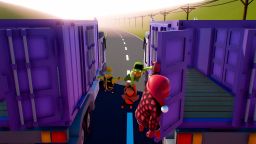
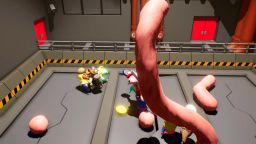
Gang Beasts is the kind of party game that looks broken until I realize the broken feeling is the entire joke. Characters wobble like jelly with unresolved personal issues, punches land with slapstick awkwardness, and every arena seems designed by someone who believes safety rails are optional comedy. It is a multiplayer brawler, but not in the precise martial-arts sense. It is more like a group of rubbery mascots trying to settle an argument on a moving truck, inside an elevator shaft, beside a grinder, or anywhere else a sensible person would immediately leave.
The Core Appeal Is Beautifully Stupid Physics
The official Gang Beasts site describes it as a silly multiplayer party game with surly gelatinous characters, brutal slapstick fight sequences, and absurdly hazardous environments. That is exactly the pitch. The game is funny because bodies do not behave properly. Arms flail, heads wobble, players grab the wrong thing, and a heroic throw can become self-destruction in half a second.
I like that Gang Beasts does not chase polished fighting-game precision. It builds comedy out of imperfect control. A serious brawler wants me to master combos. Gang Beasts wants me to grab someone by the costume, drag them toward danger, lose my grip, fall over, and somehow accidentally win. That unpredictability makes every round feel like a tiny slapstick film.
-
Ragdoll movement makes every fight feel physically funny;
-
Simple actions become unpredictable because characters are so floppy;
-
The game turns mistakes into entertainment rather than pure failure;
-
The physics are chaotic by design, not by accident;
Beef City Is a Perfectly Ridiculous Battleground
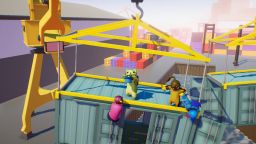
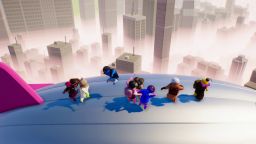
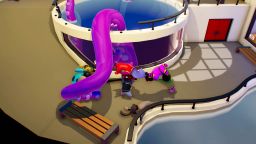
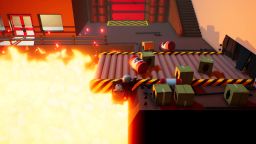
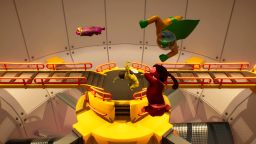
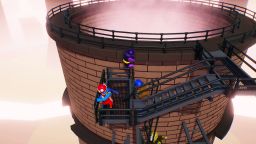
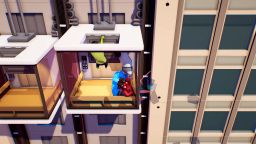
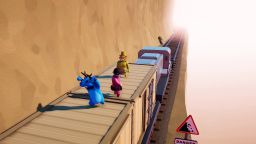
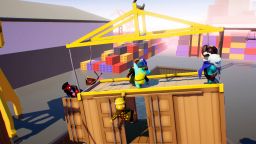
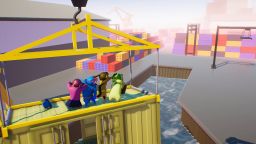
Gang Beasts takes place across hazardous locations in Beef City, a fictional industrial playground where almost every map seems to ask, “What if this fight happened somewhere deeply unsafe?” Steam describes the game around slapstick fight sequences and absurd hazardous environments, which fits arenas like rooftops, trucks, elevators, incinerators, fans, and factory-like spaces.
I enjoy how much the environments matter. A flat arena would not be enough. Gang Beasts becomes funny because the stage is another opponent. The real threat is not always the person punching me. Sometimes it is the subway, the collapsing platform, the giant fan, the grinder, or the edge I forgot was directly behind me.
The Controls Are Simple, but Not Easy
Gang Beasts uses basic actions like punching, grabbing, lifting, jumping, and moving, but the challenge comes from making those actions behave under pressure. A player can understand the controls quickly and still spend several rounds grabbing a wall instead of an enemy. That is part of the charm.
I like the gap between intention and result. I may plan to knock someone out, lift them heroically, and toss them over a railing. What actually happens is that I grab their hat, fall down, get dragged across the floor, and survive only because another player makes an even worse decision. Gang Beasts is funny because the controls make confidence dangerous.
-
Punching and grabbing are easy to understand;
-
Lifting and throwing require messy timing;
-
The floppy movement keeps fights unpredictable;
-
Winning often means recovering from failed plans faster than everyone else;
Local Multiplayer Is Where the Game Shines
Gang Beasts is at its best when several people are in the same room laughing at the same disaster. Steam lists it as a multiplayer party game, and that party identity is the heart of the experience. Online play matters, but local play brings out the best reactions: shouting, betrayal, sudden alliances, and the kind of laughter that happens when someone loses while explaining how skilled they are.
I think Gang Beasts belongs in the same emotional category as couch-party games that do not require everyone to be equally experienced. New players can participate quickly because the controls are not intimidating. Skilled players may win more often, but physics chaos keeps matches loose enough for surprise victories.
Online Multiplayer Extends the Chaos
Online play gives Gang Beasts more life beyond local parties. It lets players jump into brawls without needing friends physically nearby, which is useful for a game built around repeated short rounds. The official identity as a multiplayer party game supports both casual and more regular online sessions.
I like online Gang Beasts when the connection feels stable and the lobby has the right spirit. This is not a game I play for ranked seriousness. It works best when everyone accepts that absurdity is part of the contract. If someone expects clean competitive balance, they may leave confused. If they expect rubber-body nonsense, they are home.
-
Online play makes the game easier to revisit without a couch group;
-
Short rounds fit casual multiplayer sessions well;
-
The best lobbies embrace chaos instead of treating every match too seriously;
-
Connection quality can affect how satisfying grabs and throws feel;
The Costumes Add More Personality Than Expected
Gang Beasts’ characters are simple, but the costume system gives them personality. The outfits help players identify themselves quickly and turn each fighter into a ridiculous little mascot. A shark, a chicken, a worker, a bear-like blob, or some other strange figure can become instantly memorable after one dramatic fall.
I enjoy cosmetics here because they support the comedy. A normal punch is funny. A punch from a tiny gelatinous creature wearing a silly outfit is better. Costumes also make local multiplayer easier because everyone can shout at the right character instead of yelling, “No, the other red one!” which is the beginning of every couch-game legal dispute.
The Best Fights Are Improvised Stories
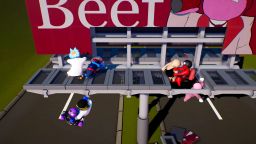
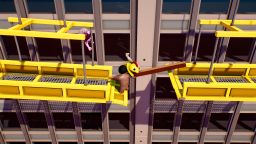
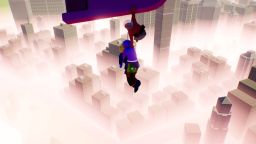
Gang Beasts does not need scripted moments because the physics create stories naturally. One player hangs from a sign. Another tries to help and accidentally pulls them down. Two people wrestle near a hazard while a third waits cowardly in the corner. Someone who looked eliminated somehow climbs back up and wins. This is the game’s real content.
I like that no two rounds feel exactly the same even when the rules are simple. The game creates comedy through timing and accident. A match can become a revenge story, a rescue mission, a betrayal, or a tragic documentary about why standing near industrial machinery is bad.
-
Rounds naturally create funny little narratives;
-
Comebacks feel memorable because climbing and grabbing are messy;
-
Accidental betrayals are almost guaranteed in group play;
-
The game is as fun to watch as it is to play;
The Hazard Design Keeps Matches Moving
The arenas are not passive backgrounds. They push players toward danger. Moving platforms, drops, machinery, vehicles, and edges keep rounds from becoming endless shoving matches. The hazard design forces action even when players try to play cautiously.
I appreciate this because party brawlers can stall if players refuse to commit. Gang Beasts solves that by making the map itself unstable. Eventually someone has to move, jump, grab, or panic. The environment turns hesitation into comedy.
The Game Works Because It Is Easy to Explain
Gang Beasts has one of the cleanest party-game explanations: throw everyone else out of the arena and try not to fall with them. That is enough. Players do not need long tutorials, complex builds, or deep menus to understand the fun.
I like games that can be taught in under a minute. Gang Beasts may take time to handle well, but the goal is immediately obvious. That makes it excellent for mixed groups where some people play games constantly and others only touch a controller when peer pressure becomes strong enough.
-
The objective is clear almost instantly;
-
New players can join without studying systems;
-
The game supports mixed-skill party groups;
-
Mechanical messiness keeps beginners from feeling completely helpless;
The PC Release Established the Game’s Identity
Steam lists Gang Beasts as developed by Boneloaf and Rocket Science, published by Boneloaf, and released on December 12, 2017. The game had built attention earlier through its Early Access period, but the full release helped cement it as one of the most recognizable physics-based party brawlers.
I think the PC version remains important because it reflects the game’s indie-party roots. Gang Beasts became popular not because it looked like a huge studio product, but because it had a strong idea and made people laugh quickly. It understood that a floppy body falling into danger can be more memorable than a perfectly animated combo.
Console Versions Make It a Better Party Fit
Gang Beasts has appeared on major platforms, including PC, PlayStation 4, Xbox One, and Nintendo Switch. That matters because this kind of game feels natural on a TV with controllers. The console versions make it easier to use Gang Beasts as a party-game option rather than something confined to a desk.
I especially like the idea of Gang Beasts on Switch because the system is already associated with local multiplayer flexibility. But the game also makes sense on PlayStation and Xbox, where couch co-op and online lobbies can both support the same core chaos. Platform choice mainly depends on where a player’s friends are.
-
Console availability helps Gang Beasts fit local multiplayer nights;
-
PC remains important for the game’s original audience and online community;
-
Switch portability suits casual party play especially well;
-
Players should choose the platform where their friends are most active;
The Humor Is Physical, Not Verbal
Gang Beasts does not rely on dialogue, jokes, or written punchlines. The humor comes from bodies, timing, hazards, and failure. A player dangling from a ledge while three others slap each other nearby is already funny. A character triumphantly lifting an opponent and then falling into the same hole is even better.
I like this because physical comedy crosses language barriers. A person does not need to understand lore or dialogue to laugh at a wobbly fighter being dragged into danger. That makes Gang Beasts easy to recommend for international groups, families, and mixed audiences.
The Game Can Be Frustrating When Precision Matters
The same physics that make Gang Beasts hilarious can also make it frustrating. Sometimes I want to grab a ledge and grab a sleeve instead. Sometimes I think I have knocked someone out, only to watch them recover at the worst moment. Sometimes the game feels less like skill and more like an argument with jelly.
I think this frustration is part of the design, but it will not suit everyone. Players who need tight mechanical control may bounce off it. Gang Beasts is not about perfect input execution. It is about managing chaos better than the other fools in the room, and occasionally accepting that the room has chosen you as the fool.
-
Ragdoll controls can feel imprecise by design;
-
Throws and grabs may not always behave as expected;
-
Some players may find chaos funny while others find it irritating;
-
The game is better for party moods than serious competitive moods;
The Skill Ceiling Is Sneakier Than It Looks
Gang Beasts looks random, but experience does matter. Skilled players learn how to recover, climb, time grabs, use headbutts, drag opponents, avoid hazards, and survive when knocked down. They also learn which maps reward aggression and which punish it.
I like that hidden skill layer. A beginner can win through chaos, but a practiced player starts to control the mess more consistently. The game never becomes fully clean, and that is good. But it does reward players who understand its strange body language.
It Is Better in Short Bursts
Gang Beasts is not the kind of game I usually want to play for six straight hours. It works best in bursts: a few rounds before another game, a party session, a quick online lobby, or a chaotic break between more serious games. Its loop is strong, but narrow.
I see that as a natural party-game rhythm. The game delivers laughter quickly, then risks repetition if overplayed. It is like very spicy snack food. Great in the right amount. Questionable as dinner.
-
Short sessions keep the chaos fresh;
-
The game is ideal for parties and casual multiplayer nights;
-
Long sessions can make the repetition more noticeable;
-
It pairs well with other couch multiplayer games;
The Modes Add Variety, but Brawling Is the Main Event
Gang Beasts includes modes beyond the basic free-for-all brawler structure, including team-oriented and survival-style variations. Wikipedia’s gameplay summary notes modes such as Waves, Gang, and Soccer. These modes help add variety, especially for groups that want something different after several standard matches.
Still, the main brawl remains the heart of the game. I appreciate extra modes, but I return for the classic experience: grab, punch, lift, fall, laugh, accuse someone of cheating, and restart. The simple brawler format is where Gang Beasts feels most iconic.
Gang Beasts Is More Fun With the Right Group
This game depends heavily on social chemistry. With the right group, Gang Beasts is hilarious. With players who get angry at randomness, it can become tense in the wrong way. The best group understands that losing absurdly is part of the entertainment.
I like playing Gang Beasts with people who narrate their own disasters. The game becomes better when players laugh at bad throws, failed climbs, and accidental self-eliminations. If everyone treats it like a serious tournament, the mood can get strange fast.
-
Players who enjoy chaos will get the most out of it;
-
Mixed-skill groups can still have fun because randomness creates surprises;
-
Overly competitive players may find the physics annoying;
-
The social mood matters as much as the mechanics;
The Visual Style Is Simple but Memorable
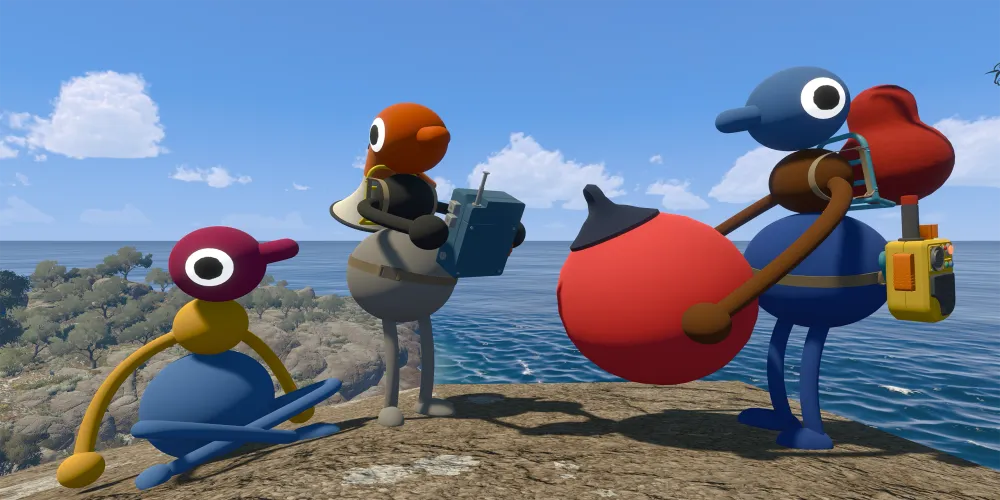
Gang Beasts has a chunky, toy-like look that fits the physics. The characters are not detailed fighters with realistic anatomy. They are colorful, rubbery figures built to bend, wobble, grab, and flop. The environments are readable and exaggerated enough to support quick party play.
I like the simplicity because it keeps the focus on movement and danger. A more realistic style might make the violence feel harsh. Gang Beasts stays goofy because everything looks like a strange plastic playset where health-and-safety rules have been deleted.
The Best Audience Is Party-Game Fans
Gang Beasts is easiest to recommend to players who enjoy local multiplayer, silly physics, couch brawlers, chaotic online lobbies, and games where losing can be as funny as winning. It is also a good fit for groups that want something easy to explain and hard to control perfectly.
It may be less appealing to players who want precise fighting systems, serious competitive balance, deep progression, or a strong single-player campaign. Gang Beasts is not built for that. It is built for laughter, physical nonsense, and the joy of throwing someone off a platform while accidentally following them down.
Where Gang Beasts Feels Most Effective
Gang Beasts feels most effective when a fight becomes a mess nobody could have scripted. Two players hang from a sign. Another charges in and knocks them both loose. A fourth player celebrates too early and slips into the same danger. The winner is not always the most skilled person. Sometimes the winner is simply the last gelatinous fool still standing.
The game also succeeds because it makes failure entertaining. In many multiplayer games, losing feels bad. In Gang Beasts, losing can be the highlight of the match if it happens in a funny enough way. That is a rare and valuable party-game quality.
Where Gang Beasts Feels Less Strong
Gang Beasts feels less strong when played alone or without the right group energy. The game’s systems are simple, and the comedy depends on social reaction. Without laughter, rivalry, and shared chaos, the loop can feel thin.
It also feels less strong for players who want precision. The controls are intentionally loose, and the physics can make outcomes feel unfair. That looseness is the joke, but not everyone enjoys being the punchline.