Fall Guys Summary
Get From the Official Digital Markets
All trademarks belong to their
respective owners.
Fall Guys feels like a party game that somehow escaped from a candy shop, rolled through a television studio, and landed directly in my hands with confetti still stuck to its shoes. I went into it expecting quick chaos, but what kept me playing was the strange mix of comedy, competition, and tiny moments of personal triumph. It is not the kind of game that asks me to master a serious combat system or memorize a heavy lore timeline. Instead, it drops me into a bright obstacle course with dozens of wobbling bean-shaped contestants and dares me not to laugh when everything goes wrong.
What I enjoy most is how easily Fall Guys turns failure into entertainment. Missing a jump, being swept away by a rotating platform, or getting shoved off balance by a crowd rarely feels punishing for long. The game has a slapstick rhythm that makes defeat look funny rather than frustrating. Even when I lose early, I often stay amused because the whole match feels like a cartoon sporting event where dignity was never invited.
A Playground Wrapped in Sugar-Colored Madness
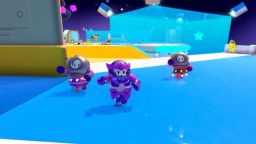
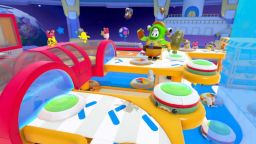
The first thing that stands out to me is the visual identity. Fall Guys is loud, soft, and aggressively cheerful. Its stages are built from bright colors, inflated shapes, spinning obstacles, foam-like platforms, and oversized props that make the whole game feel like a futuristic game show designed by someone with unlimited access to jellybeans and trampolines.
I appreciate how readable the design is. Even when the screen is full of players, swinging objects, and moving platforms, the game usually communicates danger clearly. Pink slime means trouble. A spinning beam means timing matters. A narrow bridge means someone nearby will probably ruin my careful plan. The aesthetics are playful, but they also serve the gameplay well.
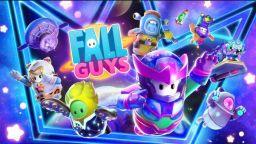
The costumes add another layer of personality. Seeing a banana, a dragon, a robot, a hot dog, and a pirate sprinting toward the same finish line gives every round a silly visual punch. My own character never feels like a heroic champion in the traditional sense. It feels more like a determined little mascot trying to survive a theme park built by mischievous engineers.
The Bean Characters Have More Personality Than Expected
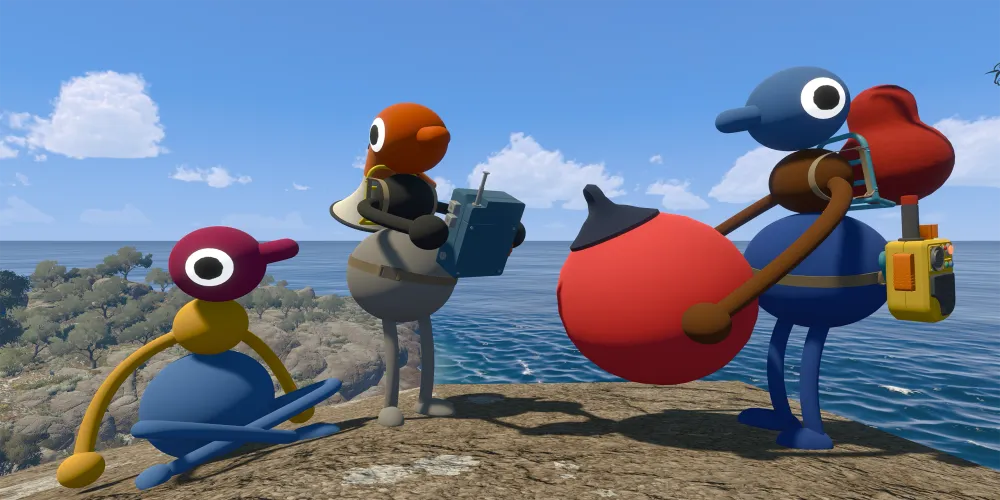
The main characters in Fall Guys are simple bean-like figures, but their charm comes from how physically expressive they are. They do not need detailed faces or dramatic dialogue. Their personality appears through their clumsy movement, tiny arms, dramatic falls, and relentless commitment to running forward even when the situation is clearly hopeless.
I find the character design smart because it makes every player look equally ridiculous. No matter how stylish my costume is, I am still controlling a wobbly bean that can trip, tumble, and get bounced around like a toy. That keeps the tone light. Winning feels satisfying, but the game never lets me take myself too seriously.
The customization system gives me enough freedom to feel attached to my character without turning the experience into a complicated fashion simulator. I can change colors, patterns, faces, upper costumes, lower costumes, nameplates, and celebrations. Some outfits are cute, some are strange, and some are completely absurd in the best way. The result is a lobby full of tiny personalities competing in a giant parade of nonsense.
Obstacle Courses That Reward Instinct and Adaptation
The core gameplay works because it is easy to understand but harder to control under pressure. Most rounds ask me to run, jump, dive, grab, balance, dodge, or cooperate. On paper, that sounds simple. In practice, the challenge comes from physics, timing, moving platforms, and the unpredictable behavior of other players.
I like that many levels reward quick adaptation more than perfect planning. A route that looks safe can become crowded in seconds. A shortcut can save time or throw me into disaster. A spinning obstacle can become my best friend if I time it well, or my worst enemy if I hesitate for half a second. Fall Guys constantly forces me to make tiny decisions while surrounded by chaos.
The strongest stages have a clear sense of momentum. Door Dash, The Whirlygig, Hex-A-Gone, Lily Leapers, and Roll Off all offer different kinds of tension. Some are about racing. Some are about survival. Some are about reading the arena and staying calm while everything disappears beneath my feet. The best rounds make me feel like I am learning through motion rather than studying a rulebook.
Comedy Comes From the Physics, Not From Forced Jokes
Fall Guys is funny because it lets situations become ridiculous on their own. The physics are loose enough to create surprise but stable enough to remain playable. My character can bounce, slide, tumble, get pushed, recover awkwardly, and somehow still qualify by a tiny margin. That balance is important. The game would be annoying if it felt completely random, but it would lose its charm if everything felt too precise.
Some of my favorite moments happen when I am not even doing well. I might get launched across the map by a giant hammer and accidentally land closer to the finish. I might mistime a jump, collide with another player, and both of us roll into the slime together. I might watch a crowd rush toward one platform, realize too late that it is the wrong choice, and enjoy the collective panic that follows.
This physical comedy gives Fall Guys a social energy even when I play solo. Every match feels shared. I am not just competing against other players; I am participating in a group performance where everyone is one bad jump away from becoming the joke.
Competition Without the Heavy Mood
What separates Fall Guys from many multiplayer games is its low-pressure competitive atmosphere. I still want to win. A crown feels great, and reaching the final round gives me a genuine rush. But the game rarely creates the bitter mood that some competitive titles can produce. The tone is too bright, too silly, and too unpredictable to feel cold or overly serious.
That does not mean Fall Guys lacks skill. Experienced players learn routes, understand timing, control dives better, and recognize patterns quickly. There is a real difference between a newcomer and someone who has played many shows. Still, the design leaves room for surprise. A skilled player can make a mistake. A casual player can have a lucky run. That uncertainty keeps matches lively.
I also enjoy how short the rounds are. Fall Guys respects quick sessions. I can play a few matches without committing an entire evening, yet it also has that dangerous “one more round” pull. Since failure resets quickly, I rarely feel trapped in a bad match for long.
Sound, Music, and the Game Show Energy
The audio design deserves more credit than it sometimes gets. The music is bouncy, strange, and energetic, matching the visual style perfectly. It gives each match a playful sense of urgency without turning the atmosphere stressful. The soundtrack makes me feel like I am inside a colorful televised contest where the audience is made of confetti cannons.
The character sounds are minimal but effective. The little yelps, impact noises, and bouncy effects add texture to every stumble. Obstacles also have satisfying audio cues, from spinning machinery to springy pads. These sounds help the world feel physical, toy-like, and responsive.
When everything comes together, Fall Guys has a rhythm that is almost musical. The crowd rushes forward, platforms swing, players bounce, music speeds the mood along, and suddenly I am leaning toward the screen as if my posture can help my bean make the jump.
Variety, Events, and the Live-Service Layer
Fall Guys has grown beyond its original shape through new seasons, collaborations, themed events, and rotating modes. This helps the game stay fresh, especially because its basic formula is so simple. New costumes and limited-time challenges give me reasons to return, while different playlists can change the pace depending on whether I want solo competition, squads, duos, or a more unusual mode.
The crossover costumes are a major part of the appeal. The game can absorb characters from other franchises without breaking its identity because everything becomes a Fall Guys bean first. A serious character suddenly looks cute and silly once translated into this world. That visual transformation is part of the fun.
At the same time, the live-service structure can sometimes feel uneven. Some events are exciting, while others feel more like checklist tasks. The in-game store and currency systems may not appeal to everyone, especially players who prefer unlocking cosmetics purely through play. I enjoy the customization, but I notice the difference between earning something through progress and seeing the most tempting outfit placed behind a purchase option.
Where Fall Guys Feels Best and Where It Wobbles
Fall Guys is at its best when it leans into fast, readable, physical chaos. Race rounds, survival rounds, and clever final arenas show the game’s strengths clearly. The moment-to-moment experience feels light, funny, and surprisingly tense. I can lose five times in a row and still remember the one perfect jump that saved me from elimination in the previous match.
Where it sometimes struggles is repetition. Some rounds remain fun for a long time, while others can feel less exciting after repeated appearances. Team-based rounds can also be divisive because my success may depend heavily on players I cannot coordinate with. That can create funny stories, but it can also feel unfair when I play well and still get eliminated because the group falls apart.
Even with those issues, I keep seeing Fall Guys as a game with a very clear identity. It knows what it is: a bright multiplayer obstacle contest built around laughter, momentum, and cosmetic absurdity. It does not need deep storytelling or intense drama. Its best moments happen when I am sprinting across a collapsing floor, dressed like a ridiculous mascot, trying to look calm while everything underneath me disappears.