





Cookie Clicker begins with one giant cookie, one simple action, and one dangerously innocent idea: click to make cookies. That is all it needs to start. The screen does not look like a grand adventure at first. There are no dramatic cutscenes, no heroic character introduction, and no complicated combat system. Instead, the game quietly turns a tiny number into a bigger number, then into an absurd number, then into a number so huge that it stops feeling like normal math and starts feeling like a private joke. That slow transformation is what makes Cookie Clicker fascinating. It looks like a joke, plays like a habit, and eventually becomes a strange little economic machine where every upgrade promises that the next milestone is just close enough to chase.
The First Click Is Funny Because It Feels Too Simple
Cookie Clicker’s opening is almost comically plain. I click the cookie, earn cookies, and click again. The official Android listing describes the loop directly: tap to make cookies, then buy things that make cookies for you, then tap some more. That sentence is simple, but it explains why the game is so effective. The first action is effortless, and the first reward is immediate.
I like how quickly the game teaches the player that effort can become automation. At first, my own clicks matter. Then I buy a cursor. Then I buy more production. Soon, the game starts moving without me. That shift from manual action to automated growth is the heart of idle design, and Cookie Clicker makes it clear in a way almost anyone can understand.
-
The first click gives an immediate reward;
-
Early purchases make progress visible very quickly;
-
Automation changes the game from clicking to managing growth;
-
The simple interface makes the loop easy to understand without instruction;
The Buildings Turn Cookies Into an Economy
The game becomes more interesting once buildings enter the picture. Cursors, grandmas, farms, mines, factories, banks, temples, wizard towers, shipments, portals, time machines, and other strange production sources gradually turn the cookie total into an expanding economy. Each purchase increases cookies per second, and that number becomes the main heartbeat of the game.
What I enjoy is the way Cookie Clicker makes production feel absurdly logical. A grandma baking cookies makes sense. A farm producing cookies is already funnier. A portal helping the bakery feels completely ridiculous, but by the time it appears, the game has trained me to accept escalation as normal. That escalation is one of the game’s best jokes. The further I go, the more impossible the cookie empire becomes, yet the structure remains easy to follow.
Upgrades Make Small Decisions Feel Important
Cookie Clicker is not only about buying more buildings. Upgrades add another layer by improving clicks, buildings, production chains, golden cookie effects, and long-term efficiency. Google Play mentions hundreds of upgrades and achievements to unlock, which is a major part of why the game keeps stretching beyond the first session.
I like upgrades because they make progress feel smarter than simply waiting. A good upgrade can change the value of an entire building type. Sometimes the choice is obvious. Sometimes I have to decide whether to save for a bigger purchase or buy several smaller improvements now. Cookie Clicker is not a traditional strategy game, but it creates enough decision-making to make the idle loop feel active.
-
Click upgrades make manual play feel useful for longer;
-
Building upgrades improve production efficiency;
-
Golden cookie upgrades reward active attention;
-
Achievement-related upgrades give completionists more to chase;
The Idle Design Makes Time Feel Like a Resource
Cookie Clicker is one of the most recognizable examples of idle game design. Steam describes it as an idle game about making cookies, originally released in 2013 on the web and actively developed since then. That idle structure changes how I think about play. I am not always doing something, but the game is still progressing.
This is where Cookie Clicker becomes oddly compelling. Closing the tab or stepping away does not feel like quitting in the normal sense. The bakery keeps existing in my mind. I return to see what changed, buy a new upgrade, click a golden cookie, and leave again. The game turns waiting into part of the experience, which is both clever and slightly dangerous for productivity.
Golden Cookies Add Active Tension to an Idle Game
Golden cookies are a smart mechanic because they interrupt passive waiting. When one appears, I suddenly have a reason to pay attention. A click can trigger a temporary bonus, production boost, or other effect that changes the next few moments. That small surprise makes the screen feel alive.
I think golden cookies are important because they balance idle and active play. The game can progress on its own, but a player who checks in regularly gets extra opportunities. That creates a soft pressure to stay nearby without forcing constant attention. It is a clever compromise: Cookie Clicker lets me be passive, then rewards me for not being too passive.
The Humor Starts Small and Gets Stranger Over Time
One of Cookie Clicker’s best qualities is its dry, escalating humor. The game begins with cookies and gradually moves toward increasingly bizarre production logic, odd flavor text, strange achievements, cosmic imagery, and unsettling implications. It is funny because the interface remains calm while the cookie empire becomes unreasonable.
I enjoy that contrast. A normal game might dramatize world-changing power. Cookie Clicker treats it like another line in a menu. The joke is not only that I am making too many cookies. The joke is that the game keeps asking me to treat that as a reasonable business plan. This deadpan absurdity gives Cookie Clicker more personality than a plain number-growing game would have.
-
The early humor comes from the absurd simplicity of cookie production;
-
Later upgrades make the cookie economy feel increasingly surreal;
-
Flavor text gives the game personality without interrupting the loop;
-
The calm interface makes the cosmic escalation funnier;
Achievements Give Completionists a Long Road
Achievements are a major reason Cookie Clicker keeps going. They reward production milestones, building counts, upgrades, special actions, rare events, and unusual accomplishments. For players who like checklists, the achievement system provides a huge amount of long-term structure.
I like achievements because they turn a game with no traditional ending into a game full of personal goals. There may not be a final boss or dramatic story conclusion, but there is always another target. That target might be a cookie total, a building milestone, or a strange hidden requirement. The game understands that completionists do not always need a plot. Sometimes they only need another box to fill.
Ascension Gives the Endless Loop a Reset Button With Meaning
One of the smartest long-term systems in Cookie Clicker is ascension. Instead of simply letting numbers rise forever, the game eventually encourages players to reset progress in exchange for permanent bonuses. This turns restarting into strategy. I am not losing everything for nothing. I am sacrificing one version of the bakery to make the next version stronger.
This system matters because idle games can otherwise collapse under their own scale. If the only goal is bigger numbers, progress eventually slows until it feels dead. Ascension refreshes the pace. The early game becomes faster, new upgrades become possible, and the player gets a reason to rebuild with more knowledge. It makes repetition feel like progression rather than pure repetition.
-
Ascension gives long-term players a reason to restart;
-
Permanent bonuses make each new run faster and more efficient;
-
The reset system helps the game avoid complete stagnation;
-
Planning when to ascend becomes part of the strategy;
The Web Version Still Feels Like the Purest Form
The official DashNet page still hosts Cookie Clicker on the web, with links to the Android and Steam versions. The browser format suits the game beautifully because Cookie Clicker feels natural as something that can sit open in a tab. It becomes part of the background of the day.
I like the web version because it preserves the original spirit of the game: accessible, immediate, and slightly mischievous. It does not need installation or a big commitment to begin. A player can visit, click, and slowly realize they have started a machine that will keep asking for attention. That casual entry point is part of why Cookie Clicker became so influential.
The Android Version Makes the Habit More Portable
Your product list specifically includes Cookie Clicker with a Google Play link, so the Android version is especially relevant here. Google Play describes it as the official Cookie Clicker app by Orteil & Opti and notes that the free version has an ad-less paid version, with saves exportable between versions.
I can see why Cookie Clicker works on mobile. The core action is tapping, checking progress, buying upgrades, and returning later. That fits phone behavior almost too well. A mobile idle game can become a pocket routine: check cookies, buy something, close the app, repeat later. The convenience is excellent, though it also makes the habit harder to ignore.
The Steam Version Gives the Classic Game a More Premium Frame
The Steam version gives Cookie Clicker a different presentation. Steam lists Orteil and DashNet as developer, Playsaurus as publisher, and the release date as September 1, 2021. It also identifies the Steam release as the official version for Steam. That matters because many players prefer having the game in a library, with platform features and a more finished wrapper around the web-origin experience.
I think the Steam version is useful for players who want Cookie Clicker to feel like a proper installed game rather than a browser tab. It does not change the basic identity: the game is still about cookies, automation, upgrades, and escalation. But it gives that loop a slightly more formal home.
-
The web version is immediate and easy to access;
-
The Android version fits quick check-ins and portable idle play;
-
The Steam version gives the game a more traditional PC library presence;
-
All versions preserve the basic appeal of watching numbers grow;
The Game Is More Strategic Than It Looks
Cookie Clicker looks like a joke about clicking, but there is real optimization hiding under the surface. Players can think about upgrade timing, building efficiency, golden cookie bonuses, ascension planning, achievement routes, and long-term production curves. Academic researchers have even analyzed Cookie Clicker through questions of optimal strategy, approximation algorithms, and dynamic programming.
That does not mean every player needs to treat the game like a math problem. Most people can enjoy it casually. But I like knowing that the simple surface has depth for anyone who wants it. Cookie Clicker lets one player casually check cookies during the day while another player studies spreadsheets and production efficiency. Both approaches make sense.
The Minimal Interface Is Part of the Charm
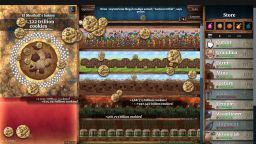
Cookie Clicker’s interface is not flashy in the modern mobile sense. It is mostly numbers, lists, icons, buttons, upgrades, and the giant cookie. That plainness is part of the charm. The game feels like an economic control panel for something deeply silly.
I appreciate that the interface keeps everything close to the central loop. The cookie is there. The buildings are there. The upgrades are there. The numbers are there. I always understand what the game wants from me: produce more cookies. The comedy comes from how seriously the interface treats that ridiculous goal.
The Sound and Music Depend on the Version
Cookie Clicker’s audio presence is not the main attraction, but it still affects the mood. The Steam version is especially notable because it includes music by C418, which gives the official PC release an extra layer of atmosphere. Steam’s listing and related public information identify the Steam version as the official release, and wider game listings note C418’s role as composer for that version.
I like that the game does not rely on intense audio to keep attention. Cookie Clicker is mostly about rhythm, checking, and accumulation. Music and sound can support that, but the core satisfaction comes from watching production increase. It is a game where silence can work just as well as background music.
-
The giant cookie remains the main visual and interaction anchor;
-
Numbers and production rates create most of the feedback;
-
Steam’s music gives that version a more polished atmosphere;
-
The game does not need loud sound design to feel satisfying;
The Lack of a Traditional Ending Is the Point
Cookie Clicker is not built around a conventional ending. It is an incremental game where the main goal keeps expanding. More cookies lead to more buildings. More buildings lead to more upgrades. More upgrades lead to more milestones. Eventually, ascension turns progress into a cycle rather than a straight line.
I think this endlessness is both the appeal and the trap. The game does not ask me to finish. It asks me to continue. That makes it relaxing when I treat it casually, but it can become strangely consuming if I start chasing every next milestone. Cookie Clicker understands that “almost enough” is one of the strongest motivators in game design.
The Influence on Idle Games Is Hard to Overstate
Cookie Clicker is widely recognized as one of the defining idle and incremental games. Steam notes that it was originally released on the web in 2013 and has been actively developed since then. Its structure helped popularize the pleasure of exponential growth, automation, prestige systems, and absurd scaling.
I can see its influence in many later games. The idea that a game can begin with a single click, turn into an economy, then become a long-term optimization machine is now familiar, but Cookie Clicker helped make that structure iconic. It is simple enough to parody and strong enough to keep playing.
The Addiction Factor Is Real
Cookie Clicker is charming, but it is also designed around constant return. The next upgrade is always close. The next achievement is always visible. The next golden cookie might appear soon. The next ascension might make everything faster. This is effective design, but it can also make the game surprisingly hard to leave alone.
I enjoy Cookie Clicker most when I keep it in perspective. It is fun as a background idle game, a numbers toy, and a piece of incremental design history. It becomes less fun if every check-in turns into compulsive optimization. The game is not aggressive in the same way as many modern free-to-play titles, but its loop is powerful.
-
Visible upgrades make the next goal feel close;
-
Golden cookies encourage frequent checking;
-
Ascension gives long-term players another reason to continue;
-
The game is best when played with relaxed self-control;
The Humor Can Turn Darker Than Expected
One of my favorite things about Cookie Clicker is that the tone gradually becomes stranger. A cute bakery slowly grows into something enormous, unnatural, and cosmic. The game does not scream this transformation at the player. It lets the absurdity accumulate through upgrades, text, and scale.
This gives Cookie Clicker a surprisingly memorable personality. It is not only a cheerful cookie game. It is a satire of endless growth, productivity, and meaningless accumulation, whether intentionally read that way or not. The more cookies I make, the more ridiculous the whole project becomes, and the more the game seems to wink at me for continuing.
The Best Audience Is Patient but Curious
Cookie Clicker is not for players who need constant action. It is for players who enjoy numbers growing, systems unlocking, and small decisions stacking into long-term progress. It works especially well for people who like idle games, incremental systems, optimization, achievements, and strange humor.
I would not recommend it to someone looking for a story-driven adventure, a reflex challenge, or a visually rich simulation. But for players who enjoy watching an absurd machine improve over time, Cookie Clicker is still one of the cleanest examples of the genre. It knows exactly what it is.
Where Cookie Clicker Feels Most Effective
Cookie Clicker feels most effective when the production curve is moving fast enough that every few minutes bring a new decision. A new building, an upgrade, a golden cookie, an achievement, or an ascension milestone can make the game feel active even when the core action remains simple. The best moments happen when the bakery suddenly jumps into a new scale of production.
The game also succeeds because it embraces absurdity. It never tries to make cookie production realistic. It makes it cosmic, mechanical, economic, and ridiculous. That willingness to escalate a joke into a full game is what gives Cookie Clicker its lasting charm.
Where Cookie Clicker Feels Less Strong
The biggest weakness is that the core loop is intentionally repetitive. Players who do not enjoy idle progression may become bored quickly. Clicking, waiting, buying, upgrading, and repeating is the entire structure. The magic comes from enjoying the curve, not from expecting dramatic variety.
The other issue is that Cookie Clicker can become more compelling than expected. The game looks harmless, but its reward timing is extremely effective. If a player dislikes compulsive check-in loops, this may be a problem. Cookie Clicker is best treated as a casual background game, not as a task that needs constant attention.
Pros
- Simple cookie-clicking loop is instantly understandable and surprisingly satisfying
- Buildings, upgrades, achievements, golden cookies, and ascension create long-term progression
- The humor escalates from bakery silliness into strange cosmic absurdity
- Web, Android, and Steam versions give players multiple ways to play the official game
- Idle design makes it easy to enjoy in short check-ins or as a background habit
Cons
- The core gameplay is repetitive and may bore players who dislike idle or incremental games
- Progress can become slow between major milestones without patience or optimization
- The reward loop can encourage frequent checking and become surprisingly hard to ignore
- Visual presentation is minimal compared with more modern simulation games
- Players looking for story, action, or traditional endings may find the endless structure unsatisfying