


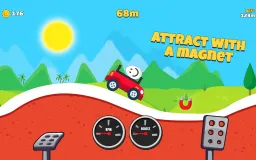
Eggy Car looks like the sort of browser game that should be easy for exactly ten seconds. There is a little car, a loose egg, a bumpy road, and two basic ideas: go forward and do not let breakfast become a tragedy. Then the first hill arrives, the car tips slightly too hard, the egg rolls like it has its own dramatic ambitions, and suddenly the whole game becomes a tiny physics panic. That is the charm. Eggy Car does not need a complicated garage, a cinematic racing career, or realistic engine tuning. It turns balance into the whole challenge, and somehow that is enough to make every extra meter feel personal.
The Premise Is Simple Enough to Understand Instantly
Eggy Car works because the goal is obvious from the first moment. CrazyGames describes it as a physics-based casual driving game where the player tries to drive as far as possible without letting the egg fall off the car and crack. That single rule gives the game all the structure it needs. Speed is useful, but too much speed is dangerous. Braking helps, but braking at the wrong moment can throw the egg forward. Every slope becomes a small test of judgment.
I like games that explain themselves through motion rather than tutorials. Eggy Car does exactly that. The first few failures teach more than a paragraph of instructions could. Accelerate too hard uphill, and the egg bounces. Brake too sharply downhill, and the egg slides. Land badly after a bump, and the run can end before I even have time to blame the road, which I absolutely still do.
-
The goal is immediately clear: keep the egg safe and drive as far as possible;
-
The challenge comes from balance rather than pure speed;
-
Every hill changes how the car and egg behave;
-
Failure is quick, readable, and easy to retry;
The Egg Is the Real Main Character
Most racing games make the car feel important. Eggy Car makes the egg important. The vehicle is only useful if it can protect the fragile passenger sitting loose on top. That changes the way I think about every input. I am not driving like a racer. I am driving like someone transporting a very dramatic grocery item across a road designed by a prankster.
This is why the game feels different from normal hill-climbing games. In many physics driving games, the danger is flipping the vehicle or running out of fuel. Here, the car can be fine while the egg is not. That separation creates comedy and tension. The run can fail because the car survives perfectly, but the egg decides gravity has made a convincing argument.
The Controls Are Minimal, but the Timing Is Everything
Eggy Car uses very simple controls. Coolmath Games explains that players tap onscreen pedals to accelerate or decelerate, while other versions use basic left and right movement controls. The simplicity helps the game feel accessible, especially in browser play. Anyone can start within seconds.
The skill comes from restraint. The game quietly teaches that holding accelerate is usually a terrible idea. A tiny tap can save the egg. A gentle brake can settle it. A perfectly timed push over a hill can keep momentum without launching the egg into disaster. Eggy Car is not about having many controls. It is about using very few controls with surprising care.
-
Basic accelerate and brake controls make the game easy to start;
-
Small inputs matter more than constant speed;
-
Downhill sections require patience and soft braking;
-
Good timing can turn a dangerous hill into a clean recovery;
The Physics Are Silly, but They Create Real Tension
The physics are not realistic in a simulator sense, and they do not need to be. They are readable, exaggerated, and funny. The egg reacts to slopes, bumps, acceleration, braking, and landings in a way that makes sense quickly. That is enough to make each run feel like a little balancing act.
I like that Eggy Car’s physics feel slightly unpredictable without becoming totally random. When I lose the egg, I usually understand why. I accelerated too hard, slowed too late, landed badly, or tried to be brave where patience was clearly the better business model. The game feels fair because mistakes are visible.
The Hills Give the Game Its Rhythm
The road in Eggy Car is basically a rolling argument against confidence. A small slope can become dangerous if the egg is already moving. A steep hill can slow the car and force extra throttle. A downhill section can become terrifying because gravity starts doing its own speedrun. Every shape on the road changes the rhythm.
This makes the game more interesting than it first looks. I am not only reacting to the current hill. I am preparing for the next one. If the egg is already wobbling at the top, the descent becomes risky. If I enter a slope smoothly, the car feels calm and controlled. Eggy Car rewards players who think one bump ahead.
-
Uphill sections test throttle control;
-
Downhill sections test braking and patience;
-
Bumpy landings can ruin a run even after good driving;
-
The best runs feel like reading terrain in advance;
Coins Give Every Run a Small Reward
Coins are important because Eggy Car would feel harsher if every failed run gave nothing. Coolmath Games says players collect coins to unlock new cars, and the farther they go, the more coins they collect. That gives the game a light progression loop. Even a failed attempt can still move the player a little closer to the next vehicle.
I like this because it softens frustration. A bad run may not break a personal record, but it can still add coins. That makes retrying easier. The game does not need a huge reward system. A simple garage goal is enough to keep the loop moving.
Unlockable Cars Add Variety Without Overcomplicating the Game
Unlockable cars help Eggy Car stay interesting after the first few runs. Different vehicles can change how the egg feels on top, how stable the ride seems, and how quickly the car reacts to hills. MortgageCalculator.org’s game description notes that players collect coins to purchase additional vehicle types.
I enjoy this kind of progression because it stays close to the main mechanic. A new car is not just a cosmetic trophy. It can slightly change the balance problem. Some cars may feel safer, while others may feel faster but more dramatic. The egg remains the boss fight either way.
-
Coins create a reason to keep playing after short runs;
-
New vehicles give players something simple to unlock;
-
Different cars can make the balance challenge feel fresh;
-
The progression stays light and does not distract from the core physics loop;
The Freeze Power-Up Is a Tiny Lifesaver
The freeze power-up is one of the game’s cleverest small ideas. Coolmath Games describes it as a power-up that keeps the egg in place for a few seconds. That temporary safety creates a satisfying little break in the tension. For a few seconds, the egg stops behaving like a liability and becomes almost trustworthy.
I like the freeze power-up because it does not remove the challenge permanently. It gives just enough relief to survive a rough section or push for distance, then the danger returns. A good power-up should feel helpful without making the game meaningless. This one does that well.
The Game Is Funny Because Failure Is So Visual
Eggy Car’s failures are easy to laugh at because they are clear and physical. The egg slides, wobbles, pops upward, rolls off, and the run ends with a feeling that is both tragic and ridiculous. There is no complicated explanation. The egg is gone. The road wins.
This kind of visual failure is useful for casual games. It makes losing less bitter. Instead of feeling cheated, I usually feel like I witnessed a tiny slapstick scene. The car tried its best. The egg had other plans. Retry.
-
Failure is instant and easy to understand;
-
The egg’s movement creates natural slapstick comedy;
-
Short runs make restarting painless;
-
The humor helps balance the frustration of repeated losses;
Browser Play Makes Eggy Car Easy to Recommend
Eggy Car’s availability on browser platforms is a major advantage. Your product list links directly to the CrazyGames version, and CrazyGames presents it as a playable online game. Poki also hosts Eggy Car and identifies it as a browser driving game by Beedo Games.
I like browser games that load quickly and make sense immediately. Eggy Car belongs in that category. It is a good “one more try” game because there is no heavy setup. Open it, drive, fail, collect coins, unlock something, and try again. That quick access is a huge part of the appeal.
It Works Well for Short Sessions
Eggy Car is built for short sessions. A run can end in seconds or stretch long enough to become tense, but it rarely demands a major time commitment. That makes it ideal for quick breaks, casual play, or moments when I want something skill-based without starting a large game.
I think this short-session design is one reason the game feels so sticky. It never asks too much, so I keep giving it more. One failed run becomes another attempt. One small improvement becomes a personal record chase. The game does not need to pressure me with a campaign because my own bad decisions are enough content.
-
Runs are quick enough for casual breaks;
-
Restarting takes almost no effort;
-
Personal distance records create natural motivation;
-
The game is easy to leave and easy to return to;
The Difficulty Comes From Patience, Not Complexity
Eggy Car is not mechanically complex. It does not have advanced tuning, multiple modes, story missions, or deep racing systems. Its difficulty comes from patience. The player has to resist the urge to rush. That sounds simple, but it is surprisingly hard when a hill is coming and the car needs just a little more push.
I like that the game rewards calm driving. It quietly punishes greed. A player who treats every slope like a race will lose quickly. A player who treats the egg like a passenger with serious trust issues will go farther. That is a funny and effective learning curve.
The Visual Style Is Basic but Clear
Eggy Car’s visuals are simple, and that is fine. The car, egg, road, coins, and power-ups need to be readable. The game is not trying to impress with detailed environments or realistic vehicle models. It is trying to make the physics challenge clear at a glance.
I appreciate that clarity. In a balance game, the player needs to see the egg’s position instantly. A busy background or visual clutter would only make the game worse. Eggy Car keeps the focus where it belongs: on the egg wobbling nervously above the car.
-
The simple art keeps the road and egg easy to read;
-
Clear visuals support quick decision-making;
-
The game does not need detailed environments to be effective;
-
The egg’s movement remains the most important visual information;
The Sound Is Secondary to the Physics
Eggy Car’s sound is not the main attraction. The game’s appeal comes from the visual physics and the tension of balance. Audio can support the experience, but the loop would still work even if someone played quietly during a break.
This is not a major weakness. Many casual browser games rely more on feel than sound design. Eggy Car is about watching the egg, adjusting speed, and reacting to terrain. Sound can add flavor, but the core challenge is visual and mechanical.
The Game Is Better Than It Looks at First
Eggy Car may look extremely simple, but it has a strong casual design instinct. It gives the player a fragile object, simple controls, immediate failure, visible progress, coins, cars, and a clear personal record goal. Those pieces work together neatly.
I like that the game does not pretend to be larger than it is. It is a small physics challenge, and it commits to that. There is no unnecessary story about the egg’s destiny, no dramatic racing league, no garage economy that needs a manual. Just a car, an egg, hills, and the growing suspicion that I am worse at gentle braking than I thought.
-
The simple design hides a strong retry loop;
-
Personal records make progress feel self-directed;
-
Coins and cars add light long-term motivation;
-
The game’s small scope helps it stay focused;
The Main Weakness Is Repetition
Eggy Car’s biggest weakness is obvious: the game is repetitive. The core loop is always the same. Drive, balance, collect coins, lose the egg, retry. Players who enjoy score chasing will not mind. Players who need fresh objectives, levels, story progression, or multiplayer competition may lose interest quickly.
I do not see the repetition as a design failure. It is part of the genre. Eggy Car is closer to a quick skill toy than a full racing game. The question is whether the player enjoys the central balancing challenge enough to keep coming back. For me, the answer is yes in short bursts, but not as a long-session game.
The Game Can Be Frustrating When the Egg Feels Unfair
Most failures in Eggy Car feel understandable, but the egg can still create frustration. Sometimes a small bounce becomes a disaster. Sometimes a car feels stable until the road shape changes suddenly. Sometimes the egg seems determined to leave the vehicle as if it has somewhere important to be.
This tension is part of the appeal, but it can also annoy players who prefer precise control. Eggy Car asks players to accept a little chaos. The skill is not eliminating risk completely. It is managing risk long enough to beat the previous distance.
-
The egg can feel overly sensitive during sharp terrain changes;
-
Short failures may frustrate players who dislike physics chaos;
-
The game offers limited variety beyond cars, coins, and distance chasing;
-
It works better as a casual break than a deep racing experience;
The Best Audience Is Casual Physics Game Fans
Eggy Car is easy to recommend to players who enjoy casual physics games, hill-climbing challenges, browser games, personal best chasing, and simple one-button-style tension. It is also a good fit for younger players because the goal is clear and the failure is funny rather than harsh.
It is less suited to players who want realistic racing, complex vehicle upgrades, competitive multiplayer, or deep campaign structure. Eggy Car is not a racing simulator. It is a balance joke turned into a game, and it works best when treated that way.
Where Eggy Car Feels Most Effective
Eggy Car feels most effective when a run almost falls apart but somehow survives. The egg wobbles, the hill drops, the car slows, and one careful brake tap keeps everything together. Those tiny saves are more satisfying than they should be because the whole game is built around fragile control.
The game also succeeds because it is instantly understandable. A player can see the car and egg and know the problem before pressing anything. That clarity is valuable. Many casual games need long menus to explain themselves. Eggy Car explains itself by letting the egg fall off almost immediately.
Where Eggy Car Feels Less Strong
Eggy Car feels less strong when played for too long in one sitting. The joke, the challenge, and the progression are all narrow. The game is at its best as a quick retry experience, not as a full afternoon racing session.
It also lacks the depth that some racing players might expect. There is no serious tuning, no varied event structure, no detailed car culture, and no advanced physics simulation. The game is focused on one funny idea, and that idea either works for the player or it does not.
Pros
- Simple physics-based driving concept is instantly understandable and surprisingly tense
- Balancing the fragile egg makes every hill, brake tap, and acceleration choice matter
- Quick restarts and short runs make the game excellent for casual browser sessions
- Coins, unlockable cars, and personal distance records add light replay motivation
- The freeze power-up gives brief relief without removing the core challenge
Cons
- The gameplay loop is narrow and can become repetitive during longer sessions
- The egg can feel frustratingly sensitive when terrain changes suddenly
- Players looking for realistic racing, deep upgrades, or complex modes may find it too simple
- Visuals and sound are functional rather than impressive
- The game works best as a short casual challenge, not as a deep racing experience