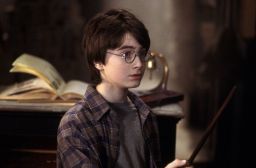
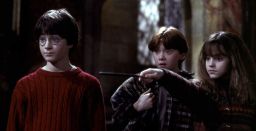
Harry Potter and the Philosopher’s Stone still works because it understands the power of invitation. Before the darker wars, complicated loyalties, political shadows, and franchise-sized mythology, the first story begins with a child who has been made to feel unwanted. Then a letter arrives. Then another. Then a giant knocks down a door. Suddenly the world is bigger, stranger, warmer, and more dangerous than Harry ever imagined. The movie’s magic is not only in wands, owls, ghosts, moving staircases, or chocolate frogs. It is in the feeling that a hidden place exists where the lonely kid might finally belong.
The First Film Is Really About Discovery
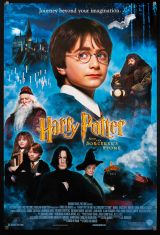
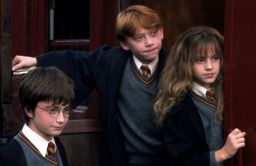
Harry Potter and the Philosopher’s Stone, released in 2001 and known as Harry Potter and the Sorcerer’s Stone in the United States, was directed by Chris Columbus, written by Steve Kloves, and based on J.K. Rowling’s first novel. The film stars Daniel Radcliffe as Harry, Rupert Grint as Ron Weasley, and Emma Watson as Hermione Granger, and it follows Harry’s first year at Hogwarts after he discovers he is a wizard.
I like how the movie structures magic through Harry’s eyes. The audience learns Diagon Alley, Gringotts, the Hogwarts Express, the Sorting Hat, the Great Hall, Quidditch, potions, charms, and house rivalries almost as Harry does. That makes the film feel welcoming. It does not begin by demanding that viewers memorize a giant fantasy system. It lets the wonder arrive step by step.
-
Harry’s point of view makes the Wizarding World easy to enter;
-
Hogwarts feels mysterious, cozy, and dangerous at the same time;
-
The film balances fantasy spectacle with a child’s emotional need for home;
-
The first-year structure gives the story a clear beginning, middle, and school-year rhythm;
Hogwarts Is the Movie’s Greatest Spell
Hogwarts is more than a school setting. It is the fantasy promise at the center of the film. The castle feels like a place with rules, secrets, traditions, food, danger, competition, and history. It is beautiful, but not sterile. Every corridor suggests there might be a hidden room, a ghost, a forbidden staircase, or a teacher who knows more than they are saying.
I think Hogwarts is why the movie remains so rewatchable. The plot matters, but the place matters even more. Returning to the Great Hall, the common rooms, the library, the grounds, and the candlelit atmosphere feels like revisiting a childhood dream of school as a magical kingdom. Real school rarely has floating candles. It mostly has fluorescent lights and someone chewing loudly. Hogwarts wins.
Harry Is a Strong Hero Because He Begins Small
Harry is not introduced as confident, powerful, or even fully informed. He is neglected, confused, and used to being treated like a burden. That starting point gives his journey emotional force. When he enters the Wizarding World, he is not only gaining magic. He is gaining identity.
I like that Harry’s fame is complicated from the beginning. Everyone knows his name, but he does not know himself. People expect him to understand a past he cannot remember. That creates a useful tension: he is famous before he is ready, special before he has learned anything, and surrounded by a world that turns his trauma into legend.
-
Harry’s neglected childhood makes his arrival at Hogwarts emotionally satisfying;
-
His fame creates pressure rather than simple wish fulfillment;
-
He is brave, but not perfect or fully prepared;
-
The story works because magic gives him belonging, not just power;
Ron Gives the Story Warmth
Ron Weasley is essential because he makes Hogwarts feel human. He is funny, insecure, loyal, occasionally jealous, and instantly more comfortable inside the Wizarding World than Harry. Through Ron, the magical world becomes less formal and more lived-in. He knows wizarding habits, family jokes, sweets, chess, house culture, and the kind of school gossip that textbooks never include.
I enjoy Ron because he brings everyday friendship into a mythic story. Harry needs information, but he also needs someone who sits beside him on a train, shares food, complains honestly, and stands with him when things become frightening. Ron’s loyalty is not polished. That makes it believable.
Hermione Gives the Trio Its Brain and Its Conscience
Hermione Granger enters the story as the student who has read everything before anyone asked. She can seem bossy at first, but the movie slowly shows why she matters. She is smart, prepared, principled, and often correct in ways Harry and Ron would prefer not to admit.
I like Hermione because she gives the trio balance. Harry acts from instinct. Ron reacts with feeling and humor. Hermione thinks, plans, studies, and challenges them both. The friendship becomes stronger when all three roles click together. Without Hermione, the boys would probably be lost, expelled, or both by October.
-
Hermione brings intelligence, preparation, and moral clarity to the trio;
-
Her friendship with Harry and Ron grows through conflict, not instant perfection;
-
She makes schoolwork feel heroic in a story full of spells and danger;
-
The trio works because each member solves different kinds of problems;
The Adult Cast Gives the World Authority
One of the film’s biggest strengths is its adult cast. Richard Harris brings warmth and mystery to Dumbledore. Maggie Smith gives McGonagall discipline and dry humor. Alan Rickman makes Snape instantly unsettling. Robbie Coltrane’s Hagrid becomes the emotional bridge between Harry’s old life and the magical world.
I think the adult performances are a major reason the movie feels durable. They ground the fantasy. Children can carry wonder, but adults give the world weight. Every teacher feels like they existed before Harry arrived, which makes Hogwarts seem older than the story being told.
Hagrid Is the Heart of the First Act
Hagrid matters because he is the first person from the Wizarding World who treats Harry with open kindness. He does not enter as a distant official or polished mentor. He enters with warmth, size, loyalty, and a birthday cake. That matters. Before Harry understands magic, he understands that someone came for him.
I like Hagrid because he makes the fantasy emotionally safe. He is not perfect, and his judgment around dangerous creatures could use a committee, but his affection is real. He gives Harry the first sense that the magical world may be frightening, but it can also be loving.
-
Hagrid gives Harry his first real welcome into the Wizarding World;
-
His warmth balances the darker mystery around Harry’s past;
-
He helps make magic feel personal rather than only spectacular;
-
His flaws make him more charming than a perfect mentor would be;
The Mystery Structure Keeps the School Year Moving
The first Harry Potter film is not only a fantasy introduction. It is also a school mystery. Something hidden is being protected. Someone seems suspicious. The forbidden corridor, the three-headed dog, Snape’s behavior, the missing object from Gringotts, and the final sequence of challenges all give the plot a clear investigation path.
I like this because it gives shape to the wonder. A movie that only introduced magical places might become loose. The mystery gives Harry, Ron, and Hermione a reason to explore, suspect, break rules, and grow closer. It also teaches the franchise’s basic formula: school life on the surface, danger underneath.
John Williams’ Music Is Instantly Mythic
The music is one of the film’s most powerful identity markers. John Williams’ score gives the Wizarding World a sound that feels delicate, mysterious, and grand. The main theme became inseparable from the franchise because it captures the exact mood: childlike wonder with shadows at the edges.
I love how the music transforms simple images. An owl, a train, a castle, a wand, a snowy hallway — all of them feel more magical because the score knows when to sparkle and when to darken. Few fantasy themes become this recognizable, and this one earned its place.
-
The score gives Hogwarts a distinct emotional identity;
-
The main theme captures wonder and mystery at once;
-
Music helps ordinary transitional scenes feel magical;
-
The sound of the first film became a core part of the entire franchise’s memory;
The Visual Effects Have Aged, but the Design Still Works
Some early-2000s visual effects naturally show their age now. Certain creatures, flying shots, and digital moments look less seamless than modern fantasy filmmaking. But the design language of the movie still works beautifully. Practical sets, costumes, props, architecture, and atmosphere carry much of the magic.
I appreciate that the film does not rely only on effects. Diagon Alley feels tactile. The Great Hall feels physical. The uniforms, books, wands, letters, food, and stone corridors give the fantasy weight. Even when some CGI looks dated, the world design remains inviting.
The Film Is Faithful in Spirit
The first movie is often remembered as one of the most faithful adaptations in the series, especially because it spends so much time preserving the shape and atmosphere of the book’s first-year journey. That faithfulness helps it feel like a gateway for readers and non-readers alike.
I like that the movie does not rush too hard to reinvent the material. It knows the first story’s job is introduction. It has to make Hogwarts believable, make the trio lovable, and make the audience want to return. On that level, it succeeds very clearly.
-
The adaptation keeps the school-year structure easy to follow;
-
It introduces key places, characters, houses, and magical rules clearly;
-
The tone preserves the early-book sense of wonder;
-
Its faithfulness makes it a strong entry point for new viewers;
The Movie Is Long, but the Pacing Feels Like a Tour
At 152 minutes, Harry Potter and the Philosopher’s Stone is not a short children’s fantasy film. Yet the length mostly works because the movie is doing several jobs at once: introducing Harry, explaining the Wizarding World, building the school year, forming the trio, planting the mystery, and creating emotional attachment to Hogwarts.
I do feel some scenes move with a first-film patience that later entries would not have. But I also enjoy that patience. The movie lets viewers sit inside discovery. It does not treat wonder as something to speed through. Sometimes the slow tour is the point.
The Tone Is Lighter Than Later Films
Compared with later Harry Potter movies, the first film is warmer and more innocent. It has danger, but the darkness is still wrapped in school adventure. The world feels magical before it feels political. The threats are real, but the emotional center is still friendship, belonging, and discovery.
I like that lighter tone because it gives the franchise somewhere to grow. If the first film had started too dark, the later escalation would have less impact. Philosopher’s Stone creates the safe version of Hogwarts first, so future cracks in that safety matter more.
-
The first film has a warmer, more childlike tone than later entries;
-
Danger exists, but wonder remains the dominant feeling;
-
The lighter beginning helps the series’ darker progression feel meaningful;
-
It works especially well as a family fantasy adventure;
The Streaming Situation Makes It Easy to Revisit
JustWatch US currently lists Harry Potter and the Philosopher’s Stone as streaming on HBO Max, HBO Max Amazon Channel, Peacock Premium, Peacock Premium Plus, and USA Network, with rental or purchase options through services such as Amazon Video, Apple TV Store, Fandango At Home, and Spectrum On Demand. That makes the film easy to revisit for viewers in the United States, although availability can change by country and over time.
I think this matters because Harry Potter is a comfort-rewatch title for many people. The first film especially has a seasonal feeling: trains, candles, snow, school halls, feasts, cloaks, and that sense of returning somewhere familiar. Streaming access keeps it in circulation for both nostalgic viewers and first-time audiences.
The 2026 HBO Series Changes the Conversation
A new Harry Potter TV series is listed by IMDb with a United States release date of December 25, 2026, and the title is also known as Harry Potter and the Philosopher’s Stone. That upcoming adaptation naturally changes how viewers talk about the 2001 film. The original movie is no longer only the first screen version; it is becoming the classic version beside a new interpretation.
I find that interesting because the film and series will likely serve different purposes. The 2001 movie is compact, nostalgic, and visually iconic. A TV format can potentially explore book details more slowly. But the movie has one major advantage: it established the screen language of Hogwarts for an entire generation. That kind of first impression is difficult to replace.
-
The 2026 TV series creates a new adaptation context for the first story;
-
The original film remains the iconic cinematic entry point for many viewers;
-
A series format may allow more book detail and slower character development;
-
The movie’s casting, music, and production design still define the Wizarding World for many fans;
The Franchise Legacy Is Enormous
Harry Potter and the Philosopher’s Stone became the first installment in a film series that continued through seven sequels, ending with Harry Potter and the Deathly Hallows - Part 2 in 2011. The first film grossed over $1 billion across its theatrical life, according to available box-office summaries. That commercial scale matters because the first movie proved the Wizarding World could work globally on-screen.
I think the first film’s legacy comes from more than box office. It gave faces to Harry, Ron, and Hermione. It gave sound to Hogwarts. It turned places like Diagon Alley, Platform 9¾, and the Great Hall into shared images. For many viewers, the movie did not replace the book. It gave the book a visual home.
The Best Scenes Are About Belonging
The strongest moments are not always the most effects-heavy. Harry receiving kindness from Hagrid, arriving at Hogwarts, sitting in the Great Hall, making friends on the train, and realizing he has a place in the world are the emotional foundation. The magic works because it answers a loneliness that the opening scenes establish clearly.
I like fantasy that understands emotional need. A wand is cool. A flying broom is cool. But the reason the movie lasts is that Harry’s magic arrives as an answer to being unseen. The story says: you were not nothing; you were part of a larger world all along. That is powerful.
-
Harry’s journey from neglect to belonging gives the fantasy emotional depth;
-
Friendship matters as much as magical discovery;
-
Hogwarts feels like a home because Harry needs one so badly;
-
The movie’s warmth makes later darkness in the series more impactful;
The Villain Mystery Is Simple but Effective
The first film’s mystery around the hidden stone, suspicious teachers, and the return of dark magic is not overly complicated, but it is effective for a first-year adventure. It gives children enough danger to feel serious without overwhelming the school story.
I like that the movie keeps the stakes personal and symbolic. Harry is not yet fighting a full war. He is learning that the past is not finished with him. That smaller scale makes the final confrontation more meaningful for a first chapter. The story promises larger darkness, but it does not spend all its magic too early.
The School Structure Gives the Movie Cozy Rewatch Value
Classes, houses, feasts, exams, sports, teachers, rivalries, rule-breaking, and friendships give the film a cozy academic rhythm. The fantasy setting is extraordinary, but the school format is familiar. That combination is very effective.
I enjoy how the movie turns ordinary school experiences into magical versions of themselves. A train ride becomes a gateway. A cafeteria becomes a candlelit hall. A sports match becomes Quidditch. Homework becomes spells and potions. Even detention becomes dangerous. The movie understands that children do not always need fantasy to escape school; sometimes they want school transformed into something wondrous.
-
The school-year rhythm makes the story easy to follow;
-
Classes and houses give the world structure;
-
Quidditch adds a sports-like identity to Hogwarts life;
-
The cozy academic setting supports repeat viewing;
Quidditch Is Ridiculous and Wonderful
Quidditch is one of the first film’s most memorable inventions on-screen. It is chaotic, dangerous, visually strange, and not exactly the safest extracurricular activity for children. But it gives the Wizarding World its own sports culture, and that matters.
I like Quidditch because it makes Hogwarts feel like a real school community. Students cheer, houses compete, teachers watch, rivalries grow, and Harry discovers something he is naturally good at. It is also a great example of how the movie blends wonder with danger. In this world, even school sports can send someone to the hospital wing. Charming.
The Dursleys Are Exaggerated, but They Serve a Purpose
The Dursleys are cartoonishly cruel, but their exaggeration gives the opening a fairy-tale quality. Harry begins as the mistreated child in the cupboard, and the arrival of magic becomes a rescue from a life designed to shrink him.
I do not watch the Dursley scenes for subtle realism. I watch them because they set the emotional contrast. The dull, mean, ordinary world makes Hogwarts feel brighter. The worse Privet Drive feels, the more powerful the escape becomes.
-
The Dursleys create a sharp contrast between Harry’s old life and Hogwarts;
-
Their cruelty makes Harry’s need for belonging clear;
-
The exaggerated tone fits the story’s fairy-tale opening;
-
Privet Drive makes the magical world feel like liberation;
The Film Is Not Perfectly Balanced
The movie’s biggest weakness is that it sometimes feels more like an illustrated introduction than a fully flexible film. It has a lot to establish, and it occasionally moves from set piece to set piece with the feeling of checking important book moments off a list. That is understandable, but noticeable.
I also think some child performances are naturally early and uneven, which is normal for a film built around very young leads. The charm is there, but the later movies give the actors more emotional range. In the first film, the world sometimes carries more weight than the performances.
The Best Audience Is Fantasy Fans and Family Viewers
Harry Potter and the Philosopher’s Stone is easiest to recommend to family audiences, fantasy fans, nostalgic viewers, and anyone who enjoys magical school stories. It is especially strong as a first entry into the Wizarding World because it explains the setting clearly and keeps the emotional goal simple.
It may be less satisfying for viewers who prefer darker fantasy, faster pacing, or more complex character drama. Later Harry Potter films offer more intensity and moral complication. The first film is warmer, simpler, and more introductory. That is exactly why it works.
Where Harry Potter Feels Most Effective
Harry Potter feels most effective when it lets wonder and loneliness exist together. The movie is not only saying, “Magic is real.” It is saying, “There is a place where you may finally be known.” That emotional promise makes the fantasy stronger than the visual effects alone.
The film also succeeds because it builds a world viewers want to revisit. Hogwarts, Diagon Alley, the train, the music, the houses, the uniforms, the feast, the friendships — all of it creates a feeling of arrival. Few fantasy films make the first step into a world feel this memorable.
Where Harry Potter Feels Less Strong
Harry Potter feels less strong when its first-film duty becomes too visible. It has to introduce so many characters, places, rules, and franchise foundations that some parts feel more like setup than drama. The mystery is enjoyable, but the worldbuilding often becomes the main attraction.
It also shows its age in some visual effects and pacing choices. The movie remains charming, but viewers coming to it fresh after modern fantasy productions may notice the early-2000s texture. Fortunately, the production design, music, cast, and emotional warmth still carry it.
Pros
- John Williams’ score gives the Wizarding World an instantly recognizable sense of wonder and mystery
- The film works beautifully as a first chapter because it introduces magic, school life, mystery, and emotional stakes clearly
- Current US streaming availability through services listed by JustWatch makes the movie easy to revisit for many viewers
Cons
- Some early-2000s visual effects have aged more noticeably than the sets, costumes, music, and production design
- The tone is lighter and simpler than later films, which may not satisfy viewers looking for darker fantasy drama
- The young cast is charming, but later movies give the actors more emotional depth and confidence