

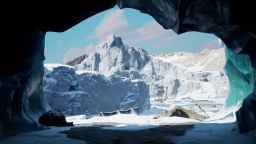
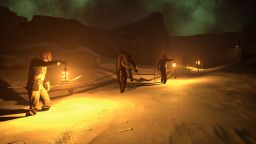
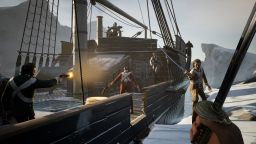


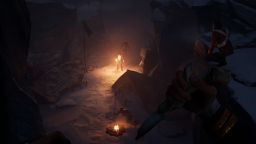
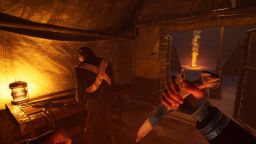
Dread Hunger takes one of multiplayer gaming’s most uncomfortable questions and drops it into the Arctic: what happens when survival depends on people you cannot fully trust? The premise is instantly strong. A crew must keep a ship moving through ice, hunger, cold, wolves, darkness, and limited supplies, while hidden traitors quietly work to sabotage the expedition. That setup gives the game a sharper identity than many social deduction titles because betrayal is not happening in a clean sci-fi corridor or a cute party-game map. It is happening while everyone is freezing, starving, and pretending that the person holding the axe is definitely on the team.
The Arctic Setting Makes Betrayal Feel Physical
Dread Hunger’s best idea is its setting. The Arctic is not just background scenery. It is part of the pressure. Cold, hunger, low visibility, hostile wildlife, and the slow movement of the ship all make the world feel dangerous before any traitor acts. Steam’s community page describes the game as a survival-and-betrayal experience where eight Explorers guide their ship through the unforgiving Arctic while two traitors call on dark powers to undermine them.
I like how the environment makes suspicion more believable. In a warm room, betrayal is mostly social. In Dread Hunger, betrayal has consequences that feel immediate. Missing food matters. A delayed repair matters. Someone wandering away matters. A crew member returning with a weak explanation matters. The cold turns every small decision into evidence.
-
The Arctic makes survival feel hostile before betrayal even begins;
-
Hunger and cold create constant practical pressure;
-
The ship gives the team a shared objective that can be quietly sabotaged;
-
The setting makes paranoia feel natural instead of forced;
The Social Deduction Works Because Everyone Has a Job
Dread Hunger is not only about voting out suspicious players. The crew has work to do. People need to gather coal, prepare food, repair problems, fight threats, navigate the environment, and keep the expedition alive. That task-based structure is important because it gives traitors room to hide behind useful behavior.
I enjoy social deduction most when deception happens through action, not only speeches. In Dread Hunger, a traitor can delay progress, mismanage supplies, lie about danger, isolate another player, or appear helpful until the timing is right. That makes trust feel unstable. Someone can do five useful things and still be waiting for the sixth moment to ruin everything.
The Two-Traitor Structure Creates Strong Psychological Pressure
The idea of two traitors among eight Explorers is one of the game’s strongest tension engines. A lone traitor can feel isolated, but two traitors create coordination, cover, and misdirection. One can act suspicious while the other gains trust. One can sabotage while the other argues innocence. One can disappear while the other explains it away.
This structure makes conversations more dangerous. If two people support the same false story, the crew may hesitate. If two people accuse a loyal player at the right time, panic can spread. Dread Hunger understands that betrayal becomes stronger when it has a partner.
-
Two traitors can coordinate lies and sabotage;
-
One traitor can distract while the other damages the mission;
-
False trust becomes more convincing when another player supports it;
-
The crew must read both behavior and relationships between players;
The Ship Gives the Match a Clear Spine
The ship is one of Dread Hunger’s smartest structural choices. Many social deduction games rely on loose task maps, but here the ship gives everyone a shared expedition fantasy. It must move forward. It needs resources. It represents progress. It also represents a fragile home base that can become unsafe very quickly.
I like how the ship creates social friction. Who is helping? Who is staying near the engine? Who brought coal? Who vanished when work needed doing? Who returns with supplies, and who returns with excuses? The ship turns teamwork into something visible, which gives suspicion something to attach to.
Survival Systems Make Lies More Expensive
Hunger, warmth, and supplies make Dread Hunger feel more demanding than a pure deduction game. A bad decision can weaken the crew even before open conflict starts. If players waste food, split up poorly, fail to gather fuel, or ignore the cold, the environment does the traitors’ work for them.
This is where the game becomes interesting as a survival title. The innocent crew cannot spend the whole match debating. They have to act. But acting creates vulnerability. Someone must go gather. Someone must carry resources. Someone must trust another player nearby. Survival systems force the team to keep moving, which gives deception room to breathe.
-
Food and warmth make survival management central to every match;
-
Resource trips create opportunities for isolation and betrayal;
-
The crew cannot solve suspicion by standing still and talking forever;
-
Environmental danger makes traitor sabotage harder to separate from normal failure;
The Dark Powers Give Traitors a Theatrical Edge
Dread Hunger is not only historical Arctic survival. The traitors use dark powers, which pushes the game into occult horror. Steam’s description specifically mentions traitors calling on dark powers to undermine the crew. This supernatural element gives betrayal more flavor than ordinary sabotage.
I think the dark powers help the game feel distinct. Without them, Dread Hunger would still have a good survival-deception setup, but the occult layer gives traitors a stronger identity. They are not merely selfish explorers. They feel like hidden agents of something unnatural, which fits the frozen, desperate atmosphere.
The Best Moments Come From Uncertainty
Dread Hunger is most exciting when nobody is completely sure what happened. Maybe someone made a mistake. Maybe someone lied. Maybe the missing supplies were used correctly. Maybe the person who found the body is the person who caused it. That uncertainty is the heart of social deception.
I like how the game creates stories that are messy rather than scripted. A match can turn on a single accusation, a badly timed absence, or a desperate decision to trust the wrong person. The best rounds are not always the cleanest. They are the ones where everyone leaves with a different version of the truth.
-
Ambiguous mistakes make accusations harder to prove;
-
Voice chat and social reading matter as much as mechanics;
-
Small choices can become major evidence later;
-
The best matches create stories players want to discuss afterward;
Team Communication Is Essential
Dread Hunger depends heavily on communication. Players need to share plans, explain movements, coordinate supplies, call out danger, and defend themselves when suspicion rises. Quiet players can become suspicious even when innocent, while confident liars can survive longer than they should.
This makes the game much stronger with a good group. Friends who enjoy roleplay, deception, and dramatic arguments can turn a match into a tense expedition story. Random groups can still work, but the experience depends heavily on voice communication, patience, and willingness to play into the social drama.
The Game Is Hard to Separate From Its Server Shutdown
Dread Hunger’s current status is impossible to ignore. The developers announced that the game would no longer be available for purchase on December 1, 2023, and that official servers would shut down on January 1, 2024. Delisted Games reported the same delisting and shutdown timeline, noting that official server support was ending and server tools were being handed over to players.
That changes how I review it now. Dread Hunger may still be worth discussing as a design, but it is not a normal live multiplayer recommendation anymore. The core idea remains strong, yet availability and official support are major issues. A multiplayer game lives through its community, servers, and ease of access. Once those become unstable or unofficial, the experience becomes harder to recommend casually.
-
The game was removed from Steam purchase availability on December 1, 2023;
-
Official servers shut down on January 1, 2024;
-
Community server tools changed the game’s long-term access situation;
-
New players should treat current playability as limited and community-dependent;
The Shutdown Makes the Game Feel Like a Cautionary Tale
Dread Hunger’s shutdown is especially sad because the concept was strong. It had a clear identity, a tense setting, and a social structure that could create excellent stories. The Steam announcement said the team had considered options to keep official servers online but faced high ongoing server costs and frequent massive DDoS attacks.
This is the difficult reality of multiplayer games. A great design is not always enough. Servers, security, moderation, player retention, regional popularity, and operating costs all matter. Dread Hunger shows how fragile online games can be when the infrastructure around them becomes too expensive or unstable.
The Atmosphere Still Deserves Credit
Even with the shutdown context, Dread Hunger deserves credit for atmosphere. The frozen setting, ship-bound objective, limited trust, and supernatural betrayal give it a mood that many social deduction games lack. It feels colder, heavier, and more dangerous than a party game built only around quick accusations.
I like that the game tries to make betrayal feel like part of a larger expedition, not just a hidden role. Players are not merely finding impostors. They are trying to survive a doomed voyage where the environment, the occult, and human suspicion all work together. That is a strong creative identity.
-
The Arctic expedition theme is more immersive than many social deduction settings;
-
The occult traitor angle adds horror flavor;
-
The ship objective gives matches clear direction;
-
The mood remains memorable even after official support ended;
The Combat and Survival Are Secondary to Social Drama
Dread Hunger includes survival and conflict mechanics, but the main reason to play was always the social drama. Fighting wolves, managing supplies, or moving the ship forward matters because those systems create suspicion. The real question is rarely only “can we survive?” It is “who is making survival harder on purpose?”
This is why the game worked best with players who enjoyed talking, lying, accusing, and improvising. If a group treated it like a pure survival game, the experience could feel clunky. If they treated it like a theatrical deception game with survival stakes, it became much more interesting.
The Learning Curve Could Be Rough
Dread Hunger was not as instantly readable as simpler social deduction games. New players had to understand survival systems, ship roles, map flow, traitor tools, resource priorities, and social expectations. That complexity made the game richer, but it also made onboarding harder.
I think this was both a strength and a weakness. Experienced groups could create amazing matches because there were many systems to manipulate. New or casual players could feel lost, especially if veterans expected perfect role knowledge. Social deception games depend on shared understanding, and Dread Hunger asked for more shared understanding than many competitors.
-
Survival mechanics gave matches more depth than simple voting games;
-
New players needed time to understand roles, resources, and traitor options;
-
Experienced groups could use the systems creatively;
-
Unbalanced knowledge between players could make matches frustrating;
The Best Audience Was Always a Dedicated Group
Dread Hunger was never ideal as a casual solo queue game for everyone. It was strongest with a dedicated group of players who understood the rules, enjoyed deception, and wanted to commit to the mood. A group willing to roleplay panic, argue convincingly, and take the survival systems seriously could get a lot from it.
This makes the current server situation even more important. If players already have access and a group that knows how to run community-hosted sessions, the game can still be interesting as a niche experience. For a new player trying to buy and jump in normally, the shutdown and delisting make that much more complicated.
The Visual Direction Supports the Harsh Mood
Dread Hunger’s visual design is not about comfort. The Arctic setting, cold light, rough ship interiors, and historical expedition flavor all support the feeling of a voyage going wrong. The world looks practical and hostile rather than glamorous.
I appreciate that the game does not use bright social deduction language. It wants the player to feel exposed. A distant figure on ice is not just another avatar. It is a possible ally, a possible threat, or someone trying to make sure nobody sees what happens next. That visual mood supports the paranoia very well.
-
The Arctic visuals make isolation feel immediate;
-
The ship interiors create cramped social pressure;
-
The historical expedition style gives the game a distinct flavor;
-
The harsh lighting and cold spaces support suspicion and fear;
The Game’s Legacy Is Stronger Than Its Current Accessibility
Dread Hunger now feels like a game with a stronger design legacy than current accessibility. It showed how social deduction could be expanded with survival systems, environmental pressure, and a heavier horror-adventure tone. That idea remains compelling, even if the official service life ended early.
I think it belongs in conversations about multiplayer games that had a great hook but a difficult lifespan. It was not just another impostor game. It had a specific atmosphere and enough mechanical ambition to stand apart. The sad part is that multiplayer ambition needs long-term support, and Dread Hunger could not maintain that official structure.
Where Dread Hunger Feels Most Effective
Dread Hunger feels most effective when the crew is close to success but trust has completely broken down. The ship needs fuel, food is low, someone is missing, a player insists they saw suspicious behavior, and nobody knows whether the accusation is truth or strategy. That is the game at its best: survival pressure turning social doubt into action.
It also succeeds when traitors play patiently. The most memorable betrayal is not always loud. Sometimes it is a delayed coal delivery, a poisoned meal, a lie about where someone went, or a quiet moment when one player realizes they followed the wrong person into the snow.
Where Dread Hunger Feels Less Strong
The biggest weakness now is availability and support. Since Dread Hunger was delisted from purchase and official servers shut down, it cannot be treated like a normal active multiplayer title. That limits its practical value for new players, even if the concept remains excellent.
The second weakness is that the game depends heavily on group quality. With a committed, talkative, deception-friendly group, it can create unforgettable matches. With silent players, confused beginners, or poor coordination, the systems can become frustrating. Dread Hunger is a brilliant idea that needs the right people around the table, even if the table is a frozen ship.
Pros
- Excellent Arctic survival premise makes social deduction feel colder, harsher, and more physical
- Two hidden traitors, ship objectives, hunger, cold, and resource pressure create strong paranoia
- Dark powers and occult elements give the betrayal system a memorable horror flavor
- The ship structure gives every match a clear shared goal that can be quietly sabotaged
- Dedicated groups can create dramatic, unpredictable stories through voice chat, lies, teamwork, and suspicion
Cons
- The game was removed from Steam purchase availability and official servers shut down, making access and playability limited
- Multiplayer quality depends heavily on having a coordinated, talkative, deception-friendly group
- The learning curve can be rough because players must understand survival systems, roles, resources, and social deduction at once
- Random groups or silent lobbies can make the game feel clunky instead of tense
- Its strongest design ideas now feel partly trapped by the game’s ended official service life