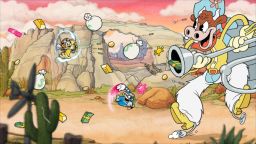
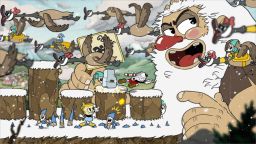
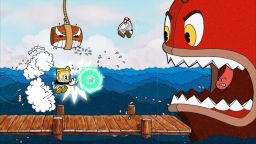
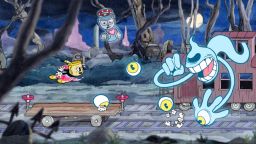
Cuphead - The Delicious Last Course feels like a dessert that was made for players who already survived the main meal and somehow asked for more pain with nicer frosting. It is colorful, musical, funny, precise, and absolutely ready to punish sloppy timing. The DLC does not try to reinvent Cuphead from the ground up. Instead, it takes the original game’s best qualities — hand-drawn cartoon animation, boss-focused action, reactive pattern learning, jazz energy, and old-school challenge — then adds a new island, new fights, new tools, and Ms. Chalice, who changes the rhythm more than she first appears to. It is short compared with a full sequel, but it feels dense, polished, and confident.
Ms. Chalice Changes the Feel of Cuphead Immediately
Ms. Chalice is the headline addition because she does more than act as a cosmetic third character. The Steam description notes that she has a modified moveset and new abilities, and can be used in both the DLC and the original Cuphead campaign after being acquired. That changes the value of the DLC because it does not only add new content. It also gives players a reason to revisit old fights with a different toolkit.
I like Ms. Chalice because she makes the game feel slightly more flexible without making it easy. Her movement changes how I approach spacing, recovery, and parries. She can feel more forgiving in some situations, but she still demands precision. Cuphead remains Cuphead. A new character does not remove the need to read patterns, dodge cleanly, and survive visual chaos.
-
Ms. Chalice brings a distinct moveset instead of acting like a simple skin;
-
Her abilities can be used across the DLC and the original game;
-
She makes some fights feel newly approachable without removing the challenge;
-
Her inclusion gives returning players a strong reason to replay older bosses;
The New Island Feels Like a Compact Showcase
The Delicious Last Course sends Cuphead, Mugman, and Ms. Chalice to a new Inkwell Isle, where the adventure connects to Chef Saltbaker and the mystery around the Legendary Chalice. Steam’s official description frames the DLC around helping Chef Saltbaker in a final challenging quest tied to Ms. Chalice. The island is not huge, but it is full of personality.
I think the compact size works in the DLC’s favor. It does not waste time. The map acts like a stage menu for highly crafted encounters, and each boss feels like a major event. There is very little filler because Cuphead’s strength has always been concentrated spectacle. The Delicious Last Course understands that the player is here for expressive fights, not a padded checklist.
The Bosses Are the Real Feast
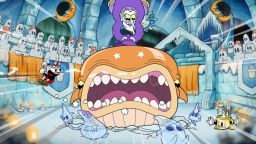
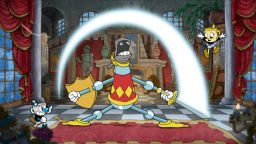
Cuphead has always been famous for boss battles, and The Delicious Last Course continues that identity aggressively. Steam describes the DLC as featuring new screen-filling, multi-faceted bosses, plus new weapons and charms to overcome brand-new challenges. That description is accurate because these fights are not small extras. They feel like Studio MDHR trying to top itself.
The best bosses in the DLC feel like animated short films that also happen to be skill tests. They transform, perform, fake out the player, change rhythm, and fill the screen with details that are beautiful and dangerous at the same time. I often found myself admiring animation right before realizing that admiration had made me stand in the wrong place. That is very Cuphead.
-
Bosses feel visually distinct rather than recycled from the main game;
-
Each encounter uses phases to build tension and surprise;
-
Screen-filling attacks create spectacle without removing pattern logic;
-
The DLC’s short length is balanced by unusually dense fight design;
The Difficulty Still Demands Patience
The Delicious Last Course is not a relaxed victory lap. It expects players to accept failure as learning. A boss may look impossible at first, then slowly become readable as patterns, tells, parry windows, safe spots, and phase transitions become familiar. This is the classic Cuphead loop: lose, understand one more thing, lose better, then finally win.
I like that the DLC keeps this identity intact. It does not apologize for being demanding. The fights can be frustrating, but they usually feel learnable. When a defeat feels fair, the game becomes motivating. When I know exactly which mistake ended the run, restarting becomes less painful because the next attempt has a purpose.
The New Weapons and Charms Matter More Than Expected
New weapons and charms give the DLC more strategic flexibility. Steam’s description specifically highlights new weapons and charms as tools for overcoming new challenges and setting new records on old bosses. That second point is important because the DLC’s additions interact with the full game, not only the new island.
I enjoy this because Cuphead loadouts are not just minor preferences. A weapon can change how safe I feel during a boss phase. A charm can change movement, survivability, or aggression. Choosing the right setup becomes part of learning the fight. Sometimes the solution is not only better reflexes. It is bringing a tool that fits the pattern better.
-
New weapons help players approach boss phases from different ranges and angles;
-
Charms create meaningful trade-offs around mobility, survival, and style;
-
Loadout choices make repeated attempts feel less static;
-
The DLC tools add replay value to the original Cuphead campaign;
The Animation Is Still the Main Miracle
Cuphead’s identity depends on its 1930s cartoon inspiration, hand-drawn cel animation style, watercolor backgrounds, and jazz recordings. Steam’s base game page describes those production inspirations clearly, and The Delicious Last Course continues that same visual and audio language. The result remains one of the most immediately recognizable looks in modern games.
What impresses me most is not only that the DLC looks beautiful. It is that the animation communicates gameplay. Boss expressions, body motion, object movement, and exaggerated transformations often work as attack warnings. The art is not only decoration. It is part of the control language. That makes the game feel theatrical and readable at the same time.
The Jazz Soundtrack Gives Every Fight a Pulse
Cuphead would not be the same without its music. The jazz energy gives each boss a performance quality, as if the fight is happening on a stage with a live band daring the player to keep up. The Delicious Last Course continues that energy with music that feels lively, chaotic, and perfectly matched to the animation.
I like how the soundtrack keeps tension playful. The game can be brutally hard, but the music makes failure feel like part of a show. Instead of gloomy punishment, the atmosphere is theatrical. A boss defeats me, the music keeps dancing, and the game seems to say: again, from the top.
-
Jazz rhythms make boss fights feel energetic and theatrical;
-
The music supports the 1930s cartoon atmosphere;
-
Audio cues help the action feel lively rather than cold;
-
The soundtrack makes repeated attempts easier to tolerate;
The DLC Is Short, but It Does Not Feel Thin
The Delicious Last Course is clearly an expansion, not a full new game. Steam lists it as DLC that requires the base Cuphead game on Steam in order to play. That distinction matters because players should not expect a campaign as large as the original. This is a concentrated addition.
Still, I do not think the DLC feels thin. The fights are elaborate, Ms. Chalice changes replay value, and the new tools affect old content. The package feels like quality over volume. If a player measures value only by hours, they may wish for more. If they measure it by craft density, The Delicious Last Course feels rich.
Chef Saltbaker Gives the Story a Stronger Center
Cuphead is mostly remembered for bosses and style, but The Delicious Last Course gives the DLC a clean narrative hook through Chef Saltbaker and the mystery of Ms. Chalice. The story remains simple, but it gives the island a reason to exist beyond “more bosses.”
I appreciate that the plot does not overtake the game. Cuphead works best when story behaves like old cartoon framing: enough setup to create personality, then quickly into visual comedy and danger. Chef Saltbaker fits that rhythm. He feels like part of the world without slowing down the action.
The King’s Leap Adds a Clever Parry-Focused Twist
One of the DLC’s smartest additions is the set of parry-focused challenges often associated with the King’s Leap. These encounters shift the usual combat rhythm because they emphasize parrying instead of standard shooting. That makes them feel like little mechanical tests inside the larger expansion.
I like these challenges because they force me to respect a skill that can sometimes become secondary during normal boss fights. Parrying in Cuphead is not only a bonus trick. It is part of the game’s design vocabulary. When a challenge focuses on it directly, the player learns timing, patience, and positioning in a cleaner way.
-
Parry-focused encounters give the DLC variety beyond normal boss fights;
-
They teach timing without relying on standard weapon damage;
-
The challenges create a nice break from screen-filling boss chaos;
-
They make the parry mechanic feel central rather than optional;
The DLC Rewards Players Who Already Love Cuphead
The Delicious Last Course is not designed to convert players who disliked the original. It is for people who enjoy Cuphead’s exact mixture of style, punishment, pattern learning, and audiovisual excess. If the base game’s difficulty felt exhausting, the DLC will probably not change that reaction.
For existing fans, though, this is exactly the kind of expansion that makes sense. It respects the original game’s identity while adding enough new material to feel meaningful. Ms. Chalice, weapons, charms, bosses, and the new island all expand the game without diluting what made it special.
The Boss Design Is More Confident Than Ever
The DLC’s boss design feels like a team that already knows its own language. The phases are bold, the animations are dense, and the visual ideas are often more elaborate than expected from an expansion. The fights do not feel like leftover concepts. They feel like premium Cuphead encounters.
I also like how the bosses often mix comedy with threat. A boss can look absurd and still be dangerous. That is one of Cuphead’s greatest strengths. The game makes me laugh at a character’s design, then immediately demands complete focus because that same character has filled the screen with attacks.
-
Boss phases are theatrical and visually memorable;
-
Comedy and danger are blended into the same encounter design;
-
Animations often act as both spectacle and attack telegraphing;
-
The DLC feels carefully built rather than assembled from spare ideas;
The Challenge Can Be Tiring in Long Sessions
Cuphead’s difficulty is satisfying when I am patient. It becomes exhausting when I keep forcing attempts after my focus is gone. The Delicious Last Course has the same issue. Boss fights reward precision, and precision fades when frustration rises.
I think the best way to play is in focused sessions rather than marathon grinding. A few attempts can teach patterns. Too many angry attempts can make the same boss feel worse than it is. The game is hard, but it is also rhythm-based. If my rhythm is gone, the smart move is to stop and return later.
The Visual Detail Can Sometimes Compete With Readability
The Delicious Last Course is gorgeous, but that beauty can occasionally make the screen feel busy. Cuphead’s style depends on dense animation, exaggerated motion, and lively backgrounds. Most of the time, the game keeps hazards readable. Occasionally, the spectacle can make it harder to process everything at once.
This is a trade-off I mostly accept because the visual excess is part of the identity. Cuphead is supposed to feel like a cartoon gone wild. Still, players who prefer clean minimalist action games may find the presentation visually demanding, especially during later phases where many things move at once.
-
The dense animation creates unmatched personality;
-
Most attack patterns remain readable after practice;
-
Some phases can feel visually overwhelming at first;
-
The spectacle is part of the charm, but it asks for concentration;
The Expansion Adds Replay Value to the Original Game
One of the smartest things about The Delicious Last Course is that its additions do not stay locked inside the DLC island. Ms. Chalice can be used in the original Cuphead after being acquired, and the new weapons and charms can help players set records or approach old bosses differently. That makes the DLC feel connected to the whole game.
I like expansions that change how older content feels. Returning to original bosses with Ms. Chalice or a different setup can make familiar fights feel fresh. It also helps justify the DLC beyond its new boss count. The Delicious Last Course gives Cuphead more life as a complete package.
The Platform Availability Is Strong for Existing Fans
Studio MDHR announced that The Delicious Last Course launched on all platforms on June 30, 2022, and the Steam page confirms the same release date for the PC version. This broad release helped the DLC reach players who already owned Cuphead across major platforms.
That matters because Cuphead’s audience is not tied to one device. The game has long lived across PC and consoles, and the DLC’s availability made it feel like a proper global return rather than a limited add-on. For fans who waited years, that launch felt like the missing final piece of the original game’s era.
The DLC’s Success Shows How Much Fans Wanted More Cuphead
Studio MDHR later announced that The Delicious Last Course had passed two million copies sold, a milestone reported by GameDeveloper as “double platinum.” That success is not surprising. Cuphead built a strong identity, and the DLC delivered more of that identity with enough refinement to justify the wait.
I think the sales milestone reflects something important: players did not just want more content. They wanted more of this specific craft. More hand-drawn boss chaos. More jazz. More unfair-looking but learnable attacks. More expressive animation. The Delicious Last Course understood that demand clearly.
The Best Audience Is Already Prepared for Failure
The Delicious Last Course is best for players who enjoy learning through defeat. This is not a DLC for someone who wants easy sightseeing. It is for players who can lose repeatedly and still appreciate that each attempt teaches a small lesson. That mindset makes the difference between joy and frustration.
It is also ideal for fans of animation as much as action. Many games are fun to play but ordinary to watch. Cuphead is different. Even when I am losing, the fights are visually interesting. The DLC continues that rare quality where challenge, style, and performance all support each other.
Where Cuphead - The Delicious Last Course Feels Most Effective
The DLC feels most effective when a boss fight moves from impossible chaos to readable music. At first, I see too much. Then I learn one tell, then another, then another. Eventually, the fight becomes a dance of dodges, parries, shots, and tiny survival decisions. That transformation is the core pleasure of Cuphead.
It also succeeds because it adds meaningful variety without betraying the original. Ms. Chalice changes movement. New weapons and charms change loadouts. New bosses raise the spectacle. The island gives the expansion personality. The Delicious Last Course feels like a final polished plate rather than a reheated leftover.
Where Cuphead - The Delicious Last Course Feels Less Strong
The main limitation is size. The DLC is dense and polished, but players expecting a full sequel-scale campaign may finish it faster than they want. Its value comes from boss quality, replay attempts, and new tools, not from a huge amount of map content.
The second limitation is the same as Cuphead’s original challenge: it can be frustrating. Players who dislike repeated failure, precise dodging, or pattern learning may not enjoy the expansion. Ms. Chalice helps adjust the feel, but she does not turn Cuphead into a relaxed platform adventure.
Pros
- Ms. Chalice adds a meaningful new moveset and can refresh both DLC and original Cuphead fights
- New bosses are visually spectacular, mechanically demanding, and packed with personality
- Hand-drawn animation, watercolor-style backgrounds, and jazz energy remain exceptional
- New weapons, charms, and parry-focused challenges add variety and replay value
- The DLC feels dense, polished, and carefully connected to the full Cuphead experience
Cons
- The expansion is compact, so players expecting a full sequel-sized campaign may want more content
- Difficulty remains high and can frustrate players who dislike repeated boss attempts
- Some visually dense phases can feel overwhelming before patterns become familiar
- The DLC requires the base Cuphead game, so it is not a standalone entry point
- Players who did not enjoy the original game’s boss-focused structure are unlikely to be converted