




Crossy Road is built from a question so silly that it became the entire game: how far can the chicken go before traffic, rivers, trains, or one bad decision ends the run? That simplicity is the reason it still works. There is no complicated story to remember, no giant tutorial to survive, and no long commitment before the fun begins. I tap, hop forward, dodge danger, collect coins, unlock characters, and try to beat my last distance. Crossy Road feels like classic arcade design squeezed into a modern mobile rhythm. It is quick, funny, unfair in small ways, generous in small ways, and always ready to tempt one more attempt.
The Core Loop Is Almost Perfectly Simple
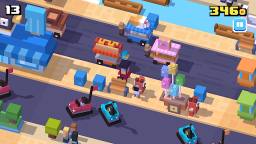
Crossy Road works because the basic action is instantly clear. Tap to move forward, swipe to move sideways or backward, and keep crossing as the world throws roads, rivers, railroads, logs, cars, trucks, trains, and gaps in the way. Google Play calls it the 8-bit endless arcade hopper that started it all, with freeways, railroads, rivers, and much more to navigate.
That description sounds basic, but the design is sharp. Every hop is a small risk. Moving forward increases the score, but rushing creates mistakes. Waiting too long can also become dangerous because the game pushes the player to keep moving. Crossy Road understands that a great arcade game does not need many buttons. It needs one clear action with endless consequences.
-
Tap controls make the game easy to learn in seconds;
-
Roads, rivers, and train tracks create readable hazards;
-
Every hop increases tension because stopping is never fully safe;
-
The endless format keeps the goal simple: go farther than last time;
The Traffic Turns Timing Into Comedy
Traffic is the first thing that gives Crossy Road its personality. Cars and trucks move in predictable lanes, but the pressure of timing makes them feel chaotic. A safe gap can disappear quickly. A rushed hop can put the character directly in front of a vehicle. A moment of hesitation can ruin a perfect line.
I like how funny failure feels. Getting flattened by a car is frustrating for half a second, then amusing. The game rarely feels cruel because the mistake is usually obvious. I moved too soon. I waited too long. I misread the lane. Crossy Road makes failure quick enough that it becomes part of the joke instead of a reason to quit.
Rivers and Logs Change the Rhythm
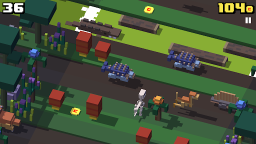
Rivers are important because they break the traffic pattern. Instead of waiting for moving vehicles to pass, I need to use logs, lily pads, or other floating objects to cross safely. The movement feels different. Roads ask me to avoid motion. Rivers ask me to ride it.
This contrast keeps the game from feeling too flat. A run can move from slow traffic timing to fast river hopping to railroad panic in just a few seconds. The controls stay the same, but the meaning of each move changes. That is one of Crossy Road’s smartest strengths: it creates variety without complicating the input.
-
Roads reward patience and lane reading;
-
Rivers reward quick positioning and movement timing;
-
Railroads create sudden high-pressure moments;
-
Changing hazard types keep short runs from feeling identical;
Trains Make the World Feel Dangerous in an Instant
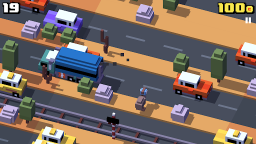
Train tracks are one of Crossy Road’s best hazards because they create immediate drama. The warning comes quickly, the sound is urgent, and the punishment is clear. A train does not politely slow down because the chicken is nervous. It arrives, fills the screen, and ends careless runs without discussion.
I think the trains work so well because they interrupt the player’s comfort. Roads can sometimes be studied. Rivers can be managed. Trains demand respect. They also make the world feel more alive, as if the game is not waiting for the player but continuing with or without them.
The Eagle Prevents Overthinking
Crossy Road would be a much easier game if players could stand still forever and plan every move. The eagle prevents that. Wait too long, and the game punishes hesitation. TechRadar described this pressure as part of the design that forces players to keep moving instead of treating the game like a relaxed puzzle.
I like this because it creates urgency without adding a visible timer to every second. The eagle is a reminder that Crossy Road is an arcade game, not a chessboard. I can think, but not forever. The best runs happen when planning and instinct work together.
The Character Collection Gives the Game Its Long-Term Hook
The collection system is a huge part of Crossy Road’s appeal. Google Play and App Store both mention unlocking and collecting more than 300 characters in the game’s distinctive retro style. These characters give players a reason to keep earning coins and returning to the prize machine.
I like that characters are mostly about personality rather than raw advantage. A new character changes the mood, sounds, environment, or visual joke more than it changes the core challenge. That keeps the game from feeling aggressively pay-to-win. The chicken can still go far. The silly unlocks just make the journey more entertaining.
-
More than 300 characters give players a large collection goal;
-
Different characters add visual humor and variety;
-
The prize-machine style makes unlocks feel playful;
-
Most characters preserve the same simple skill-based structure;
Some Characters Change the Whole Mood
One of the cleverest things about Crossy Road is that character unlocks can do more than swap the model. TechRadar noted that certain characters can change the world around them, such as a penguin turning the setting into a snowy tundra or a spooky character shifting the atmosphere into a darker mode.
This matters because the core game is repetitive by design. If every character only looked different, the collection would lose charm faster. When a character changes the environment, sound, or tone, the game feels refreshed without needing a new mode. It is a simple trick, but it makes unlocking feel more meaningful.
The Retro Visual Style Is Clear and Charming
Crossy Road’s voxel-style look is one of its most recognizable features. The world is blocky, colorful, readable, and cute without becoming visually messy. The retro style helps every hazard stand out clearly. Cars, rivers, logs, trains, grass, coins, and characters all communicate quickly.
I think the visual style is one reason the game aged well. It never tried to look realistic, so it does not feel visually outdated in the same way many older mobile games do. The chunky design is part of the identity. It looks like a toy version of arcade danger, which fits the tone perfectly.
-
Blocky visuals make hazards easy to read quickly;
-
Bright colors keep the game friendly despite constant failure;
-
Retro style gives Crossy Road a timeless arcade identity;
-
Character designs are simple enough to be funny at a glance;
The Sound Design Makes Failure Fun
Crossy Road’s sound design helps sell the comedy. The hops, splashes, vehicle noises, train warnings, coin pickups, and character sounds make every run feel lively. The audio is not complex, but it is memorable. It gives the game a toy-like energy.
I especially like how sound supports reaction speed. A train warning matters. A splash confirms a mistake. A sudden impact becomes part of the joke. The audio cues keep the player connected to danger even when the screen is busy. Good arcade sound should be useful and funny, and Crossy Road understands both sides.
The Game Is Best in Short Sessions
Crossy Road is almost perfectly suited to short mobile sessions. A run can last a few seconds or several minutes. That makes it easy to play during a break, while waiting, or when I want a game that does not ask for emotional commitment. Time Magazine described the game’s appeal as something that can work whether played for two minutes or much longer.
This short-session structure is one of the reasons the game became so sticky. A bad run does not feel like wasted time. A good run feels like a story. The next attempt is always nearby, and the cost of starting again is almost nothing. That is dangerous for productivity, but excellent for mobile design.
-
Runs are short enough for quick breaks;
-
Instant restarts make failure feel less frustrating;
-
High-score chasing creates natural replay value;
-
The game works well without long setup or tutorials;
High Scores Give Every Run a Clear Purpose
Crossy Road does not need levels because distance is the level. The goal is always to go farther. That clarity is powerful. I do not need to ask what the mission is. I need to beat myself, beat a friend, or unlock something new. The game turns distance into pride.
I like how high scores create personal drama. A run that starts badly can suddenly become a record attempt. A great run can collapse because of one rushed hop. The score at the top of the screen quietly turns every move into pressure. The player is always only one mistake away from ending the best run of the day.
The Free-to-Play Model Is Visible but Usually Bearable
Crossy Road includes ads and in-app purchases on Google Play, and the developer listing shows the game as containing ads and in-app purchases. Time’s early review also described the game as freemium, with coins available through watching ads or purchases, while noting that the characters add variety without being necessary to enjoy the core game.
I think that is a fair way to view the monetization. Crossy Road wants players to unlock characters and engage with rewards, but the main game remains skill-based and playable without buying a path forward. Ads can still be annoying, especially if a player is sensitive to interruption, but the model feels less aggressive than many modern mobile games built around energy systems or heavy progression walls.
-
The game is free to start;
-
Coins and character unlocks create optional collection goals;
-
Ads can interrupt the flow for some players;
-
The core gameplay does not depend on buying stronger characters;
The Prize Machine Turns Rewards Into a Tiny Ritual
The prize machine is a small but important part of the experience. Collecting enough coins to unlock a new character gives players a goal beyond the next high score. It also turns randomness into a reward moment. I may not know what character is coming, but I know the reveal will probably be funny.
This system works because Crossy Road’s characters are playful. A new animal, creature, mascot, or strange unlock can make the next few runs feel fresh. The prize machine is not deep, but it gives the game a toy-collecting layer that fits the visual style beautifully.
Same-Device Multiplayer Adds a Party-Game Angle
Crossy Road also has same-device multiplayer in some versions, allowing friends and family to compete on one device, and it has supported Android TV play. APKMirror’s mirrored listing describes same-device multiplayer and big-screen Android TV support, while Hipster Whale’s support page references running Crossy Road on Android TV.
I like the idea because Crossy Road is funny to watch. A friend failing at the same traffic lane that just defeated me creates instant comedy. The game’s controls are simple enough that almost anyone can join, and the short runs make it friendly for casual local competition.
-
Simple controls make local competition easy to understand;
-
Short runs keep multiplayer rounds moving quickly;
-
Watching someone fail can be as funny as playing;
-
Big-screen support makes the arcade style feel more social;
The Game Has Clear Arcade DNA
Crossy Road feels like a modern answer to classic arcade crossing games. It takes the basic idea of moving through danger one step at a time and updates it for touchscreens, quick sessions, collectibles, and mobile reward systems. TechRadar directly connects its appeal to Frogger-like nostalgia while explaining how Crossy Road adapts that structure through modern mobile controls and rewards.
I think this arcade DNA is why the game remains easy to recommend. It does not need a complicated explanation because the concept is familiar even to players who have never played it before. Cross the road. Avoid danger. Beat your score. That is a complete game idea, and Crossy Road executes it with confidence.
The Difficulty Feels Fair Until Panic Takes Over
Crossy Road is not easy, but it usually feels fair. The hazards are visible, the controls are responsive, and most failures come from bad timing or impatience. That fairness is important because the game depends on quick restarts. If deaths felt random too often, the loop would become frustrating.
Still, panic is always nearby. A fast lane, a moving log, a railroad warning, and the pressure to keep moving can all stack into a messy moment. I like that the game creates panic from simple ingredients. It does not need complicated enemies. It only needs traffic, water, timing, and my own poor judgment.
The Humor Keeps the Repetition Fresh
Crossy Road is repetitive by design, but humor softens the repetition. The character names, sounds, strange unlocks, and little environmental jokes give the game a playful personality. Google Play’s own description leans into the joke with questions like why the chicken crossed the road, why the pigeon left something behind, and why Unihorse ate all that candy.
That silliness matters. Without humor, Crossy Road would still be a good arcade game, but it might feel colder. The jokes make the world more charming and make failure feel less serious. A game where I fail constantly needs to make failure feel funny, and Crossy Road does that well.
-
Funny character designs make unlocks more memorable;
-
Silly sounds turn short runs into little comedy moments;
-
Environmental changes keep repeated attempts feeling lighter;
-
The game’s humor makes failure easier to accept;
The Age Rating and Accessibility Fit a Broad Audience
Crossy Road is listed with an Everyone content rating on Google Play, and the developer page shows it as a widely downloaded arcade title with 100M+ downloads. That broad accessibility fits the design. The game is easy enough for casual players but tense enough for score chasers.
I think Crossy Road is especially strong as a family-friendly mobile game because it is simple, funny, and not built around complex violence or heavy narrative. The main caution is still ads, purchases, and screen-time management, but the core content is approachable.
The Game’s Longevity Comes From Discipline
Crossy Road has lasted because it knows what not to add. It could have become overloaded with complicated modes, heavy progression, or too many systems fighting for attention. Instead, the core remains focused: hop forward, avoid hazards, collect characters, chase scores.
That restraint is important. Many mobile games become noisy over time. Crossy Road can still feel fresh because the main loop is so clean. The collection library may grow, events may appear, and versions may differ, but the reason to play remains the same. One more run. One more hop. One more silly failure.
Where Crossy Road Feels Most Effective
Crossy Road feels most effective when a run starts casually and suddenly becomes a personal record attempt. The first few hops feel easy. Then the roads get busier, the rivers get trickier, the train warning sounds, and every move feels like it could end the run. That slow rise from playful to stressful is the game’s best rhythm.
The game also succeeds because it makes mobile arcade play feel pure. The controls are simple, the goal is clear, the failures are fast, and the rewards are charming. It is a game that can entertain in tiny slices, which is exactly what many phone games try to do and fail to accomplish with far more systems.
Where Crossy Road Feels Less Strong
The biggest weakness is repetition. The game adds characters, visual changes, and reward systems, but the main action remains crossing roads, rivers, and tracks forever. Players who need structured levels, story progress, or deep mechanical variety may lose interest after the novelty fades.
The second weakness is the free-to-play layer. Ads and optional purchases are not unusual for mobile games, and Crossy Road’s core remains playable without spending, but interruptions can still affect the rhythm. The game is best when the arcade flow stays clean and quick.
Pros
- Simple tap-and-swipe controls make Crossy Road instantly understandable for almost any player
- Roads, rivers, trains, logs, traffic, and the eagle create clear arcade pressure with very few rules
- More than 300 collectible characters add humor, variety, and long-term replay motivation
- Retro voxel visuals, funny sounds, and quick failures make the game charming rather than frustrating
- Short endless runs fit mobile play perfectly and make high-score chasing easy to return to
Cons
- The core gameplay can become repetitive because every run is built around the same crossing loop
- Ads and in-app purchases may interrupt the clean arcade rhythm for some players
- Players looking for story, levels, or deep progression may find the endless format too simple
- Random character unlocks can feel slow if a player wants a specific character quickly
- The “one more run” design can make short sessions stretch longer than intended