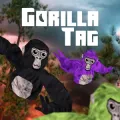
Gorilla Tag feels like one of those games that looks almost too simple until I actually start moving. On the surface, it is just a group of gorilla-like players running, climbing, chasing, and escaping through compact VR maps. But after a few minutes, I realized the real magic is not in complicated mechanics or cinematic presentation. It is in the physical feeling of pushing myself forward with my arms, learning momentum, bouncing off surfaces, and discovering that movement itself can be the main attraction.
What makes Gorilla Tag memorable for me is how completely it commits to its strange idea. I do not walk with thumbsticks in the usual way. I use arm movement to launch, turn, climb, and scramble through the environment. That makes the game feel more physical than many VR experiences. Every chase feels personal because my own timing, reach, rhythm, and coordination shape what happens. When I escape a tag by grabbing the right surface and swinging around a corner, it feels earned in a way that traditional button-based movement rarely does.
A Simple Visual Style That Serves the Movement
Gorilla Tag does not try to overwhelm me with realistic graphics. Its visual style is clean, blocky, colorful, and intentionally lightweight. At first, that simplicity may seem basic, but it quickly makes sense. The game needs to run smoothly, keep maps readable, and make movement feel immediate. Fancy visual clutter would only get in the way.
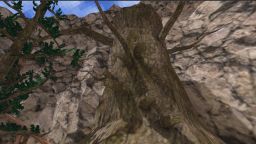
I actually like the stripped-down look because it keeps my attention on motion. Trees, walls, platforms, ramps, caves, and open spaces are easy to understand at a glance. When I am moving quickly, I need to know where I can push, climb, jump, and land. Gorilla Tag’s art direction supports that perfectly.
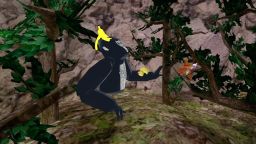
The environments have a playground-like quality. They feel less like realistic places and more like obstacle spaces built for chasing. Forest areas, indoor zones, caves, city-like spaces, and seasonal changes give the game enough variety without distracting from the core idea. Every map is basically asking the same question: how well can I move through this space?
The Main Characters Are Silly, Expressive, and Instantly Recognizable
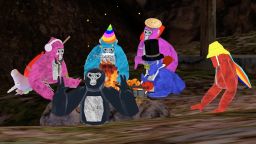
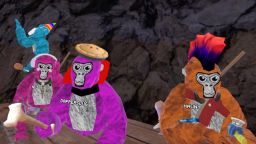
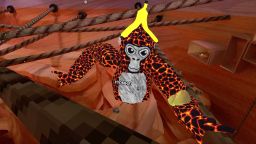
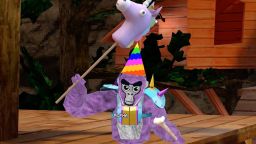
The gorilla characters are simple, but they work extremely well in VR. They have no legs, long arms, rounded bodies, and a funny physical presence that makes every player look slightly ridiculous. That is part of the charm. Even skilled players still look like energetic cartoon creatures flinging themselves across walls and trees.
I like how the character design matches the control system. Since movement comes from the arms, the gorilla body makes sense. The lack of legs is not just a visual joke. It explains the whole style of motion. I am not pretending to be a normal human running through a VR world. I am playing as a creature built for climbing, pushing, and swinging.
Cosmetics add personality without changing the basic silhouette. Hats, glasses, badges, and other accessories let players stand out, but the core gorilla shape remains readable. That matters during fast games because I can quickly recognize who is near me, who might be chasing, and where the action is happening.
Arm-Based Movement Is the Real Star
The movement system is the reason Gorilla Tag works. Instead of pressing a stick to run, I push against surfaces with my virtual hands. The harder and more accurately I move, the better I travel. It feels awkward at first, almost like learning a new sport, but that learning curve becomes the game’s biggest reward.
I enjoyed how physical the controls feel. To move well, I have to think about angles, timing, surface contact, and momentum. A sloppy push sends me in the wrong direction. A clean push launches me forward smoothly. Climbing a wall is not just holding a button. It requires rhythm and coordination.
This makes improvement extremely visible. In my first sessions, I felt clumsy and slow. After more practice, I started moving with intention. I could climb faster, turn more sharply, and recover from bad landings. Gorilla Tag gives me that satisfying feeling of getting better through body memory rather than menu upgrades.
Chasing and Escaping Create Natural Tension
The tag format is simple, but it creates excellent tension. When I am being chased, every movement matters. A wrong push, a missed wall contact, or a bad landing can give someone enough time to reach me. When I am chasing, I have to predict routes, cut off escapes, and use the map more intelligently than simply following behind.
I like that the game turns basic playground rules into something exciting in VR. Tag is easy to understand, so I do not need a long explanation before playing. The depth comes from movement skill and map knowledge. Better players know shortcuts, climbing lines, wall routes, and escape paths that make them look almost impossible to catch.
The best moments happen when the chase becomes a flowing sequence. I launch from a tree, slap a wall, change direction, hear someone close behind me, and barely escape by reaching a higher platform. Even without weapons, scores, or complex objectives, those moments feel intense because they are built from pure movement pressure.
The Social Energy Is Loud, Chaotic, and Often Funny
Gorilla Tag is not only a movement game. It is also a social VR space, and that part can be just as important. The lobbies often feel like a strange playground full of shouting, laughing, teaching, teasing, and spontaneous chaos. Sometimes the game feels less like a polished sports arena and more like recess inside a virtual jungle gym.
I enjoy the unpredictability of meeting other players. Someone might explain a climbing technique, start a silly conversation, challenge others to a chase, or turn a normal lobby into a comedy scene. The game’s simple structure leaves a lot of room for player behavior to shape the experience.
That social side can also be messy. Public lobbies vary a lot depending on who is there. Some are friendly and energetic, while others can become noisy or irritating. Gorilla Tag is at its best when the lobby has playful energy and players respect the shared space. When that happens, the game feels alive in a way scripted multiplayer rarely can.
Maps Feel Like Skill Courses Disguised as Playgrounds
The maps in Gorilla Tag are designed around movement lines. Trees, walls, ramps, platforms, tunnels, and open areas are not just scenery. They are tools. Each surface gives me a different opportunity to climb, redirect, hide, chase, or escape.
I like how map knowledge becomes a real skill. A beginner may see a wall as an obstacle. An experienced player sees it as a route. A tall tree might look decorative at first, but later it becomes part of a fast escape path. Learning the environment changes the way I move through it.
The maps also encourage experimentation. I often find myself trying a jump or climb just to see whether it is possible. Even outside active chases, moving around can be fun. That is a strong sign of good VR design: the basic act of navigating the world feels entertaining on its own.
Physical Effort Makes Victories Feel Different
Gorilla Tag can be surprisingly tiring. Because movement depends on arm motion, I feel the game in my body much more than I expected. A long session can leave my arms working hard, especially if I am climbing, escaping, and chasing with full energy.
I actually see that as part of the appeal. The game gives victories a physical quality. Escaping someone does not feel like I simply pressed the right buttons. It feels like I moved well, reacted quickly, and used my own coordination. That makes successful plays feel more personal.
Of course, the physical nature also means the game may not suit every mood. It is not the kind of VR experience I always want when I feel tired. It asks for space, movement, and attention to surroundings. But when I am ready for an active session, Gorilla Tag delivers an energy that few VR games match.
Skill Growth Comes From Practice, Not Upgrades
One of the things I respect about Gorilla Tag is that improvement is mostly mechanical. I do not become better because the game gives me stronger gear. I become better because I learn how to move. That makes the skill curve feel clean and honest.
There is a strong difference between new and experienced players. A skilled player can climb faster, wall-run more smoothly, and move through maps with almost no wasted motion. Watching someone experienced can be intimidating, but it also shows what is possible. The game constantly gives me visible goals to chase.
This practice-based growth makes every session useful. Even when I lose, I usually learn something. Maybe I discover a better route, improve my timing, or realize why a certain wall push failed. The game rewards repetition because repetition builds real coordination.
Sound and Presence Make the Space Feel Alive
The audio in Gorilla Tag is simple but important. Player voices, movement sounds, environmental effects, and the sudden noise of someone approaching all add to the tension. In VR, hearing another player nearby can create immediate pressure because distance feels more personal.
I like how voice chat turns every chase into a social moment. Someone laughing behind me while I scramble up a wall makes the escape funnier and more intense. A quiet lobby feels completely different from a loud one, which shows how much the players shape the atmosphere.
The sound design does not need to be cinematic. It needs to support presence, and it does. I feel aware of the space around me, especially when I hear movement or voices coming from a direction I was not watching. That awareness makes the game feel more immersive despite its simple graphics.
Pros
- Simple tag rules make the game easy to understand quickly
- High skill ceiling rewards practice and body coordination
- Clean visual style keeps maps readable during fast movement
- Social VR energy creates funny and memorable moments
- Maps work well as climbing routes and movement playgrounds
- No complex gear systems are needed for improvement
- Great choice for active VR sessions with friends or public lobbies
Cons
- Simple graphics may not appeal to players seeking visual realism
- The core gameplay can feel repetitive for players who dislike tag-style modes
- Motion-heavy VR may be uncomfortable for some players