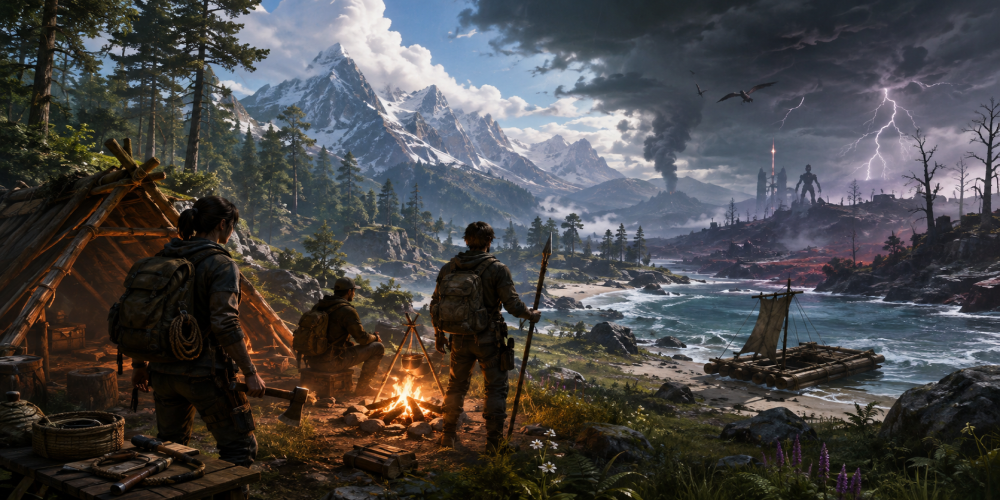
Survival games can be relaxing, stressful, creative, lonely, cooperative, or all of those things during the same evening. One moment you are calmly organizing supplies inside a wooden shelter. Ten minutes later, the weather changes, food runs out, and something unpleasant begins making noises outside the door.
The genre is also far more varied than it first appears. Some survival games focus on realistic resource management, while others mix crafting with fantasy, science fiction, horror, or large-scale exploration. A few are designed to welcome new players gradually, while others expect you to learn through failure.
This ranking includes accessible survival games for beginners as well as deeper and more demanding experiences for veteran players. Each title offers a different balance of crafting, exploration, construction, combat, and long-term progression.
15. Raft
Raft begins with a tiny floating platform surrounded by an enormous ocean. Armed with a hook, players collect drifting materials and slowly transform their fragile starting area into a functional home.
The basic loop is easy to understand. Wood, plastic, and other resources float nearby, while islands provide additional materials, food, and clues connected to the story. The raft gradually gains storage, cooking stations, farming areas, engines, and multiple floors.
Raft is particularly enjoyable in cooperative play because responsibilities develop naturally. One player can gather resources while another expands the structure or prepares food.
Why It Works for Beginners
The central goals are clear, and progression is easy to see. Every collected object contributes to a larger and more capable raft, creating a satisfying sense of improvement.
Pros
- Simple and rewarding crafting loop;
- Excellent cooperative experience;
- Visible base progression;
- Relaxing exploration between dangerous moments;
Cons
- Resource collection can become repetitive;
- Solo play may feel slower;
14. Astroneer
Astroneer offers a gentler interpretation of survival. Players explore colorful planets, gather unusual resources, build research stations, and create increasingly complex networks of machines.
Oxygen management is the most immediate concern. Tethers connect the player to a supply source, creating visible paths across the landscape and encouraging careful exploration.
There is no traditional hunger system, which makes Astroneer less punishing than many survival games. Its challenge comes from planning routes, managing equipment, and learning how different resources support technological growth.
Why It Works for Beginners
The game provides survival pressure without constantly punishing small mistakes. Its bright presentation and flexible construction systems also make experimentation feel inviting.
Pros
- Accessible survival mechanics;
- Creative terrain manipulation;
- Strong cooperative play;
- Several planets to explore;
Cons
- Objectives can feel unclear;
- Inventory management requires patience;
13. Grounded
Grounded reduces its characters to insect size and places them inside an ordinary backyard that suddenly feels enormous. Grass becomes a forest, puddles resemble lakes, and harmless household objects become major landmarks.
The game combines base building, crafting, exploration, and story progression. Players create armor from natural materials, construct shelters from grass and stems, and learn how different insects behave.
Grounded includes adjustable difficulty settings and accessibility options, making it suitable for players who want to reduce the intensity of certain creatures.
Why It Works for Different Skill Levels
Beginners can focus on exploration and construction, while experienced players can pursue stronger equipment, difficult encounters, and more ambitious bases.
Pros
- Creative setting;
- Flexible difficulty options;
- Detailed base-building system;
- Fun solo or with friends;
Cons
- Some creatures may be uncomfortable for certain players;
- Early resource gathering can feel slow;
12. Minecraft
Minecraft remains one of the best introductions to survival games because its systems are easy to understand but deep enough to support years of experimentation.
Players gather materials, craft tools, create shelter, grow food, explore underground areas, and improve their equipment. The first night provides a simple objective: find safety before dangerous creatures appear.
After that, the world becomes almost completely open-ended. Players can build villages, create automated farms, explore distant regions, or focus on major progression milestones.
Why It Works for Beginners
Difficulty can be adjusted at any time, and Creative Mode allows players to learn construction without resource pressure. Survival Mode introduces its mechanics gradually through clear materials and recipes.
Pros
- Extremely flexible gameplay;
- Suitable for many ages;
- Excellent multiplayer support;
- Almost unlimited building possibilities;
Cons
- Limited narrative direction;
- New players may need guidance for advanced systems;
11. Subnautica
Subnautica places the player on an ocean-covered alien planet after a spacecraft disaster. Survival begins with collecting food, water, and basic materials near a small escape pod.
Exploration gradually moves into deeper and more dangerous environments. Better equipment allows access to caves, wreckage, unusual ecosystems, and hidden facilities.
The game creates tension without relying on constant combat. Darkness, limited oxygen, unfamiliar sounds, and enormous underwater spaces make every descent feel significant.
Why It Works for Beginners
Subnautica introduces new areas in stages. Players can remain near safer regions until they feel ready to travel farther, while different modes reduce or remove certain survival needs.
Pros
- Memorable underwater world;
- Strong environmental storytelling;
- Rewarding technological progression;
- Excellent atmosphere;
Cons
- Deep water can feel intimidating;
- Resource searches occasionally interrupt progress;
10. The Long Dark
The Long Dark focuses on quiet, realistic survival in a frozen wilderness. There are no fantasy creatures or elaborate machines. The main dangers are cold temperatures, hunger, exhaustion, wildlife, and poor preparation.
Players must understand clothing, shelter, fire, food, weather, and travel time. A short journey can become dangerous when a storm begins or daylight disappears earlier than expected.
The game rewards patience and planning rather than quick reactions. Carrying too much equipment can be as dangerous as forgetting an important tool.
Why Experienced Players Will Enjoy It
The Long Dark creates meaningful decisions from simple needs. Every match, piece of food, and safe location can matter when resources become limited.
Pros
- Excellent survival atmosphere;
- Detailed resource management;
- Strong sense of isolation;
- Multiple difficulty settings;
Cons
- Slow pacing may not suit everyone;
- Mistakes can have long consequences;
9. Valheim
Valheim combines Viking-inspired fantasy with survival, exploration, construction, and large boss encounters. Players begin with basic tools before building settlements, sailing across oceans, and entering increasingly dangerous biomes.
Food improves health and stamina rather than simply preventing starvation. This makes preparation important without creating constant pressure to eat.
Construction is one of Valheim’s strongest systems. Buildings require structural support, ventilation, and protection from weather, encouraging thoughtful design.
Why It Works for Different Skill Levels
New players can enjoy farming and construction near safer areas, while experienced groups can pursue dangerous resources and difficult progression objectives.
Pros
- Excellent cooperative progression;
- Strong building mechanics;
- Large procedural world;
- Memorable exploration by sea;
Cons
- Resource transportation can be time-consuming;
- Difficulty rises sharply between some regions;
8. Core Keeper
Core Keeper is a top-down survival adventure set inside a massive underground world. Players gather resources, construct bases, grow crops, create equipment, and discover unusual biomes beneath the surface.
Its visual style makes information easy to read, while its crafting systems become increasingly detailed as the player progresses. Exploration is supported by lighting, rail systems, boats, and other transportation tools.
Core Keeper works particularly well for players who enjoy survival mechanics but prefer a more compact perspective than first-person or third-person games.
Why It Works for Beginners
The early game is understandable, and progress is divided into manageable goals. Cooperative play allows friends to specialize in mining, farming, construction, or exploration.
Pros
- Accessible controls;
- Strong crafting and farming systems;
- Large underground environments;
- Excellent cooperative structure;
Cons
- Mining can become repetitive;
- Some progression clues are easy to miss;
7. No Man’s Sky
No Man’s Sky offers survival across an enormous procedural universe. Players visit planets, gather resources, improve equipment, purchase spacecraft, build bases, and discover strange creatures.
The survival systems are most demanding during the opening hours, when environmental protection and basic resources are limited. Progress soon provides stronger technology and greater freedom.
The game supports many playstyles. Some players follow story missions, while others focus on exploration, trading, construction, fleet management, or multiplayer expeditions.
Why It Works for Different Skill Levels
Custom difficulty options allow players to adjust resource costs, combat pressure, environmental danger, and other systems. This makes the same universe accessible to beginners and demanding for veterans.
Pros
- Massive exploration potential;
- Flexible difficulty settings;
- Frequent sense of discovery;
- Many progression systems;
Cons
- Procedural planets can feel repetitive;
- The number of systems may overwhelm newcomers;
6. Project Zomboid
Project Zomboid is a detailed survival simulation where ordinary mistakes can become serious problems. Players manage hunger, fatigue, injuries, illness, stress, temperature, and equipment while trying to remain alive inside a dangerous region.
The game does not treat the player like a powerful hero. A broken window, loud alarm, untreated wound, or poorly planned journey can end an otherwise successful run.
Its systems encourage careful preparation. Players can secure buildings, grow food, repair vehicles, improve skills, and create long-term shelters.
Why Experienced Players Will Enjoy It
Project Zomboid provides deep simulation and enormous customization. Sandbox settings allow players to alter population, resource availability, weather, and many other conditions.
Pros
- Extremely detailed survival mechanics;
- Highly customizable sandbox;
- Strong cooperative potential;
- Meaningful long-term planning;
Cons
- Steep learning curve;
- Interface can feel complicated;
5. Sons of the Forest
Sons of the Forest combines survival construction with horror and mystery. Players arrive on a remote island, search for missing people, collect supplies, and uncover dangerous secrets.
The building system supports both quick shelters and more complex custom structures. Players can place individual logs, create walls, construct defensive positions, and develop large camps.
Companion characters can assist with routine work, reducing some of the repetition associated with gathering basic resources.
Why Experienced Players Will Enjoy It
The game combines environmental danger, limited resources, exploration, and unpredictable encounters. Cooperative play makes large construction projects easier but does not completely remove the tension.
Pros
- Detailed construction system;
- Strong atmosphere;
- Large island to explore;
- Useful companion mechanics;
Cons
- Horror elements can be intense;
- Story direction is sometimes unclear;
4. Don’t Starve Together
Don’t Starve Together turns survival into a strange and unforgiving cooperative experiment. Players enter a hand-drawn world filled with unusual creatures, changing seasons, limited food, and dangerous nights.
Each character has unique strengths and weaknesses. Team composition matters because one survivor may specialize in combat while another supports farming, crafting, or exploration.
The game rarely explains everything directly. Success comes from observation, experimentation, and learning from previous runs.
Why Experienced Players Will Enjoy It
Seasonal changes force groups to prepare in advance. A base that works during mild weather may become useless when extreme temperatures arrive.
Pros
- Distinctive visual style;
- Deep character variety;
- Excellent cooperative challenge;
- Strong replay value;
Cons
- Early failures can feel harsh;
- Important mechanics are not always explained clearly;
3. Green Hell
Green Hell offers one of the most demanding survival experiences on this list. Set in a rainforest, it requires players to manage nutrition, injuries, infections, mental stability, weather, and dangerous wildlife.
Food is divided into nutritional categories rather than represented by one simple hunger bar. Maintaining physical condition requires different types of meals and clean water.
Injuries must be inspected directly. Leeches, cuts, infections, and other conditions require specific treatments, making knowledge just as important as collected materials.
Why Experienced Players Will Enjoy It
Green Hell rewards careful observation and preparation. Learning how the environment works gradually transforms the rainforest from an overwhelming threat into a manageable ecosystem.
Pros
- Detailed health system;
- Dense rainforest environment;
- Strong sense of vulnerability;
- Solo and cooperative options;
Cons
- Very demanding for beginners;
- Frequent health problems can interrupt exploration;
2. Terraria
Terraria combines survival, exploration, crafting, building, and progression inside a large two-dimensional world. Its simple visual presentation hides an enormous amount of content.
Players begin with basic tools and a small amount of information. Exploration reveals underground structures, unusual materials, characters, equipment, and powerful enemies.
Progression changes the world dramatically. New events, resources, and dangers appear as major objectives are completed, ensuring that a developed world continues to provide new challenges.
Why It Works for Every Skill Level
Beginners can build, explore, and learn at their own pace. Experienced players can optimize character builds, pursue rare equipment, and face increasingly complex encounters.
Pros
- Enormous amount of content;
- Deep equipment progression;
- Flexible building tools;
- Excellent value for long-term play;
Cons
- Early objectives may be confusing;
- Inventory organization becomes demanding;
1. Subnautica
Subnautica earns first place because it balances accessibility, exploration, survival, and narrative better than almost any other game in the genre. Its basic systems are understandable, yet the world remains mysterious enough to challenge experienced players.
The journey begins in relatively safe water with simple needs. Players gather food, produce clean water, scan technology, and create equipment that extends oxygen capacity and travel range.
Every major upgrade creates a meaningful opportunity. A better diving vehicle does not simply increase a statistic; it allows the player to enter a completely new region of the planet.
The game’s strongest moments come from curiosity. A distant shape, unfamiliar sound, or unexplored cave encourages the player to continue even when returning to the surface would be safer.
Why It Is the Best Overall Survival Game
- Accessible opening hours;
- Excellent exploration and atmosphere;
- Meaningful technological progression;
- Strong story without excessive interruption;
- Difficulty options for different players;
Best Survival Games for Complete Beginners
Minecraft, Astroneer, Raft, and Core Keeper are the easiest places to begin. Their basic resource loops are clear, and mistakes rarely destroy several hours of progress.
Minecraft is the most flexible choice because players can reduce difficulty or switch to Creative Mode. Astroneer removes hunger and focuses more on oxygen, exploration, and construction.
Raft provides a visible objective through the expansion of the player’s floating home, while Core Keeper offers a readable top-down perspective and structured progression.
Best Survival Games for Experienced Players
Project Zomboid, Green Hell, The Long Dark, and Don’t Starve Together provide deeper survival pressure. These games require players to understand systems rather than simply collect larger quantities of resources.
Project Zomboid is the strongest simulation, while Green Hell focuses on physical condition and environmental knowledge. The Long Dark emphasizes weather and careful travel, and Don’t Starve Together introduces seasonal preparation and character specialization.
Best Cooperative Survival Games
Valheim, Grounded, Raft, and Don’t Starve Together are excellent choices for groups. Each allows players to divide responsibilities and develop shared bases.
Valheim is ideal for long campaigns built around exploration and major encounters. Grounded offers a more directed story, while Raft keeps every player physically connected to the same moving base.
Don’t Starve Together provides the greatest cooperative challenge because teams must prepare for seasonal threats and support characters with very different abilities.
Best Survival Games With Base Building
Valheim and Sons of the Forest provide some of the most satisfying construction systems. Their building mechanics support practical shelters as well as large creative projects.
Minecraft remains the most flexible option for unrestricted creativity. No Man’s Sky allows players to build across different planets, while Grounded turns ordinary backyard materials into impressive structures.
Best Survival Games With a Story
Subnautica combines survival with a clear mystery and environmental storytelling. Players uncover the history of the planet while searching for a way to escape.
Grounded provides a more direct narrative supported by missions and recognizable characters. Sons of the Forest offers a darker mystery, while Green Hell includes a story focused on memory, isolation, and survival.
How to Choose the Right Survival Game
The best survival game depends on how much pressure you want. Players looking for a relaxing experience should choose a title with adjustable difficulty and forgiving resource systems.
- Choose Minecraft for creative freedom;
- Choose Raft for cooperative base progression;
- Choose Subnautica for exploration and story;
- Choose Valheim for fantasy and group adventures;
- Choose Project Zomboid for deep simulation;
- Choose Green Hell for realistic survival systems;
- Choose Terraria for long-term progression;
Perspective also matters. First-person games can feel more immersive, while top-down and side-view survival games often make inventory management and environmental awareness easier.
Tips for New Survival Game Players
- Build a safe shelter before exploring too far;
- Carry food and emergency supplies;
- Organize storage from the beginning;
- Learn one crafting system at a time;
- Mark important locations;
- Return home before weather or darkness becomes dangerous;
- Avoid carrying every valuable item during risky journeys;
Beginners often attempt to progress too quickly. A stronger shelter, reliable food source, and organized storage system usually provide more value than immediately entering the most dangerous region available.
What Makes a Great Survival Game?
A strong survival game creates pressure without turning every task into repetitive maintenance. Gathering resources should lead to new tools, locations, or strategic options.
The environment must also feel meaningful. Weather, geography, wildlife, and distance should influence decisions rather than function as visual decoration.
Progression is equally important. A larger inventory is useful, but the best upgrades change how players interact with the world. Vehicles, improved shelters, specialized equipment, and new transportation systems create a genuine sense of development.
Which Survival Game Is Best Overall?
Subnautica is the best overall choice because it welcomes beginners while still offering mystery, danger, and satisfying exploration for experienced players. Its survival mechanics support the adventure instead of constantly interrupting it.
Minecraft is the strongest option for creativity, while Valheim provides the best balance of cooperative exploration and construction. Project Zomboid is ideal for players seeking detailed simulation, and Terraria offers an enormous amount of progression within a compact format.
No single survival game suits every player. Some people want realistic hunger and weather systems, while others simply want to build a beautiful base and occasionally discover that they forgot to install a door. The best choice is the one that makes every new journey feel risky, useful, and worth remembering.