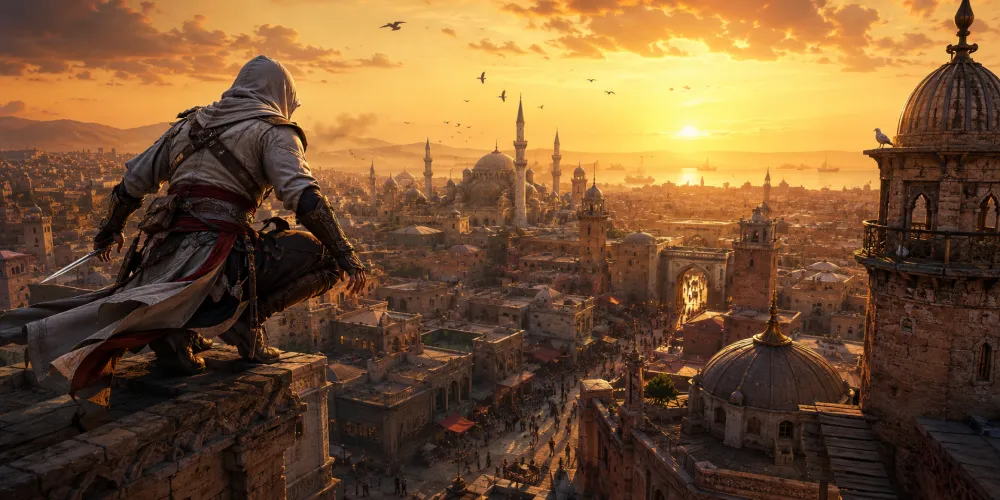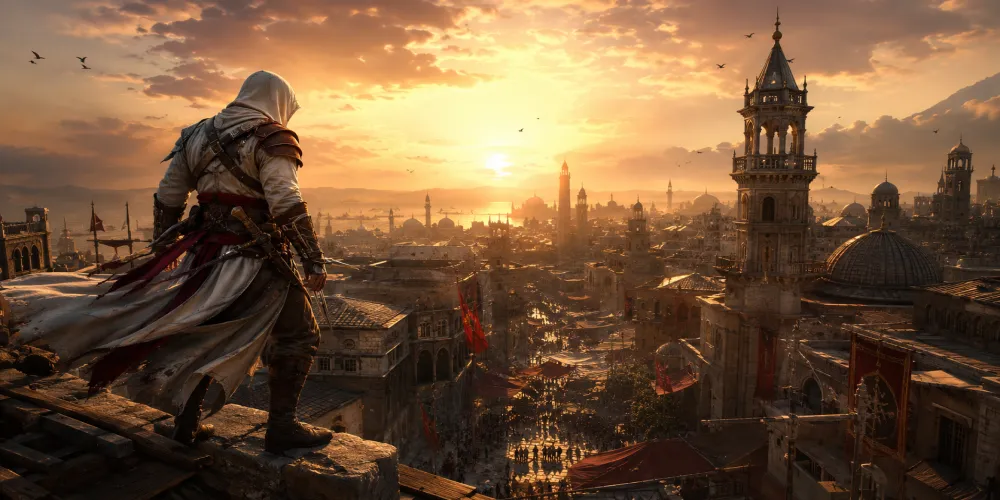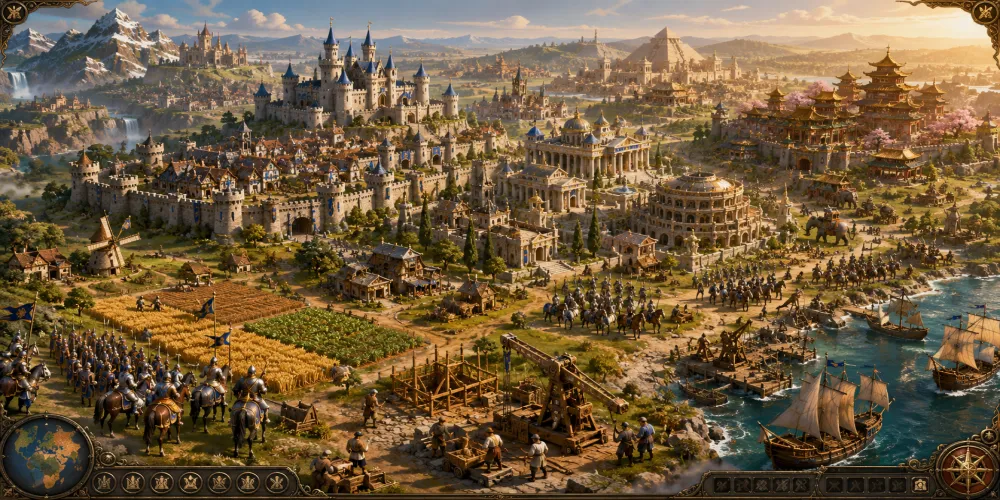
Few strategy games make progress feel as satisfying as Age of Empires. A match begins with a modest settlement, several workers, and a largely unexplored map. A short time later, farms surround a growing town, trade routes generate wealth, defensive walls protect important buildings, and organized armies prepare to challenge rival civilizations.
The series succeeds because economic growth and military power are inseparable. Expanding too quickly can leave a settlement exposed, while spending every resource on defenses may allow an opponent to control the map. Players must continuously balance food production, construction, research, scouting, and unit recruitment.
The best games like Age of Empires preserve at least part of this rhythm while introducing their own ideas. Some stretch civilization development across thousands of years. Others concentrate on medieval fortresses, enormous formations, mythology, survival, or tactical squad control.
The following ten games are excellent choices for players who enjoy building settlements, managing resources, advancing through technology, and watching a carefully prepared strategy collapse because one enemy cavalry group found the unprotected side of the base.
10. Ancestors Legacy
Ancestors Legacy is a medieval real-time strategy game that places greater emphasis on battlefield tactics than economic micromanagement. Instead of controlling an enormous population of workers and soldiers, players command compact squads with recognizable strengths, weaknesses, and experience levels.
Its factions are inspired by groups such as Vikings, Anglo-Saxons, Slavs, and Germanic forces. Campaign missions explore historical conflicts through dramatized stories and cinematic presentation.
Players capture villages to obtain resources and expand their influence. Each controlled settlement can be improved to support recruitment or strengthen the wider economy, but base construction remains more limited than in Age of Empires.
Combat rewards positioning. Forests can conceal units, elevated terrain provides tactical advantages, and attacks from multiple directions can disrupt a stronger formation. Experienced squads become increasingly valuable, making careless losses more significant than they would be in a production-heavy RTS.
Why It Feels Like Age of Empires
- Historical medieval factions;
- Resource-generating settlements;
- Infantry, ranged units, cavalry, and siege equipment;
- Single-player campaigns and skirmish battles;
What Makes It Different
Ancestors Legacy reduces worker management and concentrates on tactical combat. It is better suited to players who enjoy controlling armies but do not want to manage several large production chains.
Pros
- Terrain and flanking have meaningful effects;
- Squads gain experience over time;
- Campaigns feature several historical cultures;
- Economic management is easy to understand;
Cons
- Settlement construction lacks depth;
- Army sizes are comparatively small;
- Some campaign objectives become repetitive;
9. Cossacks 3
Cossacks 3 is an excellent alternative for players who believe an army should contain several thousand soldiers rather than a carefully selected group of twenty. Its battles can become enormous, with long formations of infantry, cavalry charges, artillery lines, and naval forces occupying the map.
The game is primarily inspired by warfare from the 17th and 18th centuries. Players collect resources, construct towns, research improvements, produce military units, and develop an economy capable of supporting a rapidly growing population.
Army formation is particularly important. Musketeers become more effective when arranged properly, artillery needs protection, and cavalry can exploit exposed units or weak defensive positions.
Food consumption adds pressure to expansion. Recruiting a huge army without increasing agricultural production can create an economic disaster before the opponent even arrives.
Why It Feels Like Age of Empires
- Worker-based resource gathering;
- Large historical technology trees;
- City construction and military production;
- Land and naval combat;
What Makes It Different
The scale is significantly larger. Individual soldiers are replaceable, while production capacity, formations, and economic sustainability determine the outcome of most wars.
Pros
- Massive historical battles;
- Numerous playable nations;
- Detailed economic development;
- Strong selection of military units;
Cons
- Large formations can be difficult to control;
- Matches may require substantial time;
- Several nations share similar mechanics;
8. Northgard
Northgard combines real-time strategy with survival and territory management. Players lead a Viking clan attempting to establish a permanent settlement in a dangerous new land.
The map is divided into regions that must be explored and colonized. Each territory contains limited construction space, so every building placement becomes a strategic choice. A region used for farms cannot always support military production or additional housing.
Weather creates a natural rhythm. Resources are easier to collect during warmer months, while winter reduces production and increases consumption. Expanding too aggressively before preparing food and firewood can create serious problems.
Different clans support specialized strategies. One may benefit from trade, another from exploration, warfare, animals, or rapid territorial expansion.
Why It Feels Like Age of Empires
- Settlement growth and resource collection;
- Technology development;
- Military and economic victory conditions;
- Distinct factions with unique bonuses;
What Makes It Different
Northgard uses smaller populations and predefined territories. Survival, happiness, and winter preparation matter as much as direct military strength.
Pros
- Distinct and replayable Viking clans;
- Seasonal economy creates strategic pressure;
- Territory expansion is easy to understand;
- Suitable for players new to RTS games;
Cons
- Battles are relatively small;
- Construction space is restrictive;
- Combat offers less direct control than the economy;
7. 0 A.D.
0 A.D. is a free historical strategy game inspired by the classic structure of Age of Empires. It focuses on civilizations from the ancient world and includes workers, resources, technologies, military units, defensive structures, and naval combat.
Players collect food, wood, stone, and metal while developing settlements across several phases. Advancing unlocks stronger buildings, technologies, and armies.
The citizen-soldier system gives certain units both economic and military functions. Infantry may gather resources during peaceful periods and join the army when the settlement is threatened.
Factions receive distinctive architecture, units, heroes, and bonuses. This provides stronger cultural identity than a simple visual change between otherwise identical civilizations.
Why It Feels Like Age of Empires
- Ancient historical civilizations;
- Traditional worker management;
- Settlement phases that unlock advanced content;
- Military, economic, and territorial competition;
What Makes It Different
The game is open source and developed with community participation. Its citizen-soldier system also creates a direct relationship between economic productivity and military readiness.
Pros
- Available without an initial purchase;
- Strong historical visual design;
- Support for mods and custom maps;
- Familiar structure for Age of Empires players;
Cons
- Some systems remain less polished than commercial RTS releases;
- Artificial intelligence can behave inconsistently;
- Performance may decline during large battles;
6. Stronghold: Definitive Edition
Stronghold: Definitive Edition concentrates on one of the most enjoyable parts of medieval strategy: constructing a fortress capable of surviving a determined siege.
Players build walls, towers, gatehouses, stairways, traps, workshops, farms, markets, and military structures. Castle design directly influences how enemies approach and whether defenders can reach important positions.
The economy is built around production chains. Wood becomes processed material, grain supports flour production, and flour eventually reaches bakeries. Efficient placement reduces travel time and increases productivity.
Population happiness also matters. Citizens need food and housing, while taxes and working conditions influence whether new workers arrive. Raising taxes may support an army, but an unhappy population can quickly undermine the entire settlement.
Why It Feels Like Age of Empires
- Medieval settlement development;
- Resource production and military recruitment;
- Walls, towers, siege engines, and ranged units;
- Historical campaign missions;
What Makes It Different
Stronghold offers significantly deeper castle construction and economic production chains. It is less focused on advancing through several historical ages.
Pros
- Excellent fortress-building tools;
- Detailed medieval economy;
- Memorable defensive missions;
- Every castle layout can produce different battle conditions;
Cons
- Open-field combat is less refined;
- Some missions contain sudden difficulty increases;
- Economic disruption can be difficult to recover from;
5. Empire Earth
Empire Earth takes age progression to an extreme. A civilization can begin with primitive technology and eventually develop aircraft, armored vehicles, advanced weapons, and futuristic units.
The central structure will feel familiar to any Age of Empires fan. Workers gather resources, settlements produce units, research improves efficiency, and new epochs unlock stronger technologies.
The enormous timeline creates dramatic matches. An early border conflict fought with simple weapons can eventually become a modern war involving submarines, bombers, and mechanized armies.
Different civilizations can be customized with bonuses, allowing players to emphasize economic development, defensive strength, naval power, or specific military units.
Why It Feels Like Age of Empires
- Workers, resources, buildings, and armies;
- Progression through historical periods;
- Large technology trees;
- Campaign and skirmish modes;
What Makes It Different
Empire Earth covers a much wider section of history. Its matches can continue far beyond the medieval era represented in the most popular Age of Empires entry.
Pros
- Enormous historical timeline;
- Wide range of land, naval, and air units;
- Flexible civilization bonuses;
- Long matches provide a strong sense of development;
Cons
- The interface feels dated;
- Unit behavior requires patience;
- Balance varies between historical periods;
4. Manor Lords
Manor Lords blends medieval city construction with economic management and tactical warfare. Instead of placing buildings on a rigid grid, players develop settlements along roads and adapt individual plots to the landscape.
Families perform most work, so population planning matters. A household assigned to one profession cannot simultaneously support another industry. Seasonal agriculture, market access, food variety, and transportation all influence the settlement’s stability.
Military forces emerge from the population itself. Calling workers into a militia can leave farms and workshops understaffed, creating a realistic connection between war and the local economy.
Battles emphasize formations, morale, terrain, fatigue, and direction. A smaller force can succeed by holding favorable ground or attacking a vulnerable flank.
Why It Feels Like Age of Empires
- Medieval settlement growth;
- Resource collection and production chains;
- Military recruitment and territorial conflict;
- Economic preparation before warfare;
What Makes It Different
Manor Lords is slower and more simulation-focused. It models households, transportation, seasonal work, and organic town layouts in greater detail.
Pros
- Beautiful organic settlement construction;
- Economy and warfare are closely connected;
- Tactical battles reward formations;
- Strong medieval atmosphere;
Cons
- Development is more deliberate than in a traditional RTS;
- Some systems require careful experimentation;
- Players seeking rapid multiplayer matches may prefer another game;
3. Age of Mythology: Retold
Age of Mythology: Retold is the most natural alternative for players who want familiar Age of Empires mechanics with more fantasy and spectacle.
Workers gather ordinary resources, settlements advance through ages, and military buildings produce recognizable unit categories. The major difference is favor, a special resource generated through worship or culture-specific systems.
Favor allows players to recruit mythological creatures such as giants, centaurs, trolls, and cyclopes. Heroes counter these creatures, creating an additional strategic relationship alongside ordinary infantry, cavalry, and ranged units.
God powers can change a battle instantly. Depending on the selected civilization and deity path, players may receive economic benefits, defensive assistance, environmental disasters, or destructive supernatural abilities.
Why It Feels Like Age of Empires
- Created around the same fundamental RTS structure;
- Workers, ages, technology, and settlement construction;
- Land and naval battles;
- Campaigns, skirmishes, and competitive multiplayer;
What Makes It Different
Myth units, heroes, divine powers, and deity choices make factions significantly more asymmetric and unpredictable.
Pros
- Immediately familiar to Age of Empires players;
- Mythological creatures add variety;
- God powers create dramatic strategic opportunities;
- Strong faction identities;
Cons
- Less suitable for players seeking strict history;
- Divine abilities can rapidly change a balanced match;
- Myth counters introduce another system to learn;
2. Stronghold Crusader: Definitive Edition
Stronghold Crusader: Definitive Edition takes medieval castle strategy into desert environments where fertile land is limited and resource control becomes extremely important.
Players construct fortresses, manage production chains, recruit armies, and challenge AI lords with recognizable personalities and strategies. Some opponents create compact defensive castles, while others prioritize fast attacks or large economic settlements.
Oases are critical because farms cannot be placed freely across every part of the map. Losing access to fertile land can damage food production and force a player to depend on alternative industries or market purchases.
Sieges involve archers, engineers, catapults, fire-based weapons, tunneling units, and heavy infantry. A direct assault is rarely efficient against a well-designed fortress, so identifying weak walls and exposed industries is essential.
Why It Feels Like Age of Empires
- Historical military setting;
- Resource gathering and population management;
- Construction of armies and defenses;
- Real-time skirmish battles;
What Makes It Different
The game focuses on castles and siege warfare instead of technological progression through several ages. AI personalities also give skirmish matches a distinctive character.
Pros
- Deep fortress construction;
- Memorable AI opponents;
- Strong siege and defense mechanics;
- Resource limitations encourage different strategies;
Cons
- Economic mistakes can be difficult to correct;
- Some defensive structures are particularly powerful;
- The desert setting offers less environmental variety;
1. Rise of Nations: Extended Edition
Rise of Nations is the best overall alternative to Age of Empires because it combines real-time settlement building with civilization-scale systems normally associated with turn-based strategy.
Players establish cities, gather several resources, construct military forces, research technologies, and advance from ancient societies into modern nations. Warfare eventually expands to include gunpowder, industrial equipment, aircraft, and advanced weapons.
Cities create national borders. Expanding with additional settlements increases territorial control, while forts strengthen nearby regions. Enemy armies operating inside hostile territory may suffer attrition, making map ownership strategically important even when no battle is taking place.
Resources are produced through assigned workers rather than gradually disappearing from the map. Players still need to expand and improve production, but they spend less time replacing exhausted gathering locations.
Research is divided into categories such as military, civic, commercial, and scientific development. This gives players freedom to specialize rather than following one identical technology path in every match.
Why It Feels Like Age of Empires
- Real-time civilization development;
- Worker management and resource production;
- Historical age progression;
- Large armies, cities, technologies, and Wonders;
What Makes It Different
Rise of Nations adds borders, attrition, national bonuses, multiple cities, and a timeline extending into modern warfare. It feels broader without abandoning the satisfying foundation of a classic RTS.
Pros
- Excellent balance between economy and combat;
- Long historical progression;
- National borders make territory valuable;
- Distinct nations and research strategies;
- Supports campaigns, skirmishes, and multiplayer;
Cons
- The visual presentation shows its age;
- Late-game battles can become chaotic;
- New players must learn several economic systems;
Which Game Is Closest to Age of Empires?
Age of Mythology: Retold is the closest match mechanically. It uses workers, resource gathering, age progression, town centers, military counters, technologies, and naval combat within a familiar structure.
Players who prefer historical civilizations should consider 0 A.D. It resembles the ancient and medieval style of classic Age of Empires games while adding its own citizen-soldier system.
Rise of Nations feels familiar at the beginning but becomes broader as cities, borders, and modern technologies enter the match.
Best Game Like Age of Empires for Castle Building
Stronghold: Definitive Edition and Stronghold Crusader: Definitive Edition provide the deepest castle-building systems in this selection.
Players can design individual walls, towers, gates, internal routes, traps, and defensive positions. The location of workshops, farms, and storage buildings also affects how efficiently a settlement functions during a siege.
Choose the original Stronghold for story campaigns and detailed economic missions. Select Crusader for repeatable skirmishes against distinctive AI lords.
Best Free Alternative to Age of Empires
0 A.D. is the strongest option for players seeking a free historical RTS. Its structure includes nearly everything expected from the genre: workers, resources, buildings, research, heroes, armies, ships, defenses, and territorial expansion.
Its open-source development also supports custom maps and modifications. However, players should expect occasional technical issues and systems that continue changing between versions.
Best Game for Massive Historical Battles
Cossacks 3 is the clear recommendation for enormous army sizes. Its economy is designed to support thousands of soldiers, allowing players to organize lengthy formations of infantry, cavalry, and artillery.
Empire Earth and Rise of Nations offer broader technology progression, but neither places the same emphasis on filling the battlefield with vast formations.
Best Alternative for Beginners
Northgard is one of the most approachable games on the list. Its territories create clear expansion goals, building limits prevent uncontrolled settlement growth, and smaller populations are easier to manage.
Age of Mythology: Retold is also accessible to anyone who already understands Age of Empires. Its mythological systems add complexity gradually without changing the familiar foundation.
Stronghold can appear straightforward, but its production chains and popularity systems may require more planning than beginners expect.
Best Game for Detailed Medieval Economy
Manor Lords provides the most simulation-focused medieval economy. Households supply workers, goods move physically between buildings, and seasonal agriculture influences food availability.
Stronghold also contains detailed production chains but presents them through a faster traditional RTS structure. It is the better choice for players who want economic planning to lead quickly into siege warfare.
Important Features to Look For
Not every historical strategy game provides the same experience. Before selecting an Age of Empires alternative, consider which systems matter most.
- Age progression for a visible technological journey;
- Worker management for detailed economic control;
- Faction differences that change strategic priorities;
- Defensive construction for players who enjoy fortified settlements;
- Naval combat for maps containing important waterways;
- Campaigns for structured historical or fictional stories;
- Competitive multiplayer for repeatable human opponents;
- Custom maps and mod support for long-term variety;
How to Adapt Your Age of Empires Skills
Several fundamental habits transfer between most RTS games. Continuous worker production usually supports stronger growth, while scouting prevents surprises and reveals opportunities for expansion.
However, each alternative changes the value of familiar decisions. Northgard limits expansion through food and territory costs. Stronghold requires careful production chains. Manor Lords connects military recruitment directly to the civilian population.
Do not assume that an effective Age of Empires build order will work unchanged. Spend the first matches learning how quickly resources arrive, which structures unlock essential units, and what limits population growth.
Common Mistakes New RTS Players Make
Stopping Economic Growth Too Early
A temporary resource surplus does not mean the economy is complete. Stronger units, research, and fortifications create increasing costs as a match continues.
Ignoring Scouting
Without information, players cannot tell whether an opponent is expanding, preparing an attack, or advancing technologically. A cheap scouting unit can prevent an expensive surprise.
Producing Only One Unit
Historical RTS games usually rely on counters. Infantry, cavalry, ranged units, and siege equipment perform different roles. An army built around one category can disappear quickly when the opponent identifies the weakness.
Advancing Without Protection
Technological advancement consumes resources that could have produced soldiers. Players are often vulnerable while moving into a new age or research tier.
Building Too Many Defenses
Walls and towers can protect an economy, but they rarely capture resources or pressure an opponent. Defensive construction should support a broader strategy rather than replace one.
Historical Accuracy Versus Strategic Freedom
Games inspired by history often simplify technology, geography, and military organization to create readable matches. A perfectly accurate simulation would not necessarily produce balanced or enjoyable factions.
Ancestors Legacy uses historical conflicts but focuses on tactical drama. Cossacks 3 emphasizes the visual scale of early modern armies. Manor Lords models aspects of medieval settlement development in greater detail.
Age of Mythology abandons strict history and uses gods and legendary creatures to create stronger faction differences. The best choice depends on whether authenticity or mechanical variety is more important to the player.
Which Age of Empires Alternative Is Best Overall?
Rise of Nations: Extended Edition takes the top position because it preserves the familiar pleasure of developing a civilization while expanding the formula through borders, multiple cities, national powers, and modern technology.
Age of Mythology: Retold is the closest direct alternative, especially for players who enjoy the standard Age of Empires economy but want mythological armies. Stronghold Crusader is the strongest choice for castle warfare, while Manor Lords offers slower and more detailed medieval settlement management.
Every game on this list understands that an RTS victory begins long before the armies meet. It begins with workers, resources, scouting, construction, and the quiet confidence that this time the enemy definitely will not attack while the entire army is on the other side of the map.