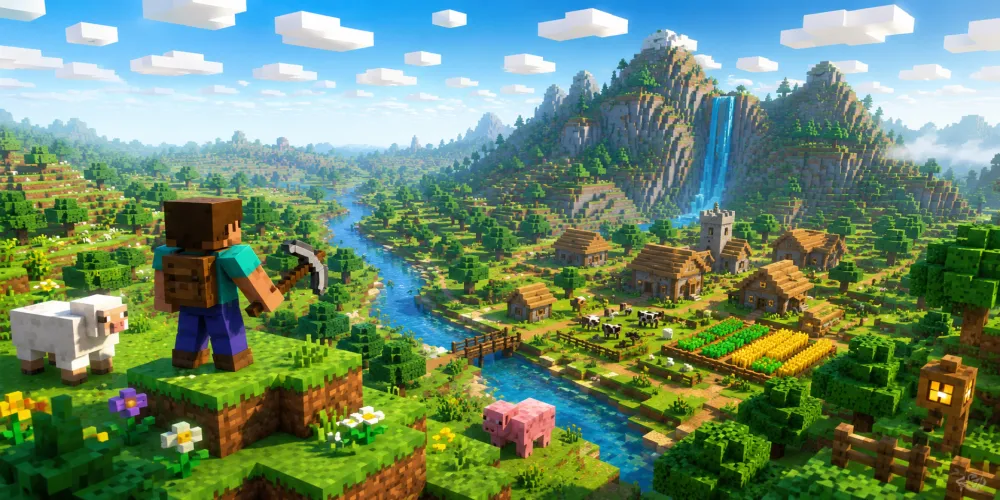
Minecraft is one of those rare games that refuses to grow old because it was never built around one narrow idea. It is not only a survival game, a building sandbox, an adventure space, or a multiplayer hangout. It is all of those things at once, and players can decide which version matters most to them. That flexibility explains why the block-building game still dominates creative gaming years after becoming a global phenomenon. Some players open Minecraft to build castles, cities, farms, and redstone machines. Others enter for exploration, cozy survival, servers, roleplay, challenges, or educational projects. The simple visual language of blocks hides a surprisingly deep design philosophy: give players tools, give them space, and let imagination do most of the heavy lifting.
A Game That Starts With Almost Nothing and Becomes Anything
Minecraft’s greatest strength is how little it demands at the beginning. A new player can appear in a random world with trees, hills, caves, animals, water, and a day-night cycle, then slowly learn what matters. There is no overcomplicated opening sequence telling everyone exactly how to play. The game trusts curiosity. Punch a tree, craft tools, dig into stone, build shelter, explore further, and suddenly a blank landscape becomes a personal story.
That openness keeps Minecraft fresh because every world begins with possibility. One player may create a quiet cottage beside a river. Another may build a giant fortress above the clouds. Someone else may ignore architecture and focus on farming, mining, trading, or mapping every biome. The game gives structure, but never traps the player inside it.
Creative Mode Changed What a Game Could Be
Creative Mode is one of the main reasons Minecraft still dominates the imagination of players. It removes resource pressure and turns the game into a digital construction studio. Blocks become paint, architecture, sculpture, engineering material, and storytelling props. The player is no longer asking, “Can I survive this night?” Instead, the question becomes, “What can I make if nothing is stopping me?”
This mode helped Minecraft move beyond traditional gaming audiences. People who do not care about combat systems or competitive rankings can still spend hours designing houses, theme parks, pixel art, fantasy kingdoms, schools, roller coasters, or entire cities. Creative Mode made the game feel approachable for builders, teachers, young players, designers, and casual users who simply enjoy shaping a world by hand.
-
It gives instant access to blocks and tools.
-
It removes survival pressure for relaxed building.
-
It supports large-scale projects and experiments.
-
It turns imagination into the main gameplay loop.
Survival Mode Gives Creativity a Reason to Matter
Survival Mode works because it gives creativity practical value. A house is not just a pretty object. It protects the player. A farm is not just decoration. It creates food. A mine is not just a tunnel. It becomes a resource network. A bridge, wall, storage room, portal room, or animal pen all serve a purpose, so building feels connected to progress.
This is where Minecraft becomes deeply satisfying. Players do not merely collect materials for the sake of collecting. They gather wood, stone, iron, diamonds, and rare resources because every material can become part of a larger plan. Survival play turns small improvements into meaningful milestones. The first shelter becomes a base. The base becomes a settlement. The settlement becomes a world with history.
Blocky Aesthetics That Became Timeless
Minecraft’s visual style looks simple, but that simplicity is exactly why it has lasted. The block-based look is instantly readable. Dirt, grass, wood, stone, sand, water, lava, glass, wool, and ore all communicate clearly. Players understand the world quickly because every object has a clean shape and a clear function. Instead of chasing realism, the game builds its own visual language.
That choice made Minecraft more flexible than many realistic games. A blocky castle can look charming rather than outdated. A simple forest can still feel atmospheric. A tiny village can feel cozy because the player’s imagination fills in emotional detail. The graphics do not limit creativity; they invite it. The style is plain enough for beginners, but flexible enough for massive artistic projects.
Redstone Turns Building Into Engineering
Redstone is one of Minecraft’s most important creative systems because it lets players build machines, circuits, doors, traps, farms, clocks, elevators, sorting systems, mini-games, and puzzle mechanisms. It adds logic to the sandbox. Suddenly, a block world becomes a place where players can design working systems instead of only static structures.
For many fans, redstone is where Minecraft becomes almost educational without feeling like homework. Players learn cause and effect, timing, signal strength, automation, and mechanical thinking through experimentation. A failed machine is not a disaster; it is a puzzle. Why did the door not open? Why is the farm not collecting items? Why does the signal stop there? Minecraft makes problem-solving feel playful.
-
Simple redstone doors help beginners understand signals.
-
Automatic farms introduce resource automation.
-
Sorting systems teach logic and sequence.
-
Complex builds reward patience and testing.
Multiplayer Makes Every World Feel More Alive
Minecraft becomes a different experience when people share a world. A solo base can be peaceful, but a multiplayer server can feel like a living community. Players divide roles, build neighborhoods, trade resources, create rules, design events, start shops, explore together, and sometimes turn simple landscapes into social spaces with their own culture.
This multiplayer flexibility helps explain the game’s staying power. Minecraft is not locked to one kind of online experience. It can be cooperative survival, competitive mini-games, roleplay, parkour, economy servers, creative building hubs, or private family worlds. The same core game supports different social moods, from quiet teamwork to chaotic party-style play.
Mods and Add-Ons Keep the Game Moving
Minecraft’s modding culture is one of the biggest reasons the game still feels current. Mods can add new biomes, creatures, tools, technology systems, magic mechanics, farming depth, furniture, maps, shaders, and quality-of-life features. This gives players a way to reshape the game when the standard experience starts to feel familiar.
The best part is that mods do not replace Minecraft’s identity. They expand it. A player can make the game more realistic, more fantasy-driven, more technical, more cozy, or more challenging. That adaptability means Minecraft can serve many audiences without becoming one fixed product. It is more like a platform for play than a single closed adventure.
Servers Turn Minecraft Into a Gaming Ecosystem
Public servers helped Minecraft become more than a personal sandbox. They created a huge ecosystem of custom experiences built by communities. Players can join worlds centered on mini-games, survival economies, parkour challenges, roleplay, building contests, PvP arenas, adventure maps, and themed hubs. This turns Minecraft into a gateway to many smaller games inside one familiar framework.
That ecosystem is especially powerful because it gives players reasons to return even after they have already built plenty of homes, mines, and farms. A server can introduce new goals, new people, and new rules. Instead of waiting for the official game to provide every fresh idea, the community constantly creates new ones.
-
Mini-game servers offer quick sessions.
-
Survival servers create long-term progression.
-
Roleplay servers add story and character identity.
-
Creative servers encourage collaborative design.
Educational Value Hidden Inside Play
Minecraft has become popular in learning environments because it naturally supports planning, design, logic, teamwork, and spatial thinking. Students can build historical landmarks, model ecosystems, recreate cities, explore math concepts, or collaborate on group projects. The game does not need to feel like a traditional lesson to become useful.
Its educational value comes from active participation. Players are not only watching information; they are shaping it. To build a structure, they must think about size, symmetry, materials, layout, and function. To survive, they must manage resources and make decisions. To collaborate, they must communicate. Minecraft makes learning physical in a digital space.
Why Minecraft Works for So Many Ages
Minecraft has a rare cross-generational appeal. Younger players enjoy the colorful world, simple controls, animals, building, and playful surprises. Teenagers often explore servers, challenges, mods, and social play. Adults may enjoy survival planning, architecture, technical builds, or relaxing creative sessions. The game adapts to the player’s mindset instead of forcing everyone into the same experience.
This is important because many games age with their original audience and slowly become less relevant. Minecraft keeps bringing in new players while still giving older players reasons to return. A person can first play it as a child, revisit it years later, and discover that the game still works, just in a different way.
Content Creators Helped Minecraft Stay Everywhere
Minecraft’s popularity on video platforms helped turn it into a cultural engine. The game is easy to understand on screen, but still unpredictable enough to support endless videos. A viewer can enjoy build tutorials, survival series, speedrun challenges, server stories, mod showcases, roleplay episodes, educational guides, and comedy moments without needing deep technical knowledge.
This creator ecosystem keeps Minecraft visible. Every impressive build, strange challenge, or dramatic server story becomes a new reason for someone to reinstall the game or try it for the first time. Minecraft is not only played; it is watched, shared, explained, remixed, and turned into community memory.
-
Build tutorials inspire new projects.
-
Survival series create long-form storytelling.
-
Challenge videos make familiar mechanics feel new.
-
Mod showcases reveal new ways to play.
The Beauty of Setting Your Own Goals
Many games tell players exactly what success looks like. Minecraft is different. A player can decide that success means defeating major bosses, building a mountain base, collecting rare blocks, designing a village, making a redstone machine, exploring every biome, or simply creating a cozy home beside a lake. The goal belongs to the player.
This is why the game feels personal. Two players can spend 100 hours in Minecraft and have completely different stories. One may remember a huge castle project. Another may remember a dangerous cave trip, a pet wolf, a hidden farm, or a silly server event with friends. The game creates memories because it gives players room to care about their own choices.
Why Minecraft Still Dominates Creative Gaming
Minecraft remains dominant because it solved a problem many creative games still struggle with. It is simple enough to understand quickly, but deep enough to support years of play. It gives freedom without becoming empty. It gives structure without becoming restrictive. It welcomes builders, explorers, engineers, casual players, educators, content creators, and multiplayer communities into the same blocky universe.
The game’s real power is not only in its mechanics, visuals, or updates. It is in the way it makes players feel capable. A blank field can become a village. A cave can become a base. A pile of blocks can become a skyline. Minecraft turns creativity into action, and that is why the block-building game still stands at the center of creative gaming.