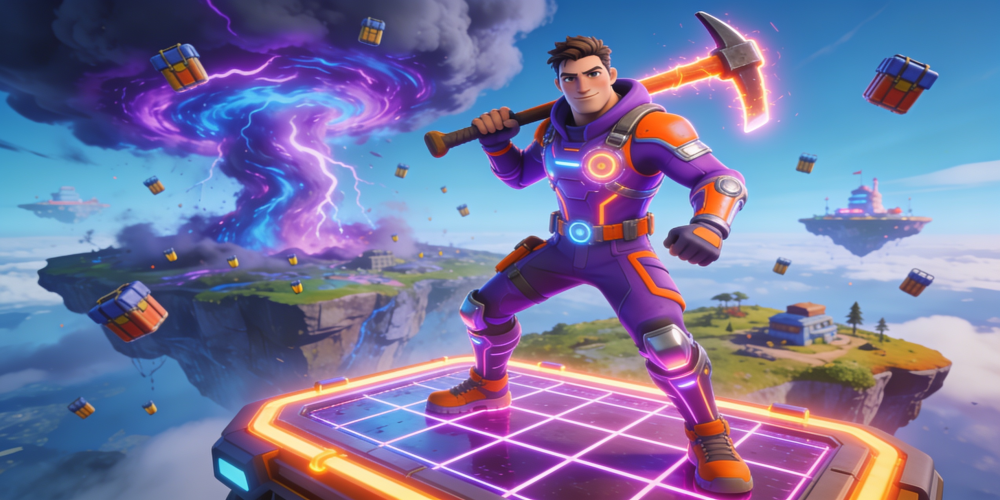
Fortnite is one of the few modern games that can change its identity without losing its audience. What began as a battle royale phenomenon has become something larger: a live entertainment platform, a social space, a creator playground, a pop-culture stage, and a constantly moving digital world. Epic Games did not keep Fortnite relevant by protecting it from change. It kept the game powerful by making change the main attraction. New seasons, map updates, concerts, collaborations, skins, modes, quests, and creative tools all feed the same idea: Fortnite is never completely finished. That is why players keep returning. They are not only logging in to win matches. They are checking what the game has become this week, this season, or during the next major event.
A Battle Royale Formula Built for Constant Drama
Fortnite’s core battle royale structure remains one of the strongest foundations in online gaming. The setup is easy to understand: players drop onto an island, search for weapons and resources, avoid the shrinking storm, and try to be the last one standing. That simplicity makes the game accessible, but the moment-to-moment action keeps it unpredictable.
Every match creates a small story. A player might land in a crowded area, escape with low health, find better gear, survive a chaotic mid-game fight, and reach the final circle with only seconds to react. Even when the rules are familiar, the outcome rarely feels identical. That repeatable tension is one reason Fortnite’s battle royale loop still works so well.
Building Gave Fortnite Its Original Competitive Identity
Fortnite separated itself from other battle royale games through building. Walls, ramps, floors, and edits turned combat into a fast mix of shooting, movement, defense, and construction. A player was not only judged by aim. They also had to control space, react quickly, and reshape the battlefield in real time.
This mechanic made Fortnite instantly recognizable. A flat field could become a tower in seconds. A dangerous open area could become temporary cover. A fight could move vertically instead of staying on one level. Building added a creative layer to competition, making each encounter feel more dynamic than a simple exchange of shots.
-
Walls create instant defense under pressure.
-
Ramps help players gain height and visibility.
-
Edits reward speed, timing, and precision.
-
Structures make every fight feel player-shaped.
Zero Build Made the Game Feel Fresh Again
One of Epic Games’ smartest moves was proving that Fortnite could survive without its most famous mechanic. Zero Build opened the door for players who liked Fortnite’s world, style, weapons, and social energy, but did not want to master high-speed construction. Instead of weakening the game, this mode expanded its appeal.
Zero Build changed the rhythm of play. Positioning, cover, movement, aim, and map awareness became more important. The result was a version of Fortnite that felt cleaner, faster to understand, and easier for returning players to enjoy. It also showed that Fortnite is flexible enough to support different types of competition inside the same ecosystem.
Seasonal Updates Turn the Island Into a Living Stage
Fortnite’s island is not just a map. It is a stage that keeps being rebuilt. New points of interest, environmental changes, weapons, vehicles, bosses, quests, and story elements make each season feel like a new chapter. Players do not simply memorize one battlefield forever. They adapt as the island changes around them.
This approach gives Fortnite a major advantage over static multiplayer games. When a new season begins, curiosity becomes part of the gameplay. Players want to see what changed, where to land, which weapons feel strongest, which areas are dangerous, and how the new theme affects the overall mood. The map itself becomes a marketing tool and a gameplay engine.
Fortnite’s Aesthetic Is Flexible Enough for Anything
Fortnite’s visual style is colorful, exaggerated, and readable. That matters because the game can absorb wildly different themes without breaking its identity. Superheroes, anime characters, musicians, athletes, original skins, fantasy creatures, futuristic soldiers, cartoon figures, and luxury-inspired outfits can all stand on the same island without feeling completely out of place.
This flexibility is one of Fortnite’s greatest design advantages. More realistic games often struggle when crossovers become too strange. Fortnite is already playful, so it can welcome almost anything. Its aesthetic is not tied to one strict tone. It is a bright, fast, expressive world where absurd combinations are part of the fun.
-
Colorful environments keep combat easy to read.
-
Stylized characters make crossovers feel natural.
-
Seasonal themes can shift the mood quickly.
-
Cosmetics turn personal style into part of play.
Pop Culture Collaborations Keep Fortnite in the Conversation
Fortnite understands modern entertainment better than most games because it treats pop culture as part of its world. Collaborations with major franchises, artists, films, comics, sports brands, and internet culture keep the game visible far beyond traditional gaming spaces. A new skin or event can attract players who may not even be regular battle royale fans.
These collaborations work because Fortnite does not present them as simple advertisements. They often become playable moments, themed items, limited-time modes, or social events. That makes the crossover feel interactive. Fans are not just watching a brand appear in the game. They are wearing it, using it, fighting beside it, dancing with it, or exploring a space built around it.
Live Events Turn Players Into an Audience
Fortnite’s live events helped redefine what a game could do with a massive online audience. Instead of separating gameplay from entertainment, Epic Games turned the game world into a shared venue. Players could gather on the island and experience dramatic map changes, concerts, cinematic sequences, or strange world-shifting moments together.
That shared timing is powerful. A live event feels different from a normal update because players know they are part of a temporary moment. They log in at the same time as friends, creators, and millions of others. Even when the event is short, it creates memory. Fortnite becomes not only something people play, but something they remember attending.
Creative Mode Changed Fortnite’s Long-Term Future
Creative Mode gave Fortnite a second life beyond battle royale. It allowed players and creators to build custom maps, mini-games, training courses, roleplay spaces, racing tracks, puzzle rooms, social hubs, and experimental modes. This changed Fortnite from a single competitive game into a flexible creation platform.
The creator ecosystem keeps Fortnite from depending only on Epic’s official updates. Players can explore community-made experiences, while creators can test ideas and build audiences. That shift matters because modern gaming is increasingly participatory. People do not only want to consume content. Many want to make it, remix it, and share it.
-
Training maps help players improve mechanics.
-
Custom mini-games add variety between matches.
-
Social islands turn Fortnite into a hangout.
-
Creator tools expand the platform’s identity.
Social Play Makes Fortnite Bigger Than Competition
Fortnite remains popular because it is often a place to spend time with friends. Squads, duos, voice chat, emotes, party systems, and casual modes make the game feel social even when players are not focused on winning. For many users, Fortnite is less like a strict esport and more like a digital meeting place with action attached.
This social layer helps explain why the game has survived so many trend cycles. Players may leave for a while, but they often return when friends come back, a new season begins, or a major collaboration creates excitement. The game benefits from network energy. Fortnite is more fun when people experience it together.
Cosmetics Turn Self-Expression Into a Daily Habit
Fortnite’s cosmetic system is central to its entertainment value. Skins, back bling, pickaxes, gliders, wraps, emotes, and music packs allow players to create a personal style. The game does not need cosmetics to affect competitive balance because their purpose is emotional and social. They help players feel recognizable.
A player’s locker can become a personal collection of memories. One outfit may represent a favorite season. Another may connect to a film, musician, or character they love. A rare emote may remind them of an event. Fortnite’s cosmetics work because they turn identity into a playful routine before every match begins.
Functionality That Supports Fast, Flexible Play
Fortnite succeeds partly because its systems are built for quick entry and constant motion. Players can join matches fast, complete quests, change loadouts, browse the shop, switch modes, invite friends, and move between official and creator-made experiences. The platform is designed to reduce friction.
This matters in online entertainment because attention is competitive. Fortnite does not only compete with other games. It competes with streaming platforms, social media, short videos, and mobile apps. Its interface and content rhythm make it easy for players to find something to do quickly, whether they have ten minutes or an entire evening.
-
Fast matchmaking supports short sessions.
-
Quests give players clear goals beyond winning.
-
Multiple modes serve different moods.
-
Cross-platform play keeps friend groups connected.
Competitive Play Keeps the Skill Ceiling High
Fortnite may be accessible, but it is not shallow. Competitive players have turned movement, aim, edits, rotations, positioning, and resource control into a deep skill system. The game can look chaotic from the outside, but high-level Fortnite is often about speed, prediction, discipline, and decision-making under pressure.
This competitive depth keeps the game interesting for players who want mastery. Casual fans may enjoy events and cosmetics, while serious players study mechanics, practice in creative maps, analyze tournaments, and follow top creators. Fortnite’s ecosystem works because it supports both playful chaos and intense skill expression.
Why Fortnite Still Feels Like the Future of Online Entertainment
Fortnite keeps reinventing online entertainment because it refuses to be only one thing. It is a battle royale game, a social space, a creative platform, a live-event venue, a fashion showroom, a pop-culture crossover machine, and a competitive playground. That combination gives it a rare ability to stay relevant even when player habits change.
The most important lesson from Fortnite is that modern games can become living platforms. Players want worlds that change, communities that gather, tools that invite creativity, and events that feel worth showing up for. Epic Games built Fortnite around that idea, and that is why the game continues to dominate the conversation around online entertainment.