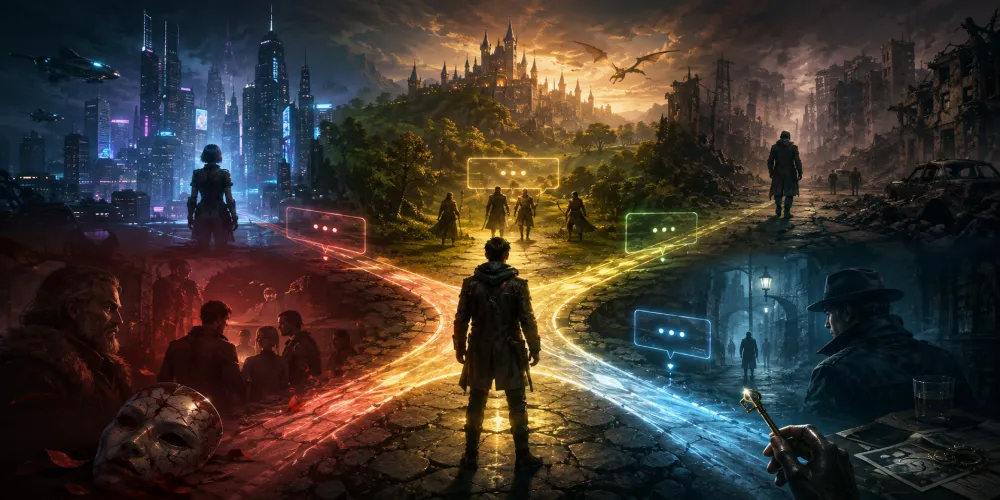
Many games allow players to select dialogue options, but only a smaller group makes those choices feel genuinely important. A meaningful decision should do more than change one sentence or briefly improve a character’s opinion. It should influence relationships, alter future missions, remove opportunities, create unexpected consequences, or force the player to live with an uncomfortable result.
The strongest choice-driven games rarely divide every situation into a clearly correct and clearly wrong answer. They present incomplete information, conflicting loyalties, limited time, and characters whose interests cannot all be protected. Even a compassionate decision may create problems several hours later.
This list includes cinematic adventures, role-playing games, political dramas, interactive mysteries, and narrative experiments. Some provide enormous freedom, while others use a smaller number of carefully designed decisions. All ten understand that choice becomes meaningful when the player cares about what might be lost.
10. Until Dawn
Until Dawn follows eight young adults trapped near an isolated mountain lodge where an apparently harmless reunion quickly becomes a dangerous nightmare. The game is structured like an interactive horror movie, with shifting perspectives, cinematic scenes, exploration, quick reactions, and important dialogue decisions.
Every main character can survive or disappear from the story depending on the player’s actions. A seemingly minor choice may alter a relationship, reveal useful information, or create a problem much later in the night.
The Butterfly Effect system tracks decisions and shows how one event can influence another. Not every consequence is immediately obvious, which encourages players to think carefully rather than treating each scene as a separate puzzle.
Until Dawn also uses player knowledge against them. Horror conventions may suggest one response, while information discovered through exploration may support another. The game becomes especially entertaining when several friends make decisions together and then attempt to deny responsibility when the situation becomes worse.
Why the Choices Matter
- Every major character has multiple possible outcomes;
- Relationships influence later interactions;
- Collected clues can change how events are understood;
- Small actions may create delayed consequences;
Best For
Until Dawn is ideal for players who enjoy cinematic horror, short chapters, and highly visible consequences. It is also one of the best narrative games to experience with a group watching and voting on decisions.
9. The Walking Dead: Season One
The Walking Dead: Season One places players in the role of Lee Everett, a man attempting to protect a young girl named Clementine during the collapse of ordinary society.
The story focuses less on defeating large groups of enemies and more on maintaining trust inside a frightened community. Food is limited, personalities clash, and every survivor carries personal fears that influence group decisions.
Dialogue choices are frequently timed, preventing players from analyzing every possible answer indefinitely. Silence is also treated as a valid response, although refusing to speak can communicate something very different from what the player intended.
Some major story events cannot be completely avoided, but choices still shape relationships, character attitudes, and the emotional meaning of later scenes. Lee’s behavior also influences what Clementine learns from him.
Why the Choices Matter
- Characters remember previous statements and actions;
- Trust determines how survivors respond during conflicts;
- Decisions shape Lee and Clementine’s relationship;
- Moral dilemmas rarely have perfect solutions;
Best For
This is a strong recommendation for players who value emotional storytelling more than mechanical complexity. Its most memorable decisions are powerful because they involve people the game has taken time to develop.
8. Detroit: Become Human
Detroit: Become Human follows three android protagonists whose stories intersect during a growing conflict between artificial beings and human society. Players investigate cases, build relationships, escape dangerous situations, and influence the direction of a wider social movement.
The branching structure is one of the game’s defining features. Entire scenes can change, characters may leave the narrative early, and later chapters can begin under dramatically different circumstances.
After completing a chapter, players can view a flowchart showing explored and unexplored paths. This makes the scale of the branching design visible without immediately revealing every missing possibility.
Decisions affect personal relationships as well as public opinion. A peaceful action may strengthen one alliance while frustrating another character who believes more forceful resistance is necessary.
Why the Choices Matter
- Major characters can have very different story paths;
- Investigation results unlock or remove later options;
- Public opinion changes according to the player’s behavior;
- Relationships influence loyalty and cooperation;
Best For
Detroit: Become Human is ideal for players who want cinematic presentation and an easily visible branching structure. It also encourages multiple playthroughs because many paths contain completely different scenes.
7. The Quarry
The Quarry follows a group of summer camp counselors forced to remain at Hackett’s Quarry for one additional night. Naturally, this small change of plan develops into an increasingly complicated horror story.
Players control different characters and decide how they respond to threats, romantic tension, suspicious strangers, and dangerous discoveries. Quick reactions matter, but many outcomes are determined through dialogue, exploration, and earlier preparation.
Characters can survive, become injured, turn against others, or miss important information. Some decisions that initially appear reckless may create unexpected advantages later.
The game includes options that reduce mechanical difficulty, making it accessible to players primarily interested in the story. Its movie-like structure also works well for group sessions.
Why the Choices Matter
- The survival of the cast depends on player decisions;
- Relationships can influence cooperation;
- Exploration reveals tools and information used later;
- Different choices create numerous ending combinations;
Best For
The Quarry is suited to horror fans who want a larger cast and a less serious tone than some emotional narrative games. It is particularly enjoyable when friends divide responsibility for different characters.
6. Disco Elysium
Disco Elysium places players in the role of a detective who wakes with little memory, a damaged reputation, and a complicated case waiting outside his hotel room.
Instead of traditional combat, the game focuses on conversations, investigation, political ideas, personal recovery, and internal conflict. Skills such as Logic, Empathy, Authority, and Inland Empire act like voices inside the protagonist’s mind.
Increasing a skill provides new information but can also make that part of the detective’s personality too influential. High confidence may help during an interrogation, yet it may also encourage embarrassing behavior.
Failed checks do not always end progress. A failure can create a new scene, reveal a character trait, or push the investigation toward an unexpected route. This makes imperfection part of the story rather than something that must always be corrected by reloading.
Why the Choices Matter
- Political and personal beliefs shape dialogue;
- Skills alter what the protagonist notices;
- Failures can create unique narrative outcomes;
- Relationships with local characters affect the investigation;
Best For
Disco Elysium is ideal for players who enjoy extensive reading, unusual humor, philosophical questions, and role-playing without conventional battles. It rewards curiosity more than efficiency.
5. The Witcher 3: Wild Hunt
The Witcher 3 follows Geralt of Rivia across a world affected by war, political ambition, ancient threats, and everyday cruelty. Although the main story has an urgent objective, many of the game’s strongest choices appear inside optional quests.
A contract that begins as a simple investigation may reveal family conflict, prejudice, desperation, or supernatural consequences. The most obvious response is not always the one that produces the best result.
Important decisions can affect entire regions, political leaders, relationships, and the ending of Geralt’s personal journey. Some consequences appear many hours after the original choice, when the player may no longer remember the exact conversation that caused them.
The game also avoids treating Geralt as an empty character. Players shape his behavior, but choices remain grounded in his profession, experience, and established relationships.
Why the Choices Matter
- Side quests can affect communities and future events;
- Political decisions influence the wider world;
- Relationship choices alter personal storylines;
- Several conclusions depend on accumulated behavior;
Best For
The Witcher 3 is recommended for players seeking a long open-world RPG where decisions are integrated into exploration, combat, investigation, and character development.
4. Mass Effect Legendary Edition
Mass Effect Legendary Edition brings together a science-fiction trilogy in which one commander’s decisions can carry across three enormous games.
Players create Commander Shepard, select a background and class, recruit companions, negotiate with alien civilizations, and respond to a threat capable of changing the entire galaxy.
Choices influence relationships, political alliances, missions, and the availability of characters in later games. A decision made during the first adventure may return dozens of hours later with new consequences.
The companions are the heart of the trilogy. Helping them resolve personal conflicts can strengthen loyalty, while neglecting their concerns may affect later missions. Romantic relationships also continue across the series and respond to Shepard’s behavior.
Why the Choices Matter
- Save data carries decisions between three games;
- Companion loyalty influences major missions;
- Political choices affect later alliances;
- Characters may return in different roles or not return at all;
Best For
Mass Effect is the best choice for players who want a long-term narrative investment. The consequences feel significant because the same relationships and conflicts develop across an entire trilogy.
3. Life Is Strange
Life Is Strange follows photography student Max Caulfield after she discovers an ability to rewind time. This power allows players to revisit conversations, test different responses, and use new information to change immediate events.
The mechanic creates the impression that mistakes can be corrected, but the story gradually demonstrates that controlling consequences is far more complicated. Fixing one problem may create another that is less visible.
The relationship between Max and Chloe forms the emotional center of the game. Their shared history, personal conflicts, and decisions about the future shape how players interpret the larger mystery.
Small interactions also contribute to the atmosphere. Speaking with classmates, examining objects, helping minor characters, and exploring optional scenes can influence later moments.
Why the Choices Matter
- Time manipulation allows players to compare immediate outcomes;
- Relationships develop through repeated personal decisions;
- Optional interactions can affect later events;
- The final chapters force players to confront accumulated consequences;
Best For
Life Is Strange is ideal for players who enjoy intimate character drama, mystery, emotional music, and slower exploration. Its central choices are personal rather than political or strategic.
2. Baldur’s Gate 3
Baldur’s Gate 3 offers one of the most reactive role-playing worlds ever created. Character race, class, background, abilities, relationships, and previous actions can all unlock different solutions.
Players may resolve a conflict through persuasion, deception, stealth, combat, magic, environmental manipulation, or an idea that appears completely unreasonable until it works.
Companions have their own beliefs, fears, and goals. They respond to decisions, form opinions of the protagonist, and may become loyal allies, romantic partners, bitter opponents, or absent from the group entirely.
The game does not protect every quest from failure. Important characters may disappear, settlements can change, and entire storylines can become inaccessible. That uncertainty makes success feel earned.
Why the Choices Matter
- Character builds unlock unique dialogue and actions;
- Companions can follow dramatically different paths;
- Quest outcomes reshape later areas;
- Failure often creates another valid direction;
- The world responds to unusual player strategies;
Best For
Baldur’s Gate 3 is the strongest choice for players who want mechanical freedom alongside narrative choice. It supports solo play and cooperative campaigns, although friends may introduce decisions no responsible hero would consider.
1. Telltale’s The Walking Dead
Telltale’s The Walking Dead takes the top position because it demonstrates that meaningful choices do not require thousands of branching missions. They require emotional investment, limited information, and consequences involving characters the player genuinely wants to protect.
Lee Everett’s relationship with Clementine turns ordinary decisions into lessons. She observes how he treats frightened people, responds to conflict, handles loss, and decides who can be trusted.
The game frequently asks players to choose between people rather than abstract rewards. There may be no way to preserve every relationship or protect every member of the group.
Timed dialogue prevents endless analysis. The player must respond while emotions are high, and silence becomes part of the conversation when no answer feels acceptable.
Although some story events remain fixed, the emotional journey changes according to the player’s behavior. Lee’s final influence on Clementine is shaped by the example he provided throughout the season.
Why It Earns First Place
- Choices are tied directly to strong relationships;
- Characters remember loyalty, honesty, and conflict;
- Timed decisions create natural pressure;
- Moral dilemmas avoid easy solutions;
- The consequences remain emotionally memorable;
Which Game Has the Most Branching Story?
Detroit: Become Human provides one of the most visibly complex branching structures. Its chapter flowcharts reveal how many scenes, actions, and outcomes can remain unexplored after a first playthrough.
Baldur’s Gate 3 offers broader systemic freedom. Instead of only selecting dialogue responses, players use character abilities and environmental interactions to create solutions the story must recognize.
Until Dawn and The Quarry specialize in survival combinations. Different groups of characters can reach the ending depending on decisions made throughout the night.
Best Choice-Driven Game for Beginners
The Walking Dead and Life Is Strange are excellent starting points because their controls are simple and the stories introduce choices gradually.
Detroit: Become Human provides more branches but includes exploration and reaction-based sequences. Difficulty settings make those sections more accessible.
Baldur’s Gate 3 and The Witcher 3 contain deeper combat, inventory, and character-development systems, which may be intimidating for someone primarily interested in the narrative.
Best Game for Multiple Playthroughs
Baldur’s Gate 3 offers the greatest replay value because a new class, companion group, moral direction, or origin character can transform the campaign.
Detroit: Become Human is also designed for replaying chapters and discovering missing routes. Its flowcharts make unexplored possibilities easy to identify.
Until Dawn and The Quarry work well for repeat sessions when players deliberately make different decisions or attempt to protect every character.
Best Story Game With Romance Choices
Mass Effect Legendary Edition provides long-term romantic relationships that can continue across multiple games. Partners respond to Shepard’s choices, loyalty, and commitments.
Baldur’s Gate 3 offers a wider selection of companions whose personal development and romantic paths can change dramatically.
The Witcher 3 includes established relationships connected to Geralt’s history. Its romantic decisions affect personal storylines and can produce uncomfortable consequences when handled carelessly.
Best Story-Driven Horror Game
Until Dawn is the strongest traditional horror choice because it combines survival decisions, mystery, exploration, and cinematic presentation.
The Quarry provides a larger and more playful summer-camp story with numerous ending combinations. Both games are well suited to group viewing.
Players who prefer psychological tension over creature-based horror may find certain parts of Life Is Strange and Disco Elysium unsettling in less conventional ways.
What Makes a Choice Meaningful?
A choice becomes meaningful when its consequences connect to something the player values. Saving one character matters because the story established a relationship, not simply because a menu reports that the correct option was selected.
The best decisions also contain uncertainty. When every compassionate response leads to a perfect result, morality becomes a puzzle with an obvious solution.
Strong choice-driven games frequently use several techniques:
- Delayed consequences that appear much later;
- Incomplete information at the moment of decision;
- Conflicting relationships and loyalties;
- Permanent loss of characters or opportunities;
- Choices between two imperfect outcomes;
- Failure that creates a new path rather than ending the game;
Do Choices Need to Change the Ending?
A decision does not need to create a completely different final chapter to be meaningful. Changing a friendship, revealing a secret, or altering how a character understands the protagonist can be equally important.
The Walking Dead has several unavoidable story events, yet its choices remain powerful because they shape relationships and emotional context.
By contrast, Detroit: Become Human and Baldur’s Gate 3 offer more substantial structural changes. Neither approach is automatically better. A smaller branch can feel significant when the writing gives it enough personal weight.
Tips for Playing Choice-Based Games
- Avoid searching for the best outcome during the first playthrough;
- Accept imperfect decisions instead of reloading immediately;
- Explore optional areas for additional information;
- Pay attention to character values and previous conversations;
- Remember that silence may also be a choice;
- Save alternate paths for a second playthrough;
- Choose responses that fit the character you want to portray;
Constantly reloading can remove uncertainty and turn emotional decisions into optimization problems. A first playthrough is usually more memorable when players accept the story created by their mistakes.
Which Story-Driven Game With Choices Is Best Overall?
Telltale’s The Walking Dead takes first place because it builds its decisions around one of gaming’s most memorable relationships. The consequences matter not because every scene changes, but because the player understands who is watching and learning from each action.
Baldur’s Gate 3 is the better choice for mechanical freedom and enormous replay value. Mass Effect provides a long science-fiction journey across three games, while Detroit: Become Human offers the clearest visual representation of branching paths.
Life Is Strange and Disco Elysium are ideal for players interested in personal identity, regret, and difficult conversations. Until Dawn and The Quarry provide more immediate entertainment for horror fans.
The best choice-driven stories make players pause before selecting an answer. They create the uncomfortable realization that there may be no perfect solution—and that the game will remember whatever happens next.