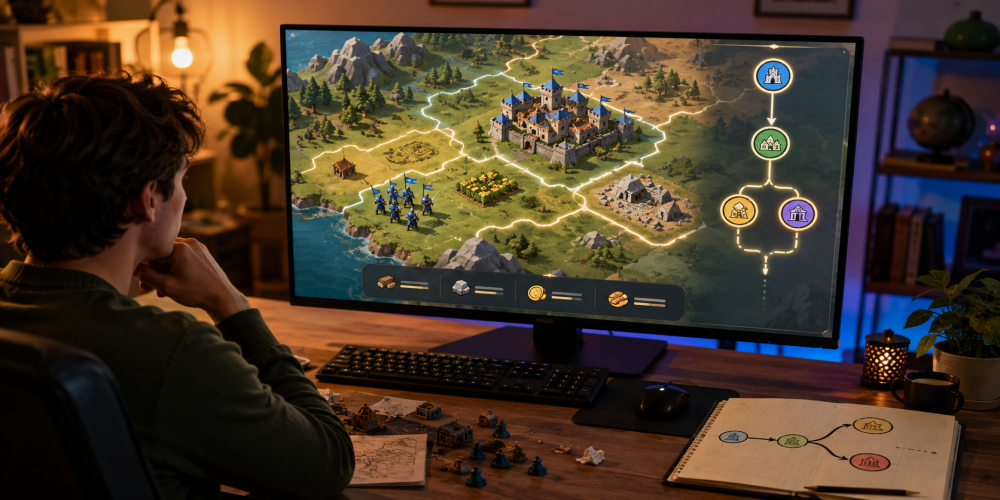
Strategy games can look intimidating from the outside. Screens are filled with resources, unit icons, technology trees, diplomatic messages, construction menus, and maps that seem large enough to require their own postal service.
Experienced players often move through these systems without hesitation, making it appear as though every strategy game requires hundreds of hours of preparation. In reality, most players learned one mechanic at a time, made several terrible decisions, and gradually discovered why building twelve farms without any defensive units was not a complete economic plan.
You do not need to memorize every rule before starting. The best approach is to choose a suitable game, reduce the difficulty, focus on one simple objective, and accept that early mistakes are part of the experience. This practical guide explains how to enter the strategy genre without turning your first evening into an unpaid management position.
Understand What a Strategy Game Actually Asks You to Do
Strategy games are built around decisions. Instead of relying mainly on fast reactions, they ask players to manage limited resources, position units, develop an economy, control territory, or choose long-term objectives.
The genre includes many different formats. Some games unfold in real time, while others wait for the player to finish a turn. Certain titles focus on individual battles, whereas others involve managing an empire across hundreds of years.
This variety means that disliking one strategy game does not mean the entire genre is unsuitable for you. A player who finds real-time battles stressful may enjoy a turn-based campaign. Someone uninterested in economic management may prefer tactical missions with a small group of characters.
Choose the Right Strategy Subgenre
The easiest way to avoid feeling overwhelmed is to select a style that matches how you naturally like to play. Strategy games may share basic ideas, but their pace and priorities can be very different.
Turn-Based Strategy
Turn-based games pause while you make decisions. This provides time to read descriptions, examine the map, compare options, and reconsider a plan before committing to it.
They are often a comfortable starting point for beginners because there is little pressure to navigate several menus at once. You can learn at your own pace and gradually understand how different systems interact.
Real-Time Strategy
Real-time strategy games continue running while players gather resources, construct buildings, produce units, and respond to opponents. They can feel more demanding because several tasks may require attention simultaneously.
However, many include adjustable game speed, active pause, beginner campaigns, and lower difficulty settings. Starting with story missions rather than competitive multiplayer makes the learning process much easier.
Tactical Strategy
Tactical games usually focus on small groups of units during individual missions. Players consider movement, cover, abilities, range, and enemy positions without managing an entire civilization.
This format is suitable for beginners who enjoy puzzles and character development. Each turn presents a smaller number of meaningful decisions, although mistakes may still have long-term consequences.
City Builders and Management Games
City builders focus on creating settlements, managing services, balancing resources, and responding to the needs of a growing population.
They are a good choice for players who prefer construction and optimization over direct conflict. Many provide sandbox modes where financial pressure and disasters can be reduced.
Grand Strategy
Grand strategy games involve politics, economics, diplomacy, military planning, internal factions, and long historical timelines. They are often the most complicated entry point.
Beginners can still enjoy them, but it is usually better to learn a simpler strategy game first. Opening a grand strategy title as your first experience may feel like being appointed finance minister of a country whose language you do not speak.
Start With a Beginner-Friendly Game
Your first strategy game should explain its systems clearly and allow mistakes without immediately ending the campaign. Look for strong tutorials, adjustable difficulty, readable interfaces, and missions that introduce mechanics gradually.
Games with shorter scenarios are often easier to learn than campaigns requiring dozens of hours. A small map provides visible feedback and allows you to restart without losing an entire weekend.
Consider beginner-friendly options such as Civilization VI for turn-based empire building, Into the Breach for compact tactical puzzles, Northgard for accessible real-time management, or Dorfromantik for a peaceful introduction to planning and placement.
Do not choose a game only because it is famous. A popular title may still use systems or pacing that do not match your preferences. The best first strategy game is the one that makes you curious enough to try another turn.
Play the Tutorial Even When It Feels Slow
Tutorials can be repetitive, especially when they explain basic camera controls or ask you to select an obvious button. Completing them is still useful because strategy games often assign unusual meanings to familiar interface elements.
A tutorial teaches more than individual mechanics. It introduces the normal order of actions: gathering resources, producing units, expanding territory, researching upgrades, and preparing for future threats.
Pay particular attention to anything related to resource generation, unit production, and victory conditions. These three systems usually determine what you should do during the opening stages.
Do not worry about remembering every detail. The purpose of a tutorial is to create familiarity, not immediate mastery.
Lower the Difficulty Without Feeling Guilty
Difficulty settings exist to shape the experience. Selecting an easier level gives you more time to understand the interface and see how decisions affect the game.
Higher difficulties may give opponents additional resources, faster production, stronger units, or better starting positions. These advantages can hide the lessons a beginner needs to learn because every small mistake becomes disproportionately expensive.
Start on the easiest or second-easiest setting. Increase the challenge after you can complete basic objectives without constantly pausing to search through menus.
Using a lower difficulty is not avoiding the real game. It is creating a controlled environment where the rules can be understood before they become demanding.
Ignore Most Advanced Systems at First
Strategy games frequently present every available menu from the beginning, even when several systems are not immediately important. This creates the impression that everything must be understood at once.
During your first session, focus on only a few questions:
- Which resources do I need?;
- How do I produce or collect them?;
- How do I create useful units or buildings?;
- What is the current objective?;
- What can threaten my progress?;
Advanced diplomacy, optimized technology routes, specialized unit combinations, and perfect economic ratios can wait. Basic competence develops faster when attention is not divided across every possible system.
Learn the Main Resources First
Most strategy games use resources to control how quickly players can expand. These may include food, gold, energy, wood, population, influence, research, or production capacity.
Begin by identifying what each major resource allows you to do. Food may support population growth, while wood enables construction and gold pays for advanced units.
Watch what happens when one resource reaches zero. Does production stop? Do units become weaker? Does the population become unhappy? Understanding these consequences is more useful than memorizing every number.
Try to maintain a small reserve instead of spending everything immediately. A flexible economy can respond to unexpected problems, while an empty storage screen tends to become very educational at the worst possible moment.
Follow One Clear Objective at a Time
Large strategy games often provide several possible goals simultaneously. You may be able to expand, research, trade, recruit units, complete side objectives, and improve buildings during the same turn.
Choose one short-term priority. For example, secure a source of food, produce three defensive units, unlock a particular technology, or connect two parts of your settlement.
Once that task is complete, select another. This creates a visible chain of progress and prevents the game from becoming a collection of unfinished plans.
A clear objective also makes failure easier to understand. If the plan was to defend one entrance and the opponent came through another, you have identified a specific problem rather than concluding that you are simply bad at strategy games.
Pause Frequently in Real-Time Games
If the game supports active pause, use it. Pausing allows you to read notifications, inspect unit abilities, plan construction, and issue several commands without pressure.
Beginners sometimes avoid pausing because they believe experienced players never use it. In single-player games, there is no benefit to making the experience unnecessarily stressful.
Some titles also allow players to reduce the simulation speed. A slower pace makes it easier to observe how resources change and how units respond to commands.
Speed should increase naturally as familiar tasks become automatic. It does not need to be forced during the first few sessions.
Read Tooltips Instead of Memorizing Everything
Modern strategy games usually explain units, buildings, resources, and abilities through tooltips. Moving the cursor over an icon can reveal costs, benefits, requirements, and special effects.
Use these descriptions as an external memory system. You do not need to remember every statistic when the information remains available inside the interface.
Compare options by asking practical questions. Which unit has greater range? Which building solves the current shortage? Which technology supports your immediate goal?
Reading only what is relevant to the present decision is less exhausting than studying a complete online encyclopedia before playing.
Learn a Simple Opening Routine
Many strategy games have an opening sequence that can be repeated across different maps. A basic routine reduces early confusion and creates enough stability for experimentation later.
A beginner-friendly opening might involve:
- Producing workers or basic resource units;
- Securing food and construction materials;
- Exploring the nearby area;
- Building a small defensive force;
- Researching one useful early upgrade;
- Expanding only after the economy becomes stable;
This does not need to be an optimized competitive build order. Its purpose is to prevent common early problems and give each match a familiar starting structure.
Do Not Expand Too Quickly
Expansion feels like progress, but every new settlement or territory creates additional responsibilities. More land may require roads, defenses, workers, housing, or public services.
Beginners often claim several areas without having enough resources to support them. The result is a large empire that looks impressive on the map and collapses whenever anything asks for maintenance.
Strengthen your starting position before expanding. Make sure basic resources are stable, important routes are protected, and new territory will provide a clear benefit.
Controlled growth is usually safer than occupying every available space simply because the game allows it.
Build Enough Defense to Buy Time
Defense is valuable because it gives you time to respond. Walls, towers, defensive units, terrain, and narrow routes can slow opponents while you reorganize.
You do not need to cover every part of the map equally. Identify likely entrances and important resources, then protect those areas first.
At the same time, avoid spending the entire economy on static defenses. A fortress with no mobile units may survive one direction of attack while being unable to influence the rest of the map.
The goal is not to become completely untouchable. It is to create enough warning and resistance to make thoughtful decisions possible.
Use a Small Number of Unit Types
Strategy games may include dozens of units with different strengths, weaknesses, and abilities. Trying to use every option immediately creates unnecessary complexity.
Begin with two or three unit types that perform clear roles. One may provide durable protection, another may attack from range, and a third may support the group or respond to a specific threat.
Learn how those units move and what they struggle against. Add more specialized choices after the basic combination feels comfortable.
A simple army used effectively is more useful than a complicated army whose abilities you forget until after the battle.
Understand Basic Counters
Many strategy games use counter systems in which certain units perform better against particular targets. Ranged units may struggle when opponents reach them, while heavily protected units may be vulnerable to specialized attacks.
You do not need to memorize a complete chart. Start by learning the most common relationships:
- Fast units can reach vulnerable ranged units;
- Ranged units can pressure slow enemies from safety;
- Specialized anti-armor units can challenge heavy targets;
- Support units improve nearby allies but require protection;
- Area attacks are effective against tightly grouped forces;
When an opponent repeatedly causes problems, inspect its description and identify what the game expects you to use against it.
Use Terrain to Reduce Difficulty
Terrain is one of the most important strategic tools because it can improve a position without consuming resources. High ground, narrow passages, forests, rivers, buildings, and defensive structures may alter movement or combat effectiveness.
A smaller group can sometimes hold a narrow route more effectively than an open field. Ranged units placed behind cover may remain useful longer, while scouts positioned near important paths can provide early warning.
Before beginning an encounter, examine the map. Ask where the opponent can approach, where your vulnerable units can remain protected, and where retreat will be possible.
Good terrain makes ordinary decisions stronger. Poor terrain can turn an excellent army into an expensive queue of units waiting to enter one doorway.
Save Frequently and Experiment
Manual saves provide freedom to test uncertain ideas. Save before a major expansion, battle, diplomatic agreement, or technological choice, then observe the result.
Reloading can help you understand mechanics, especially during early sessions. You may discover that a particular building requires more support than expected or that a unit combination behaves differently from its description.
Try not to reload every minor mistake. Some of the best lessons come from recovering after a plan fails.
Use saves as learning tools rather than as a way to create a flawless campaign.
Accept That You Will Lose Early Games
Strategy games often reveal the consequences of decisions slowly. A weak economy created twenty minutes earlier may become visible only when you cannot produce enough units during an important battle.
Early defeats are therefore useful. They show which systems require more attention and help connect long-term decisions with later results.
After losing, identify one main cause. Perhaps expansion happened too quickly, resources were unbalanced, important areas were not explored, or the army lacked a response to one type of opponent.
Correct that single issue during the next attempt. Trying to repair every weakness at once may create another overwhelming list.
Avoid Competitive Multiplayer at the Beginning
Competitive strategy games can be exciting, but they are not always a good learning environment. Experienced opponents use optimized openings, quick controls, map knowledge, and established tactics that may leave little time for experimentation.
Start with tutorials, campaigns, custom scenarios, or matches against computer-controlled opponents. These modes allow you to pause, restart, and explore systems without social pressure.
Move into multiplayer when you can complete a basic opening and understand the game’s main victory conditions. Even then, expect a new learning process because human opponents behave less predictably.
Cooperative multiplayer can be a gentler alternative. A patient friend can explain systems and share responsibilities while allowing you to make meaningful decisions.
Use Guides Only When You Have a Specific Question
Strategy communities produce detailed guides, videos, build orders, tier lists, and spreadsheets. These resources are useful, but consuming too many before playing can make the genre feel even more complicated.
Play first and search later. When a specific problem appears, look for a focused answer. You might search for how population limits work, why a particular building is unavailable, or how to counter one troublesome unit.
Avoid copying advanced strategies without understanding their purpose. A competitive build order may depend on precise timing and assumptions that do not apply to a beginner campaign.
Guides should answer questions created by experience, not replace the experience itself.
Customize the Interface
A crowded interface contributes to information overload. Check whether the game allows you to resize menus, hide unnecessary notifications, change text size, or reorganize control groups.
Learn a few useful keyboard shortcuts instead of attempting to memorize the complete control list. Start with pause, camera movement, unit selection, and access to the main construction or production menus.
Control groups can help in real-time games by assigning units or buildings to number keys. Begin with one group for your main army and another for important production buildings.
Add more shortcuts only when repeated mouse navigation becomes inconvenient.
Focus on Information That Changes Your Next Decision
Strategy games display many numbers, but not every number requires constant attention. A statistic becomes important when it affects what you should do next.
For example, low food matters because it may stop population growth. A small temporary reduction in an unused resource may not require immediate action.
Prioritize warnings connected to:
- Resource shortages;
- Unprotected territory;
- Idle workers or production buildings;
- Approaching opponents;
- Population or storage limits;
- Current victory objectives;
Learning to filter information is a major strategy skill. Strong players do not process everything equally; they identify which details require action.
Create a Simple Decision Cycle
When you are unsure what to do, use a repeated decision cycle. This turns a complicated map into a manageable checklist.
- Check your current objective;
- Review the main resources;
- Look for immediate threats;
- Confirm that workers and buildings are active;
- Select one useful action;
- Observe the result before making another major change;
This cycle works particularly well in turn-based games because it prevents important systems from being forgotten. In real-time games, it can be completed whenever the action becomes quiet or the game is paused.
Learn to Recognize Good and Bad Trades
Strategy games often involve exchanging one resource for another. You may spend materials to gain territory, sacrifice units to protect a settlement, or delay research to strengthen defenses.
A good trade moves you closer to an objective while costing less than the value gained. A bad trade consumes resources without creating a useful advantage.
Do not evaluate a battle only by counting lost units. Protecting an important route or delaying an opponent long enough to complete a project may justify the cost.
Ask what the exchange achieved. This encourages strategic thinking beyond simply preserving everything you own.
Do Not Chase Perfect Efficiency
Online discussions often focus on optimal production, ideal build orders, and maximum resource output. These concepts matter in competitive play, but beginners do not need perfect efficiency.
A slightly inefficient plan that you understand is better than an optimized plan copied without context. Understanding allows you to adapt when the map, opponent, or available resources change.
Leave room for experimentation. Build a unit because it sounds interesting, try a different technology route, or create a settlement in an unusual location.
Strategy games are more enjoyable when every decision is not treated like a financial audit.
Beginner Mistakes That Are Completely Normal
- Expanding before the economy is stable;
- Producing too many different unit types;
- Ignoring defensive positions;
- Saving resources without spending them;
- Spending resources without keeping a reserve;
- Forgetting to explore the map;
- Researching upgrades without a clear purpose;
- Leaving workers or production buildings inactive;
- Attempting advanced difficulty too early;
- Restarting after every small mistake;
These errors are not evidence that strategy games are beyond your ability. They are the normal process through which the genre becomes understandable.
A Five-Session Plan for New Strategy Players
Session One: Learn the Interface
Complete the tutorial and identify the main resources, production menus, camera controls, and victory conditions. Do not worry about playing efficiently.
Session Two: Build a Stable Economy
Focus on resource production and population support. Try to understand what causes shortages and how quickly the economy can recover.
Session Three: Practice Basic Defense
Identify likely threats, protect important locations, and use a small number of unit types. Pay attention to terrain and warning systems.
Session Four: Experiment With Expansion
Claim a new area or create another settlement only after the starting position becomes stable. Observe the additional costs created by growth.
Session Five: Complete a Full Scenario
Play from beginning to end without restarting after minor mistakes. Focus on adapting rather than creating a perfect result.
How to Know When You Are Improving
Progress in strategy games is not measured only through victories. You are improving when the interface feels less confusing, objectives become easier to identify, and mistakes are recognized earlier.
You may also notice that your plans become more specific. Instead of deciding to build a stronger army, you begin deciding to produce ranged units because the opponent relies on slow defensive forces.
Another sign of improvement is recovery. Beginners often view one setback as the end of the match. More experienced players reorganize resources, change positions, and search for another route to the objective.
When Should You Increase the Difficulty?
Increase the difficulty when the current setting no longer requires meaningful adaptation. If you can use the same plan in every match without responding to the opponent, a higher level may provide a more interesting experience.
Move up one step rather than jumping directly to the hardest option. The goal is to create new decisions, not remove all opportunity to learn.
You can also create personal challenges instead of changing the difficulty. Try a different faction, victory condition, map type, or unit composition.
Which Strategy Game Is Best for a Complete Beginner?
The best choice depends on what interests you. Civilization VI is suitable for players who enjoy long-term planning and historical development. Into the Breach provides short tactical missions with clear information about enemy actions.
Northgard offers a manageable introduction to real-time resource management, while Dorfromantik removes direct conflict and focuses on peaceful tile placement. A city-building game with a sandbox mode may suit players more interested in construction than battle.
Choose a theme that already appeals to you. Learning systems becomes easier when you care about the world, characters, or historical period surrounding them.
The Best Way to Start Playing Strategy Games
Start small. Choose an accessible subgenre, lower the difficulty, complete the tutorial, and focus on one short-term objective at a time.
Learn the main resources before studying advanced systems. Use a small number of units, pause whenever necessary, and treat losses as information rather than failure.
You do not need to understand the entire game during your first campaign. Strategy titles are designed to reveal their depth over time, and much of their appeal comes from discovering better solutions through experience.
The genre becomes less overwhelming when every screen is no longer viewed as a test. It is a collection of tools. Learn one, use it badly, understand why, and try again. Eventually, the enormous map stops looking like a problem and starts looking like an opportunity to make several highly organized mistakes.