Good aim in a first-person shooter can look like a mysterious natural talent. Experienced players move their crosshair smoothly, react quickly, and seem to know where every opponent will appear. A beginner may spend the same match decorating nearby walls with perfectly good ammunition.
Most strong aim is not based on unusually fast reflexes. It is built through comfortable settings, consistent practice, good crosshair placement, controlled movement, and an understanding of how each weapon behaves.
This guide explains the fundamentals without requiring expensive equipment or hours of daily training. The goal is not to turn every beginner into a professional competitor. It is to develop reliable habits that improve performance across games such as Counter-Strike, Valorant, Call of Duty, Apex Legends, Overwatch, Rainbow Six Siege, and other FPS titles.
Understand What Good Aim Actually Means
Aim is not one isolated skill. It is a collection of smaller abilities that work together during a match. A player may be excellent at following moving targets but struggle when quickly switching between opponents. Another may have accurate first shots but lose control during longer bursts.
The main aiming skills include:
- Crosshair placement;
- Flicking between targets;
- Tracking moving opponents;
- Making small corrections;
- Controlling recoil;
- Shooting while moving appropriately;
- Reacting to unexpected targets;
Beginners often focus entirely on reaction speed. In reality, positioning the crosshair correctly before an opponent appears can reduce the amount of reaction and mouse movement required.
Choose a Comfortable Mouse Sensitivity
Sensitivity determines how far the view moves in response to physical mouse movement. A setting that is too high makes precise corrections difficult, while one that is too low can make turning and following fast targets uncomfortable.
There is no universal perfect sensitivity. The correct setting is one that allows you to turn comfortably while maintaining control during small adjustments.
To test your sensitivity, place the mouse near the center of your available space and move it horizontally across the usable area. You should be able to make a large turn without constantly lifting the mouse, but the view should not spin uncontrollably from a small movement.
Beginners frequently use very high sensitivity because it initially feels faster. Lowering it slightly can make aiming smoother and reduce accidental overcorrection.
Signs Your Sensitivity Is Too High
- Your crosshair repeatedly moves past the target;
- Small adjustments feel unstable;
- Your aim shakes during long-range encounters;
- You struggle to follow slow movement smoothly;
Signs Your Sensitivity Is Too Low
- You cannot turn around comfortably;
- You frequently run out of mouse space;
- Following nearby fast targets requires several mouse lifts;
- Your arm becomes tired during ordinary matches;
Change sensitivity gradually. Large daily adjustments prevent muscle memory from developing and make it difficult to identify whether practice is producing results.
Keep Your Settings Consistent
Consistency is more valuable than endlessly searching for a magical configuration. Once you find a comfortable sensitivity, use it long enough for your hand and arm to become familiar with the required movement.
Try to maintain similar sensitivity across different FPS games. Exact conversion tools can help, but perfect mathematical matching is not always necessary. The important point is avoiding dramatic differences that force your movement habits to change every time you open another game.
Mouse acceleration should usually be disabled when it makes identical physical movements produce different results depending on speed. Predictable input is easier to practice because the same motion leads to the same crosshair movement.
Learn to Aim With Your Arm and Wrist
Players do not need to choose exclusively between arm aiming and wrist aiming. Most use a combination of both.
The arm is useful for larger turns and broad target changes. The wrist and fingers handle smaller corrections once the crosshair is close to the opponent.
High-sensitivity players tend to depend more heavily on the wrist, while lower-sensitivity players use more arm movement. A balanced method reduces tension and improves control.
Avoid gripping the mouse too tightly. Excessive tension makes smooth tracking difficult and can cause discomfort during longer sessions. Keep the hand relaxed and allow the forearm to move naturally.
Improve Your Crosshair Placement
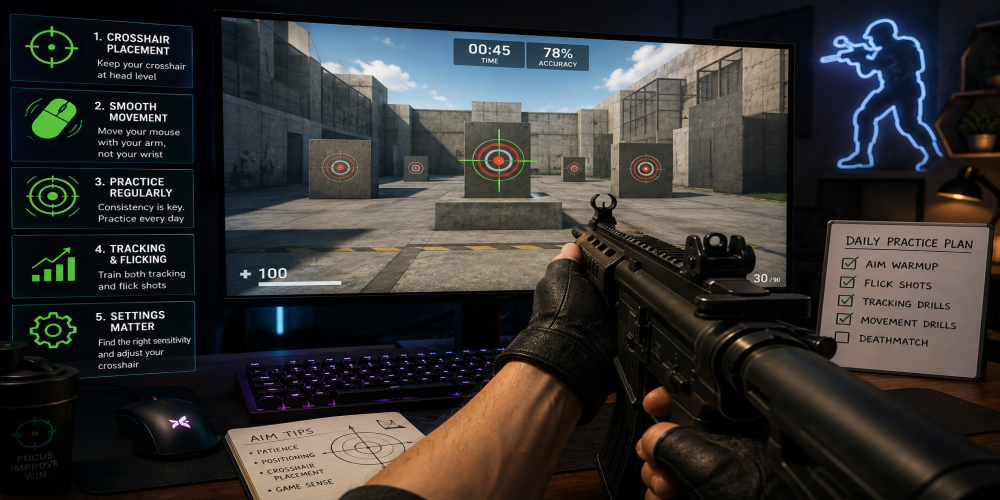
Crosshair placement is one of the fastest ways for a beginner to improve. Instead of pointing toward the floor or the center of an empty wall, keep the crosshair near the height where an opponent is likely to appear.
When approaching a corner, position the crosshair beside the edge before exposing yourself. If an opponent appears, only a small correction should be necessary.
Good placement reduces reaction time because the crosshair begins close to the target. It also makes your aim appear faster even when your physical reflexes have not changed.
Basic Crosshair Placement Rules
- Keep the crosshair near upper-body or head level;
- Aim at likely entrances before opponents appear;
- Follow corners as you move through a room;
- Avoid staring at the ground while travelling;
- Adjust for stairs, elevated platforms, and crouched positions;
Map knowledge improves this skill. The more familiar you become with common routes and defensive positions, the easier it is to predict where the next target may appear.
Understand Flicking and When to Use It
Flicking is the rapid movement of the crosshair from one location to a target. It is useful when an opponent appears unexpectedly or when switching between several threats.
Beginners often practice flicks by moving as quickly as possible. Speed matters, but accuracy should come first. A fast movement that consistently misses provides little value.
Begin with slower, controlled target changes. Try to stop directly on the target rather than moving past it and correcting backward. Speed will develop naturally as the movement becomes familiar.
Flicking is most important in games with fast encounters and weapons that reward accurate first shots. It should not replace good crosshair placement. The smaller the required flick, the more reliable it becomes.
Practice Smooth Tracking
Tracking means keeping the crosshair on a moving target for an extended period. It is especially important when using automatic weapons or playing games with longer encounters.
Strong tracking looks smooth rather than nervous. The player matches the direction and speed of the target instead of constantly moving ahead and falling behind.
Practice following targets without immediately shooting. This helps separate visual tracking from the pressure of controlling recoil and timing attacks.
Do not stare exclusively at the crosshair. Focus on the target while remaining aware of where the crosshair sits in relation to it. Your hand should respond to the opponent’s movement rather than to the shape of the crosshair itself.
Develop Better Micro-Adjustments
Micro-adjustments are the small movements used to correct aim after the crosshair reaches the general target area. They often determine whether a first shot is accurate.
Players with overly high sensitivity commonly struggle here because a tiny mouse movement creates a large change on screen. A relaxed grip and stable sensitivity make these corrections easier.
Practice moving between two nearby targets rather than always selecting targets on opposite sides of the screen. Real matches frequently require small corrections around doorways, cover, and narrow angles.
Learn the Weapon’s Recoil Pattern
Accurate initial placement does not guarantee that an entire burst will remain on target. Many FPS weapons move upward or sideways during continuous fire.
Enter a practice area and fire at a wall without moving the mouse. Observe how the bullet pattern develops. Then repeat the test while gently moving in the opposite direction.
Some games use predictable recoil patterns, while others include random variation. In either case, learning the weapon’s general movement will improve control.
Basic Recoil Control Tips
- Pull downward gently during sustained fire;
- Use shorter bursts at longer distances;
- Allow recoil to reset between bursts;
- Avoid emptying the entire magazine without adjustment;
- Practice with one or two weapons before learning the full arsenal;
Do not copy a complicated recoil routine before understanding the first few shots. Most encounters are decided before the complete pattern becomes relevant.
Stop Shooting Before Your Aim Is Ready
Beginners often press the fire button as soon as an opponent becomes visible. This feels responsive, but it can create inaccurate shots before the crosshair reaches the target.
Develop the habit of confirming placement before firing, especially with precision weapons. The delay may be extremely brief, but it improves first-shot accuracy.
In fast encounters, the goal is not to pause visibly. It is to connect the firing action with the moment the crosshair reaches the target rather than with the moment an opponent appears somewhere on screen.
Understand Movement Accuracy
Movement affects accuracy differently in every game. Some shooters allow relatively accurate fire while running, while tactical games may heavily punish movement during a shot.
Learn when your chosen game requires you to stop, crouch, walk, or use a specific movement technique before firing. Practicing aim without understanding movement accuracy can create habits that fail during actual matches.
In games where stopping is important, practice moving sideways and releasing the movement key immediately before firing. The transition should become one smooth sequence rather than two separate actions.
Standing still for too long is also dangerous. The goal is to become accurate at the correct moment, then return to movement or cover when necessary.
Use Cover to Make Aiming Easier
Aim becomes more difficult when you are exposed to several directions. Good positioning reduces the number of locations you must watch.
Use walls, boxes, vehicles, and terrain to limit enemy sightlines. Expose only the angle you intend to challenge instead of entering an open area where opponents can appear from every side.
Positioning can create easier shots by forcing enemies through predictable routes. A player with average mechanical aim and strong positioning can outperform someone with impressive flicks who repeatedly enters unfavorable encounters.
Place the Crosshair Away From the Corner When Necessary
Aiming directly against the edge of a corner is not always correct. The ideal distance depends on how quickly you expect the opponent to appear.
If an enemy is likely to move rapidly across the opening, place the crosshair slightly farther from the edge. This gives your reaction time enough space before the target passes the crosshair.
If you expect a slow or careful peek, hold closer to the corner. Understanding this difference reduces unnecessary flicking.
Train Target Switching
Target switching combines flicking, tracking, and decision-making. After finishing one encounter, the player quickly identifies the next threat and moves the crosshair efficiently.
Practice switching between targets at different distances. Focus on stopping accurately rather than drawing a curved or unstable path across the screen.
During real matches, do not automatically select the nearest opponent. Prioritize the target creating the greatest immediate danger or the one most likely to be removed quickly.
Warm Up Before Competitive Matches
A short warm-up prepares your hand, eyes, and attention. It should help you feel comfortable rather than exhaust you before the first serious match.
Spend five to fifteen minutes performing simple exercises. Begin slowly, then increase speed once your movements feel controlled.
Simple FPS Warm-Up Routine
- Two minutes of smooth horizontal tracking;
- Two minutes of small target corrections;
- Three minutes of controlled flicks;
- Three minutes of recoil practice;
- One short practice match or free-for-all session;
Stop the warm-up when your aim feels active and comfortable. Chasing a perfect practice score can create frustration before the real session begins.
Use Aim Trainers With a Clear Purpose
Aim trainers can isolate mechanical skills by providing repeated targets and measurable results. They are useful when exercises match a weakness you have identified.
Randomly completing dozens of scenarios is less effective than choosing a small routine. A beginner should train basic tracking, controlled flicking, and micro-adjustments rather than immediately attempting highly specialized challenges.
Aim trainers do not teach map positioning, weapon economy, teamwork, movement timing, or game-specific recoil. They should support actual gameplay rather than replace it.
Ten focused minutes followed by real matches is usually more valuable than an hour of unfocused target clicking.
Practice Inside the Game
The game’s own training range, custom modes, and casual playlists provide essential context. They include the correct movement, weapons, visual models, recoil, hitboxes, and environmental distractions.
Use training modes to learn specific weapons. Test how they behave at short, medium, and long distances. Compare single shots, short bursts, and sustained fire.
Casual matches are useful for applying skills without worrying about rank. Choose one focus for each session, such as crosshair placement or movement accuracy, rather than trying to correct every weakness simultaneously.
Do Not Change Your Crosshair Constantly
The ideal crosshair should remain visible without covering too much of the target. It should contrast with common environments and provide a clear center point.
A small static crosshair works well in many games, but personal preference matters. Dynamic indicators may help beginners understand movement or recoil penalties.
Avoid changing the crosshair after every poor match. Performance naturally varies, and visual adjustments cannot solve inconsistent positioning or rushed shooting.
Improve Visibility and Performance Settings
Stable performance makes aiming easier. Large frame-rate drops, input delay, motion blur, and visual clutter can interfere with target recognition and control.
Prioritize a stable frame rate over maximum graphics quality. Lowering shadows, reflections, effects, or environmental detail may improve responsiveness while keeping characters clearly visible.
Disable distracting camera effects when the game allows it. Motion blur, film grain, excessive screen shake, and depth-of-field effects can reduce visual clarity during fast movement.
Use a resolution and display mode that provide consistent performance. Full-screen options may offer lower input delay in some games and system configurations.
Make Sure Your Equipment Is Comfortable
Better hardware will not automatically create better aim, but uncomfortable equipment can make practice more difficult.
The mouse should fit your hand and grip style. It does not need an extreme sensitivity range or dozens of buttons. A reliable sensor, comfortable shape, and manageable weight matter more.
The mouse pad should provide enough room for your chosen sensitivity. A small surface can force constant repositioning and discourage controlled arm movement.
A stable chair and suitable desk height reduce tension. Your shoulders should remain relaxed, and the forearm should have enough support to move naturally.
Review Your Misses Instead of Blaming Your Reflexes
After losing an encounter, identify what happened before deciding that your aim was simply bad.
Was the crosshair too low? Were you still moving when firing? Did you begin shooting before reaching the target? Was recoil uncontrolled? Did you enter an area exposed to several angles?
Many apparent aiming failures are actually positioning or decision-making errors. Correcting the cause is more useful than repeating mechanical exercises without context.
Avoid Practicing While Frustrated
Frustration creates tension, rushed decisions, and unnecessary setting changes. It also makes normal performance variation feel like permanent failure.
Take a short break after several poor matches. Stretch the hand, look away from the screen, and return when your attention feels stable.
Do not force long practice sessions when your accuracy is steadily declining. Skill develops through repeated high-quality practice rather than exhaustion.
Track Progress Over Several Weeks
Aim improvement is rarely visible from one day to the next. Match difficulty, opponents, maps, and personal energy can change performance dramatically.
Track simple measurements over several weeks. These may include practice scores, accuracy, first-shot success, damage, or the number of avoidable mistakes.
Do not judge progress only through rank. Competitive ranking depends on teamwork, strategy, communication, and matchmaking as well as mechanical aim.
A useful sign of improvement is greater consistency. Good days become more common, poor days become less severe, and ordinary shots require less conscious effort.
Common Beginner Aiming Mistakes
- Using sensitivity that is too high;
- Changing settings after every match;
- Keeping the crosshair near the floor;
- Shooting before the crosshair reaches the target;
- Using long bursts at every distance;
- Ignoring movement accuracy;
- Practicing only flick shots;
- Entering open areas without cover;
- Holding the mouse too tightly;
- Training for hours without a clear objective;
Correcting one or two of these habits can produce a larger improvement than purchasing a new mouse or copying the settings of a professional player.
A Practical Seven-Day Aim Training Plan
Day One: Sensitivity and Comfort
Select a comfortable sensitivity and test broad turns, small corrections, and basic tracking. Avoid chasing speed. The goal is to establish controlled movement.
Day Two: Crosshair Placement
Play several matches while focusing only on keeping the crosshair at likely target height. Review moments when it drifted toward the floor or empty space.
Day Three: Flick Accuracy
Practice slow target switching. Increase speed only when you can stop reliably without moving past the target.
Day Four: Tracking
Follow moving targets smoothly in a training area. Begin without firing, then add automatic weapons once movement becomes stable.
Day Five: Recoil Control
Select two commonly used weapons and study their first several shots. Practice short bursts at different distances.
Day Six: Movement and Shooting
Work on becoming accurate immediately after stopping or changing direction. Use cover and avoid remaining stationary after each attempt.
Day Seven: Real Match Application
Play ordinary matches without changing settings. Focus on calm first shots and good positioning rather than your final score.
A Simple Daily Practice Routine
A beginner does not need a complicated schedule. Fifteen to twenty minutes of focused practice can be enough when completed consistently.
- Three minutes of smooth tracking;
- Three minutes of micro-adjustments;
- Three minutes of controlled flicking;
- Three minutes of recoil control;
- Five minutes in a game-specific training mode;
Finish with real matches and consciously apply one skill from the routine. Mechanical exercises become valuable only when they transfer into actual gameplay.
How Long Does It Take to Improve Aim?
Small improvements may appear within several sessions, particularly after correcting excessive sensitivity or poor crosshair placement. Reliable consistency takes longer.
A beginner who practices deliberately several times each week may notice meaningful progress within a month. The exact pace depends on previous experience, session quality, equipment comfort, and the complexity of the game.
Improvement is not linear. Some days will feel worse even when long-term performance is rising. Sleep, stress, posture, concentration, and match difficulty all influence short-term results.
Which Skill Should Beginners Practice First?
Crosshair placement should usually come first because it improves almost every encounter. It reduces the distance required for flicks, supports faster reactions, and makes first shots more accurate.
After that, beginners should develop smooth tracking and controlled micro-adjustments. Recoil practice becomes more useful once the crosshair can reach the target consistently.
Advanced flicking routines should come later. Impressive movements are less valuable than repeatedly beginning each encounter in a strong position.
How to Improve Aim Without an Aim Trainer
Use the game’s practice range, custom matches, training maps, and casual modes. Shoot stationary targets, follow moving characters, test recoil against walls, and practice entering common angles.
You can also play against computer-controlled opponents when available. Set a difficulty that allows frequent encounters without making every target completely passive.
Real matches remain necessary because they teach prediction, pressure management, movement, and positioning. Aim trainers are convenient tools, not mandatory equipment.
The Most Important Rule for Better FPS Aim
Practice consistently without constantly rebuilding your setup. Keep a comfortable sensitivity, use a visible crosshair, and focus on one weakness at a time.
Good aim develops when correct movements become automatic. That requires repetition, but the repetition must be controlled and connected to real gameplay.
Crosshair placement will reduce the work your hand must perform. Smooth tracking will help against moving targets. Recoil control will keep later shots useful, while better positioning will create easier encounters in the first place.
You do not need perfect reflexes, professional equipment, or several hours of daily training. A relaxed grip, sensible settings, and fifteen focused minutes can produce steady improvement. The process is not glamorous, but neither is reloading while the opponent is still standing directly in front of you.